
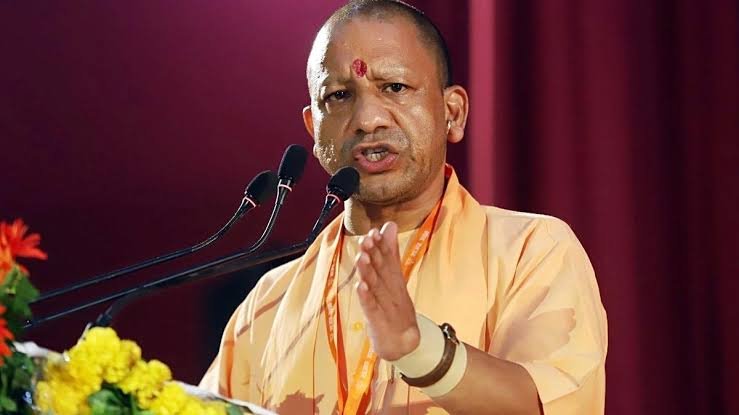
New Delhi, 17 November—In a strong rebuttal of state Chief Minister Yogi Aditynath’s assertion of 1.27 crore “Hindu” voters missing from the electoral rolls, Uttar Pradesh Chief Electoral Officer Navdeep Rinwa today said the Election Commission does not maintain voters’ religious identities in its database, rejecting allegations that the Special Intensive Revision (SIR) exercise had selectively affected any religious or caste group.
His clarification rather a polite rebuff came amid a political row over Chief Minister Yogi Adityanath’s assertion that 1.27 crore Hindu voters had gone missing from the state’s electoral rolls following the revision.
Rinwa said neither the poll panel nor any of its officials or political parties had conspired to target a particular religion, caste or community during the exercise.
He also explained that the EC’s electoral database did not contain information on voters’ religion. Any attempt to arrive at a religious or caste-wise breakdown of names removed from the rolls would, therefore, involve independent analysis of publicly available voter lists.
The electoral rolls are accessible in PDF format, he said, adding that software tools available in the market could be used to categorise individuals by religion or other identities based on their names.
Adityanath’s remarks had drawn a sharp response from Samajwadi Party chief Akhilesh Yadav, who questioned how the chief minister had obtained religion-specific figures from the Election Commission.
Yadav also alleged that there was a conspiracy to bring in voters from outside Uttar Pradesh and register them in the state ahead of next year’s Assembly elections.
Speaking to reporters at the Lok Bhavan in Lucknow, Rinwa said, “If you look at our electoral roll or our database, it contains details such as the voter’s name, relationship type such as father, husband, or wife, the name of the relative, age or date of birth, house number and gender.
“Our database does not include information regarding religion, caste, or any other such details. Therefore, it is impossible for us to conduct any analysis based on these factors using our electoral roll.”
He noted that media outlets occasionally conduct their own analysis.
“About a month ago, a social media outlet analysed the applications for the removal of names from the electoral rolls in Tarabganj and Pilibhit. They found that the majority of these applications belonged to individuals from a single religion. This raises the question: How did they conduct such an analysis? “
“The answer, as I understand it, lies in the availability of our voter lists,” Rinwa said.
He informed that the updated voter lists after the SIR are available as of April 10 and can be downloaded by anyone.
“Since our voter lists are in PDF format, they are easily accessible. One can download them, convert the data into a database, and then perform an analysis. There are various software tools available in the market capable of segregating individuals by religion or gender based on their names,” he said.
He asserted that “there has been no conspiracy by the Election Commission of India, any official or employee, any political party, or any other group to specifically target any religion, caste, community, village, city, or neighbourhood”, based on the reports he has received from all districts.
Comparing the draft electoral roll with population projections for 2026, Rinwa said UP has an estimated 16.16 crore citizens aged 18 years and above, against 13.58 crore names currently on the draft list, indicating a gap of around 2.58 crore.
“Based on my presentation, it is estimated that approximately 2.58 crore residents of Uttar Pradesh are still not included in my electoral roll. That is an estimate I can provide,” he said.
He also stated that missing voters does not mean that their names have been cut. “We are saying that 2.58 crore voters are ‘missing’. Missing here does not necessarily mean that they existed previously and were subsequently cut. It also means that they were never there to begin with, and are still not present. We are making every effort to look into this,” he said.
Rinwa noted that in India, voter registration is voluntary, and there is no instance anywhere of 100 per cent of the electorate being registered.
“Even if we look at Western democracies, in many states in the USA, up to 25 per cent of the population remains off the electoral rolls. In the UK, the figure is between 14 per cent and 17 per cent. Currently, about 84 to 85 percent of people are on our voter list.
“But we are not satisfied with this. In the time remaining, we will make every possible effort to include those whose names are currently missing,” he said.
Veteran Journalist and Political Commentator