

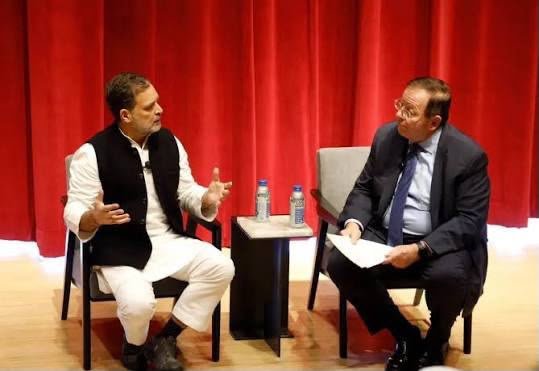
Rahul Gandhi’s recent interaction at the University of Chicago has triggered intense reactions, particularly among sections of the political left, progressive voices and some Muslim commentators who have long viewed the Congress leader as a natural ally on issues of justice and minority rights. At the heart of the controversy lies a carefully calibrated statement on India-Israel relations that refuses the comforting simplicity of ideological purity.
Speaking during a conversation with political scientist Robert Pape on India’s role in a turbulent global order, the Leader of the Opposition affirmed that India maintains good relations with Israel and procures advanced weaponry from it. He framed this as a strategic necessity. At the same time, he insisted that such ties cannot translate into silence over the humanitarian catastrophe in Gaza. He condemned the October 7, 2023 Hamas attacks that killed civilians and took hostages as “absolutely horrible.” He equally condemned Israel’s subsequent military campaign in Gaza. “One wrong cannot justify another,” he said. India’s foreign policy, he stressed, must be guided by what is good for a nation of 1.5 billion people, not by the preferences of any external power, whether Israel, the United States, Russia or China.
The formulation is deliberate. It separates commercial and strategic engagement from moral and political judgement. It rejects the idea that procurement of defence technology must entail diplomatic muteness. And it places national interest at the centre of decision-making rather than external moral expectations or domestic political signalling.
The Anatomy of the Backlash
What has united certain liberals, leftists and sections of Muslim opinion is not merely disagreement with the statement but a sense of betrayal. Many expected, or hoped for, a sharper rupture: a refusal to countenance continued defence cooperation, stronger language of “genocide,” or an explicit call to distance India from Israel. The measured language of mutual condemnation and continued strategic partnership felt, to them, like a concession to the very realpolitik they associate with the current government.
This reaction reveals more about the expectations projected onto Rahul Gandhi than about the content of his remarks. Diplomatic relationships are not social media friendships that can be toggled on or off according to the latest outrage cycle. They are instruments of statecraft calibrated to security requirements, technological needs and long-term geopolitical positioning. India has been one of the largest buyers of Israeli defence systems for years. These include surveillance technologies, missiles, drones and precision systems that fill critical gaps in the Indian armed forces’ inventory. The relationship has deepened under successive governments because it serves India’s security interests in a neighbourhood marked by persistent threats.
Demanding that a leader responsible for articulating an alternative vision for a country of India’s size and complexity adopt the purest possible moral posture risks confusing the ethics of individual conscience with the responsibilities of national policy. An individual may choose to boycott products or companies associated with political adversaries. A nation of 1.4 billion people, with complex security challenges along multiple borders, does not enjoy the same luxury of purity.


National Interest Is Not a Slogan
Gandhi’s core argument — that India is the larger power and must define its policy according to its own interests — is both elementary and frequently forgotten in domestic debates. Israel is a significant defence partner, not a patron. India does not need Israeli approval to speak on Gaza, just as it does not require American, Russian or Chinese permission to pursue its interests elsewhere. Maintaining the capacity to criticise while continuing beneficial engagement is the hallmark of confident middle powers, not of clients.
This position is also consistent with the broader trajectory of Indian foreign policy. Successive governments have expanded ties with Israel while continuing to support a two-state solution and Palestinian aspirations in principle. The Congress party itself has historically balanced solidarity with the Palestinian cause with pragmatic engagement once diplomatic relations were normalised. The difference today lies in the intensity of the Gaza war and the heightened expectations among progressive constituencies that moral condemnation must override strategic calculus.
The analogy often drawn in private conversations is instructive. Many who express fierce opposition to certain industrial houses or political formations in India continue to use the infrastructure, energy, telecommunications and consumer goods those same entities provide. Moral disapproval does not automatically translate into commercial severance when the alternatives are costly or unavailable. Scale the same logic to the level of the state, and the responsibility multiplies. Decisions affect not only the decision-maker’s conscience but the security and livelihood of hundreds of millions.
Not Our War, But Not Irrelevant
India is not a direct party to the conflict in West Asia. It is an affected party — through energy prices, diaspora concerns, maritime security in the broader region, and the risk of wider escalation. The appropriate response is therefore neither enthusiastic participation in one side’s narrative nor complete disengagement. A humanitarian position that condemns the killing of civilians on both sides, while protecting India’s ability to acquire the technologies it needs, is a coherent stance for a country that aspires to strategic autonomy.
Gandhi’s remarks also contained an implicit critique of any foreign policy that appears constrained by personal chemistry or external expectations. By insisting that no country should hold India back from playing its role on the global stage, he was arguing for a more assertive, interest-driven diplomacy. Whether one agrees with his diagnosis of India’s current standing is secondary. The principle — that a nation of India’s demographic and economic weight should not outsource its moral or strategic voice — is difficult to dismiss.
The Limits of Expectation Politics
The intensity of the reaction from some quarters suggests a deeper problem in contemporary Indian political discourse: the tendency to demand that leaders perform ideological loyalty tests rather than engage in the messy work of balancing competing goods. Rahul Gandhi did not claim that Israel’s actions in Gaza were proportionate. He did not minimise civilian suffering. He simply refused to treat strategic partnerships as all-or-nothing propositions. In doing so, he exposed the gap between the pure positions preferred in activist circles and the constrained choices available to those who would govern.
Diplomatic relationships are rarely binary. They involve simultaneous cooperation and criticism, shared interests and divergent values. A serious opposition leader must be able to articulate that complexity without fear of disappointing those who prefer simpler narratives. The Chicago remarks, stripped of the heat they generated, represent an attempt to do precisely that: affirm India’s right to pursue its security interests while refusing to abdicate the moral responsibility to speak against the suffering of civilians. Whether that balance satisfies every constituency is less important than whether it reflects the actual requirements of a rising power navigating a disordered world.

~Hasnain Naqvi is a former member of the history faculty at St. Xavier’s College, Mumbai….
The opinions expressed here are solely those of the author.