

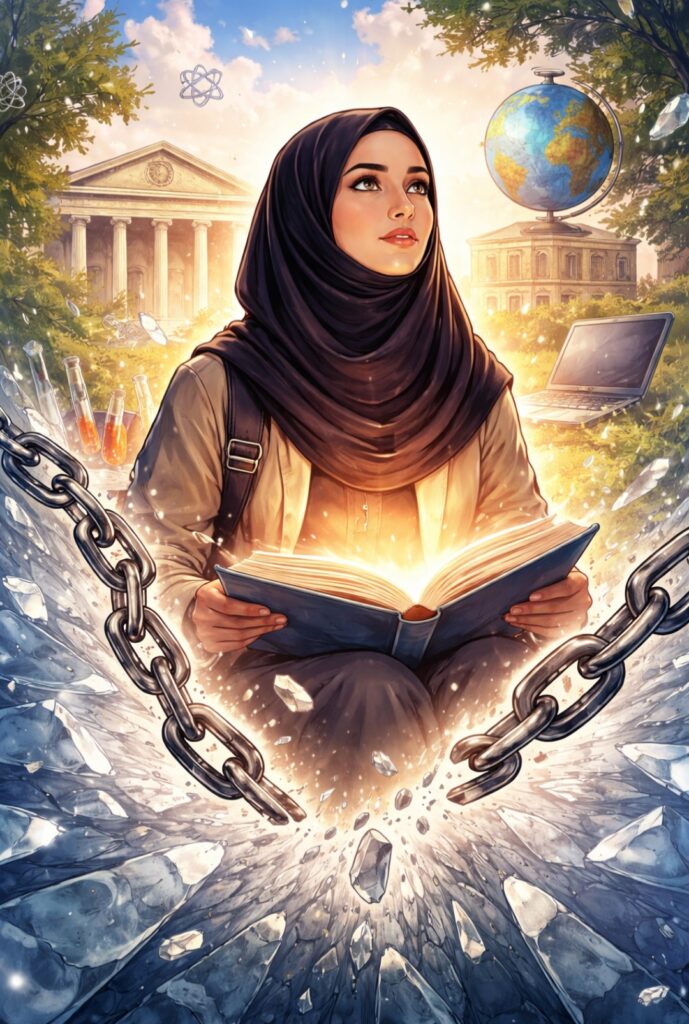
NEW DELHI 15 MARCH 2026: For decades, Western media narratives have often portrayed the condition of women in Iran in stark and monochromatic terms—defined almost entirely by images of compulsory veiling, protests over dress codes, and restrictions on social freedoms. Following the reported assassination of Iran’s Supreme Leader Ali Khamenei during the recent escalation between Iran and the United States–Israel alliance, these portrayals have resurfaced with renewed intensity. Yet a closer look at verifiable data on education, literacy, and professional achievement reveals a more complex and often overlooked dimension of Iranian society: the remarkable advancement of women in education and several professional fields over the past four decades.
While legitimate debates persist about civil liberties and cultural policies, statistics from international institutions such as UNESCO and the World Bank suggest that Iranian women have achieved significant progress in literacy, higher education, and scientific disciplines—sometimes surpassing global averages and even rivaling achievements in countries such as the United States and India.
Literacy Revolution Since the Islamic Republic
When the Islamic Republic was established in 1979, Iran inherited a deeply unequal educational landscape. Female literacy rates in rural areas were particularly low, and access to higher education was limited for women. Over the next four decades, however, the state invested heavily in mass literacy campaigns, rural schooling, and university expansion.
According to data compiled by UNESCO and the World Bank, adult female literacy in Iran now stands at approximately 85–86 percent, a dramatic rise from the levels recorded in the early years after the revolution. Even more striking is the literacy rate among young women aged 15–24, which has reached around 98–99 percent, effectively achieving near-universal literacy for the younger generation.
This figure is not merely symbolic. It places Iran among the countries with the highest youth literacy rates in the developing world and significantly above the global average, which remains around 90 percent.
The transformation reflects sustained government investment in public education, including thousands of rural schools and adult education programmes designed specifically for women. In many regions, women who were once excluded from formal schooling have become the first generation in their families to complete secondary education and enter universities.
Women in Universities: A Quiet Academic Revolution
Perhaps the most striking indicator of female advancement in Iran is the composition of its university system. Today, women constitute roughly 56–63 percent of university students, according to Iranian higher education data from 2025. This means that a clear majority of students in Iran’s universities are female.
The figure has drawn attention internationally. Lebanese journalist Sara Abdallah highlighted this trend in a widely circulated commentary noting that Iranian women have become dominant in many academic disciplines, including medicine and the sciences.
In practical terms, this means that women now form the backbone of the country’s future professional class. Medical schools, scientific institutes, and research laboratories across Iran are populated by young female students who are preparing to enter careers once considered almost exclusively male.
In comparison, while women in the United States and India have also made remarkable progress in higher education, the proportion of female students in many STEM programmes in those countries remains lower than in Iran.
Women in Science, Medicine and STEM
The impact of this educational expansion is particularly visible in scientific and medical fields.
Studies indicate that women account for roughly 60–70 percent of graduates in several scientific disciplines, particularly in life sciences, pharmacy, and medical research. Even in engineering—traditionally male-dominated worldwide—women constitute more than 35 percent of graduates, a figure comparable to or higher than many Western countries.
In medicine, the presence of women is even more pronounced. Approximately half of active postgraduate doctors in Iran are women, and around 40 percent of medical specialists are female. Hospitals, research centres, and universities across the country increasingly rely on women physicians, surgeons, and researchers.
This transformation has had profound social consequences. Women doctors serve in rural health clinics, urban hospitals, and national research programmes, contributing to improvements in public health indicators such as maternal care and vaccination coverage.
Iran’s scientific output has also grown steadily over the past two decades, with many female researchers contributing to internationally cited research in biotechnology, nanotechnology, and medical sciences.
The Paradox of Workforce Participation
Despite these educational gains, Iran presents a striking paradox. While women excel in education and professional training, their overall workforce participation remains relatively low—around 14 percent.
This gap is influenced by a combination of economic conditions, cultural expectations, and structural barriers within the labour market. Many highly educated women encounter limited opportunities for employment or leadership roles in certain sectors.
Yet the presence of a large, educated female population is gradually reshaping societal expectations. Female entrepreneurs, scientists, artists, and academics are increasingly visible in Iranian public life, challenging older stereotypes and expanding the range of professional possibilities for the next generation.
Western Narratives and Selective Visibility
The Western media often frames discussions of Iranian women primarily through the lens of dress codes, political protests, and legal restrictions. These issues are undeniably important and form part of the country’s ongoing social debate. However, critics argue that focusing exclusively on these dimensions can obscure broader realities of social progress.
The portrayal of Iranian women as universally oppressed overlooks their substantial achievements in education and professional life. In many respects, Iranian women have leveraged the country’s public education system to carve out spaces of influence in science, medicine, and academia.
At the same time, the geopolitical rivalry between Iran and Western powers—particularly the United States—has intensified the tendency to interpret Iranian society through ideological narratives. Political figures such as Donald Trump and Israeli Prime Minister Benjamin Netanyahu have frequently invoked women’s rights as part of broader criticisms of Iran’s political system.
While concerns about human rights deserve serious attention, analysts caution that these issues are sometimes framed selectively within the context of international political conflict.
The Legacy of Education Under Khamenei
During the long leadership of Ali Khamenei, Iran’s political system remained deeply conservative in many respects. Yet paradoxically, the same period witnessed an unprecedented expansion of women’s access to education.
Universities multiplied, literacy campaigns reached remote villages, and women increasingly entered fields that had once been closed to them. The result is a generation of Iranian women who are among the most educated in the Middle East.
Their presence in laboratories, hospitals, universities, and professional institutions represents a significant social transformation—one that challenges simplistic narratives about Iranian society.
A More Nuanced Reality
The story of women in Iran is neither one of absolute repression nor one of complete equality. It is a complex and evolving reality shaped by cultural traditions, political structures, economic challenges, and remarkable educational achievements.
What the data clearly demonstrates is that Iranian women have achieved extraordinary progress in literacy and higher education—often rivaling or surpassing global averages. Their growing presence in science, medicine, and academia reflects a quiet revolution that has unfolded largely beyond the glare of international headlines.
Understanding this reality requires moving beyond caricatures and acknowledging both the limitations and the accomplishments of Iranian society. Only through such nuance can the true story of Iranian women—and their continuing struggle for opportunity, recognition, and equality—be fully appreciated.

~Hasnain Naqvi is a former member of the history faculty at St. Xavier’s College, Mumbai….
The opinions expressed here are solely those of the author.

