

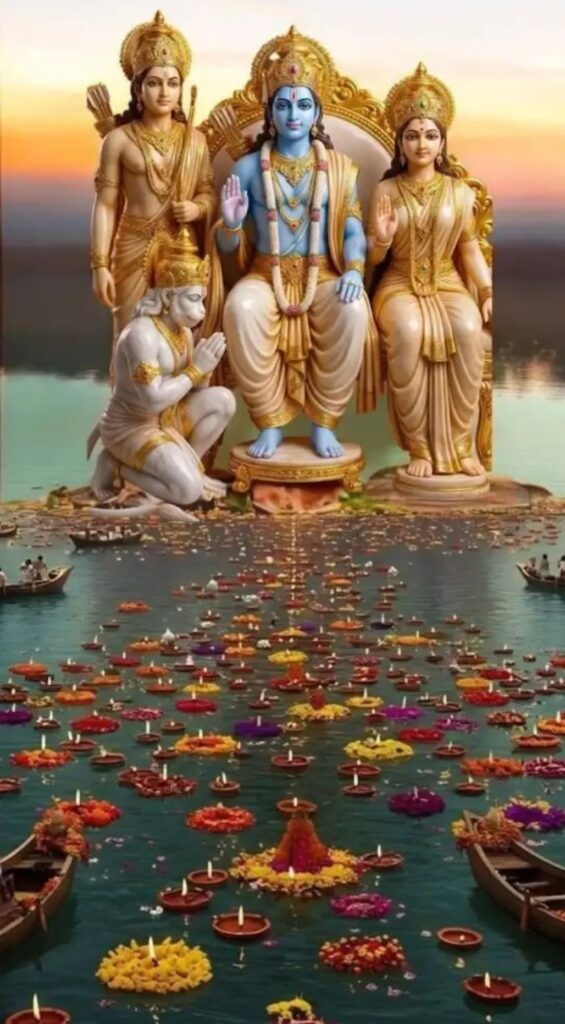
As the dawn of Ramnavmi breaks across India, millions bow before the ideal of Maryada Purushottam—Ram, the embodiment of dharma, courage, and unyielding truth. Yet in a land where rivers of faith have long mingled, Lord Ram has never been the exclusive inheritance of any single creed. His name has echoed in the hearts of Muslim poets who saw in him not a distant deity but a living moral compass, a spiritual leader, and the very pulse of the nation.
Three towering voices—Nazeer Akbarabadi, Allama Iqbal, and Sahir Ludhianvi—stand as luminous proof of this shared reverence, their verses weaving Ram into the vibrant tapestry of India’s composite culture, the Ganga-Jamuni tehzeeb that once defined the subcontinent’s soul.
Nazeer Akbarabadi (1735–1830) was among the earliest Urdu poets to embrace every facet of Indian life with equal affection. He wrote on Holi and Diwali, on Krishna’s leela and the ten avatars of Vishnu, with the same unselfconscious joy he brought to everyday bazaars and seasonal fairs. For Nazeer, the divine was not confined to mosque or temple; it danced in the human heart and the rhythms of the street. In one evocative ghazal, he draws on the timeless tale of Ram and Sita to speak of love’s transformative power:
“Ram par apne aahu-e-dil ko ghurra nihayat tha lekin
chanchal aahu-e-chashm ne us ko ek nigah mein raam kiya”
(The heart-deer was very arrogant about its own Ram—its steadfastness—but the restless deer-eyed beloved captivated it in one glance.)
Here, “Ram” becomes both the steadfast ideal and the act of surrender; Sita’s glance tames even the proudest heart. Through such playful yet profound imagery, Nazeer reminded his readers that the sacred stories of Ramayana were not relics of a bygone faith but living metaphors for the soul’s journey—accessible to every seeker, regardless of the name they called their Lord.
A century later, the philosopher-poet Allama Iqbal (1877–1938) took this reverence to a loftier plane. In his early collection *Bang-e-Dara*, he devoted an entire poem simply titled “Ram” to the hero of Ayodhya. Written when Iqbal’s vision still burned with a broad Indian nationalism, the verses celebrate Ram as the moral and spiritual anchor of the land:
“Hai Ram ke wajood pe Hindostan ko naaz,
Ahl-e-nazar samajhte hain usko *Imam-e-Hind*.”
(India is proud of the existence of Ram; the discerning ones consider him the Imam-e-Hind—the spiritual leader of India.)
Iqbal goes further, calling the “goblet of Hind” labraiz hai sharab-e-haqiqat se—overflowing with the wine of truth. For him, Ram was not merely a historical king or mythic warrior but the very essence of purity and love that India offered the world. The poem’s genius lies in its universality: Iqbal, a devout Muslim thinker, could extol Ram as *Imam-e-Hind* without the slightest contradiction, for truth, in his view, transcended sectarian labels. It was a declaration that India’s greatest moral icons belonged to every Indian.
Decades on, in the tumultuous years after Independence,
Sahir Ludhianvi (1921–1980)—the fiery progressive poet and lyricist—lent his voice to the same devotion through the silver screen.
In the 1968 film Neel Kamal, his bhajan “Hey Rom Rom Mein Basne Waale Ram,” sung with ethereal grace by Asha Bhosle, became an instant classic. Far from political posturing, Sahir’s words are an intimate, almost mystical plea:
“Hey rom rom mein basne waale Ram,
Jag mein tera hi naam…
Tu hi niraakaar hai, Prabhu, tu hi hai saakaar,
Tere hi charano mein mera jeevan, mera praan.”
(Oh Ram who dwells in every pore of my being, Your name alone echoes in the world… You are formless, O Lord, yet You take form; my life and soul lie at Your feet.)
The song’s quiet ecstasy captures the essence of bhakti: Ram is not remote on a throne in Ayodhya but present in every heartbeat, every breath. That a Muslim poet of Sahir’s stature—renowned for his sharp critiques of social injustice—could pen such a profoundly Hindu devotional piece speaks volumes about the seamless cultural osmosis that once defined Indian creativity.
These three poets, spanning two centuries, did not merely “tolerate” Lord Ram; they honoured him with the full force of their artistry. Nazeer found in Ram the tenderness of everyday love, Iqbal the ethical leadership of a nation, and Sahir the all-pervading divine presence that defies religious arithmetic. Their verses remind us that Ramnavmi is not an occasion for exclusion but for celebration of a heritage where the Ganga and the Jamuna have flowed together, enriching the soil of Hindustan.
In an age when narrow identities seek to redraw old boundaries, the poetry of these Muslim bards offers a gentler, wiser map—one where Lord Ram remains *Imam-e-Hind*, the leader who guides every heart that seeks truth, purity, and love.
On this Ramnavmi, may we listen again to their immortal lines and rediscover the syncretic soul that has always been India’s truest strength.

~Hasnain Naqvi is a former member of the history faculty at St. Xavier’s College, Mumbai….
The opinions expressed here are solely those of the author.