

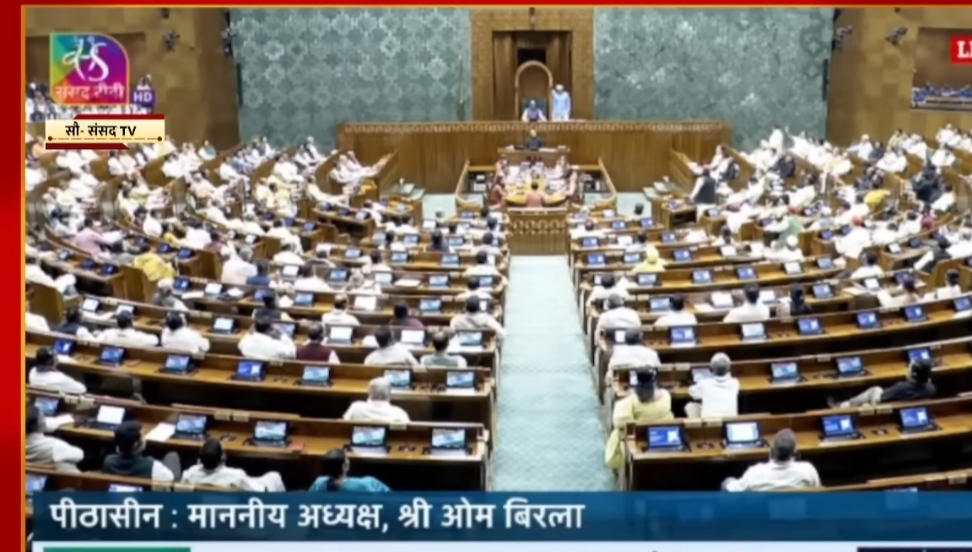
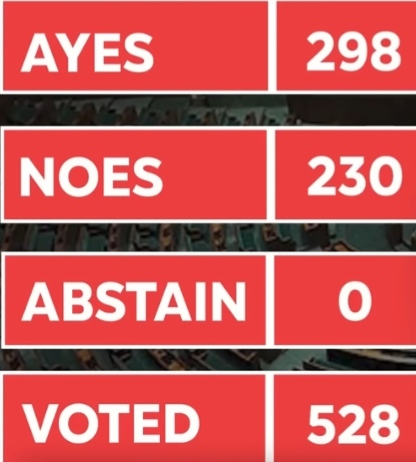
The high-stakes legislative gamble of April 2026 came to a dramatic halt yesterday as the Lok Sabha rejected the Constitution (131st Amendment) Bill. Despite a 298–230 majority in favour, the government failed to secure the mandatory two-thirds threshold required for a constitutional amendment. In the immediate aftermath, the Union government withdrew the Delimitation Bill and a companion measure for Union Territories, admitting these “bundled” reforms could not be viewed in isolation.
While the government frames this as a “missed opportunity” for women, the defeat exposes a deeper anxiety: the fear that gender equity was being used as a Trojan horse to fundamentally—and perhaps irreversibly—alter India’s electoral map.
*1. Numbers vs. Quality: The Governance Trap*
The primary argument for the Delimitation Bill was that a larger Lok Sabha (projected at 815–850 seats) would bring “greater representation.” However, the failure of these bills forces a reckoning with a hard truth: *democracy is not a volume business.* Expanding the House to nearly 900 members without reforming parliamentary procedures risks turning the Lok Sabha into a chaotic assembly where individual voices are drowned out. A dysfunctional Parliament—marked by frequent adjournments and the passing of bills without debate—will not magically become more efficient by simply adding more seats. Quality representation requires a functioning committee system and a vibrant opposition, not just a more crowded room.
*2. The UP-Bihar Dilemma: More Seats, Better Governance?*
The political heart of this reform lay in the Hindi heartland. Under the proposed population-based redraw, Uttar Pradesh and Bihar were set to gain the most. Yet, critics argue that the sheer number of MPs from these states has rarely correlated with better regional or national governance.
*Policy Stagnation:*
Despite holding the lion’s share of seats for decades, these states continue to struggle with the lowest Human Development Index (HDI) scores in the country.
*The Governance Gap:*
If increasing the number of MPs from 80 to 140 in UP were the solution to administrative failure, the state should already be India’s developmental leader.
Shifting more power to states that have struggled with demographic and social indices—while penalizing southern states that have succeeded—threatens to decouple political power from developmental performance.
*3. Is the Quota a Sincere Goal or a Political Shield?*
The defeat raises uncomfortable questions about the BJP’s sincerity toward women’s reservation. By tethering the quota to the volatile issue of delimitation, the government effectively ensured a collision course with regional parties.
Opposition leaders point out that if the intent were truly the “Nari Shakti” (Women’s Power) promised in 2023, the quota could have been implemented within the existing 543 seats. By insisting on a redraw based on the 15-year-old 2011 Census, the government appeared to be prioritizing a “power shift” over “empowerment.” The strategy now seems to be a pivot to the 2029 campaign trail, where the BJP can blame the Opposition for “denying women their rights,” even as they themselves designed the bill to be a federal poison pill.
*4. The Ghosts of J&K and Assam*
The “dread of delimitation” is not theoretical; it is rooted in recent history. The 2022 redraw in *Jammu and Kashmir* and the 2023 exercise in *Assam* serve as cautionary tales.
* *Gerrymandering Concerns:* In J&K, seats were added in a manner that critics argued favored specific demographic pockets to facilitate a particular electoral outcome.
*Communal Logic:* In both regions, boundaries were redrawn with a clinical focus on voter demographics rather than administrative logic.
Southern and Northeastern states fear that a national Delimitation Commission—whose orders cannot be challenged in any court—would use these same “J&K tactics” to marginalize regional identities under the guise of “population proportionality.”
*5. The Master Plan: Boundaries and Centralization*
What is the BJP truly up to? Under *Articles 3 and 4* of the Constitution, the Union has the unilateral power to redraw state boundaries, and under *Article 82* it controls the delimitation process.
The strategy appears to be a long-term move toward a *Unitary Presidency* within a parliamentary shell. By expanding the Lok Sabha while keeping the Rajya Sabha (the “House of States”) at its current strength, the government would significantly dilute the power of the states in joint sittings and Presidential elections.
*Beyond Re-engineering*
The collapse of the 2026 Bills is a reprieve for cooperative federalism, but it is not a solution. The demand for women’s representation remains urgent and just. However, “re-engineering” the country’s political map without a fresh census or a consensus on federal protections is a recipe for national fracture.
For a reform to be truly historic, it must be clean. Implementation of the women’s quota must be decoupled from the demographic “punishment” of successful states. Only then can India achieve gender justice without sacrificing geographic equity. The Parliament’s failure yesterday was not a defeat for women; it was a refusal to let the federal contract be rewritten in the dark.
Picture credit social media

~Hasnain Naqvi is a former member of the history faculty at St. Xavier’s College, Mumbai….
The opinions expressed here are solely those of the author.

