

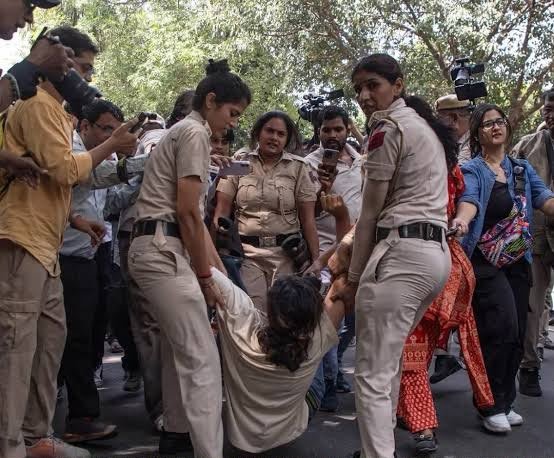
On 11 October 2026, New Delhi did not merely witness a protest being policed; it witnessed the act of witnessing itself being criminalised. As demonstrators gathered across central Delhi to demand the resignation of Chief Election Commissioner Gyanesh Kumar amid anger over the Special Intensive Revision of electoral rolls, the Delhi Police mounted one of the most extensive security operations the capital has seen in recent years. Metro stations were shut, roads barricaded, paramilitary forces deployed, and thousands of people—students, lawyers, opposition leaders, activists and ordinary citizens—were picked up before they could reach protest sites.
But what has turned a heavy-handed security operation into a constitutional scandal is the treatment of journalists. Reporters with press cards around their necks, cameras in hand and microphones clearly marked were stopped, shoved, dragged, detained and in some cases separated from their equipment. They were not merely caught in the crossfire between police and protesters. In several documented instances, they were targeted precisely because they were recording the police action.
The message was unmistakable: the state may permit the public to be informed, but only on terms it approves. Anything outside those terms—especially images of batons, buses, detentions and injuries—was to be prevented from leaving the street.
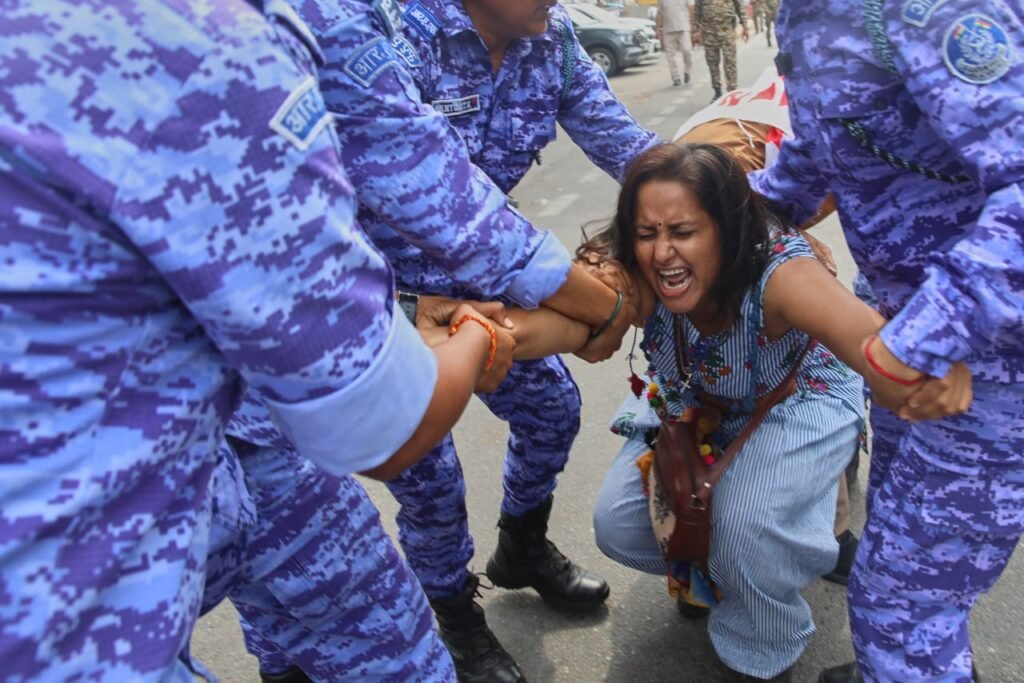
‘Koi media nahi hai’
The phrase reportedly used by police personnel—“there is no media here”—captures the logic of the crackdown. It was not a denial that journalists existed; it was a denial that journalism had any legitimate place in the space being controlled.
Journalists from mainstream organisations and independent digital platforms alike were affected. Reporters from The Quint, The Wire, Scroll, Reporter TV, Navbharat Times, Newslaundry and The Indian Express Hindi were among those detained or obstructed. Three Newslaundry journalists—Ashwine Singh, Savyasachi Astha and Anmol Pritam—said their work phones were seized. Scroll reporter Ayush Tiwari was detained in central Delhi, while the outlet’s political editor, Shoaib Daniyal, was picked up near CR Park.
Two Navbharat Times journalists, Ritik Joshi and Rahul Charas, said they repeatedly identified themselves as reporters near Minto Bridge, showed their identity cards and were nevertheless bundled into a bus with protesters and taken to Maurice Nagar police station. Three Indian Express Hindi journalists—Shashwat, Siya and Vijay Kumar—were detained at Chelmsford Road and released roughly 45 minutes later near Chhatrasal Stadium, miles away from where they had been picked up.
This was not a case of a few reporters being inadvertently swept up in a chaotic crowd-control operation. The pattern was too consistent: press identification was ignored, reporters were placed in detention buses, phones and cameras were seized, and journalists were released only after being removed from the sites where news was being made.
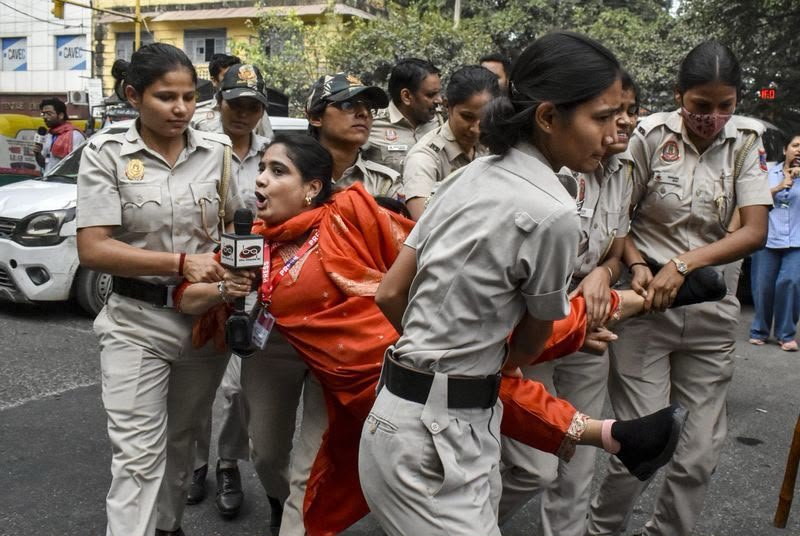
Pragya Mishra’s account
Among the most disturbing accounts came from Pragya Mishra, the Uttar Pradesh-based journalist associated with Ulta Chasma and Bharat Samachar. In a video statement posted after her detention, Mishra said she was covering police action when she was seized by several policewomen, dragged and pushed into a bus. She said her cameraperson’s hair was pulled and that she had been trying to protect him after he was injured.
“I was only doing my work,” she said, describing how she had been showing the beating of protesters and the use of lathis. Her account, delivered in Hindi and circulated widely on YouTube, Instagram and X, alleged that police deliberately humiliated her despite her carrying a microphone and identification.
In a post on X, Mishra wrote that the authorities wanted to “stop those who are showing the truth” and prevent images of what she called the “rape of democracy” from going out. Whatever one makes of the rhetoric, the underlying allegation is precise and serious: that she was detained not for violence, obstruction or unlawful assembly, but for documenting state violence.
Her account matters because it comes from a reporter whose job was not to join the protest but to record it. The distinction is fundamental. A democracy may disagree fiercely with a journalist’s framing, editorial line or political sympathies. It may investigate alleged illegality. But it cannot treat the presence of a camera as itself an offence.
The view from the ground
Saurabh Shukla of The Red Mike, an independent digital news platform known for its on-the-ground reporting, documented the crackdown from Connaught Place and nearby protest zones. His reports described police dragging and detaining journalists through the day, and recorded the wider atmosphere of fear, confusion and coercion in which reporters were forced to work.
Shukla’s reporting is significant for another reason. Independent digital journalists now often operate where legacy media either cannot reach or chooses not to go. They work with smaller crews, mobile cameras and direct social-media distribution. Their visibility makes them vulnerable; their immediacy makes them dangerous to any authority seeking to control the visual record.
The Red Mike’s coverage did not merely report that journalists had been detained. It showed the mechanics of the operation: buses filling with detainees, police cordons, injured protesters, reporters being pulled away from scenes, and the growing impossibility of independent verification. That is exactly the kind of journalism that becomes indispensable during a crackdown—and exactly the kind that authorities find hardest to tolerate.
Senior journalist Ajit Anjum was also reported to have been detained during the protests, according to parliamentary correspondence and media accounts. His detention underscored that the action was not confined to young digital creators or reporters at the margins of the profession; it reached established voices with large audiences and long records of political reporting.
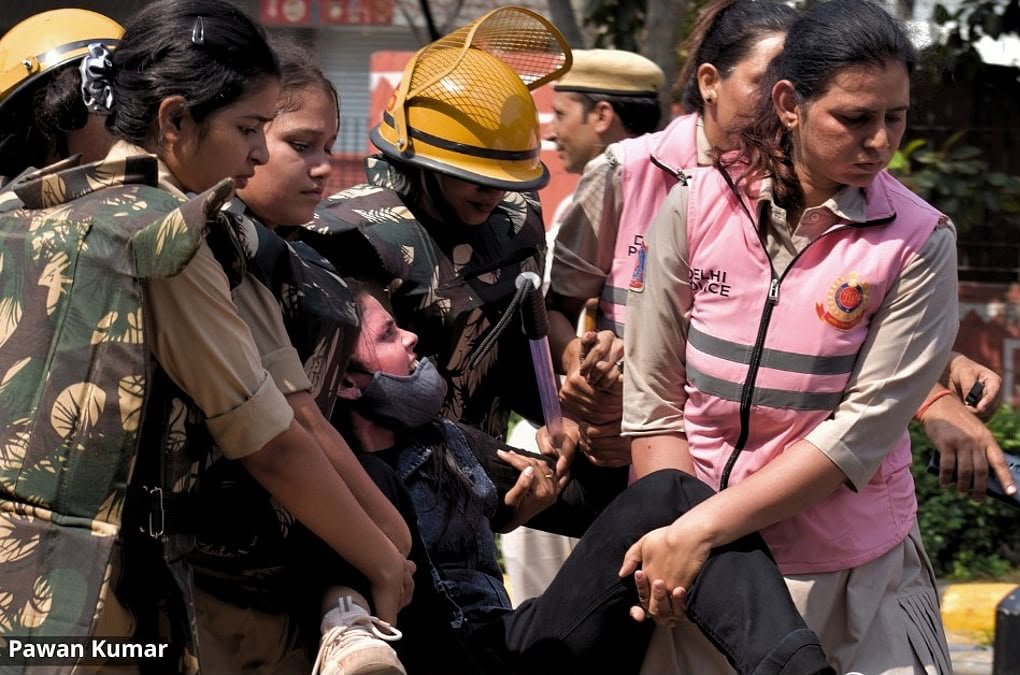
More than 30 journalists detained
By the time the second day of protests ended, more than 30 journalists were reported to have been detained across 10 and 11 October. Some were dragged or beaten, others had phones stolen or seized, and many were held in buses or taken to detention sites including Chhatrasal Stadium and Chanakyapuri police station.
The number itself is less important than its implication. This was not an isolated error by an overzealous constable. It was a systemic operation in which journalists were treated as an appendage of the protest rather than as independent observers of it.
The Press Club of India, Indian Women’s Press Corps, Delhi Union of Journalists and the Delhi unit of the Kerala Union of Working Journalists jointly condemned the action. They said journalists displaying valid press identity cards were detained, that equipment was confiscated, and that reporters were bundled into buses and taken to detention centres. They demanded the release of all detained journalists, the return of seized equipment, a public apology from Delhi Police and an independent inquiry.
Those demands are modest. They do not ask the police to abandon public order. They ask the state to accept that a press card is not a disguise, a camera is not a weapon, and reporting is not conspiracy.
The Supreme Court’s rebuke
The crackdown acquired an additional constitutional dimension because it occurred while the Supreme Court was explicitly addressing the rights of protesters, lawyers and journalists. The court said peaceful, unarmed protesters could not be detained except according to procedure established by law, and that lawyers and journalists should not be impeded in carrying out their professional duties.
That intervention makes the police action harder to defend. If journalists are to be protected from obstruction while performing professional duties, then detaining them despite visible press credentials, seizing their phones and removing them from protest sites is not merely poor policing. It is a direct challenge to a judicially recognised principle.
The Communist Party of India’s Rajya Sabha member Sandosh Kumar P. subsequently wrote to Union Home Minister Amit Shah, seeking intervention against what he described as harassment and detention of journalists. His letter framed the issue plainly: the right to know had been obstructed.
Why the cameras mattered
The authorities’ apparent anxiety about footage is understandable only if one accepts that the footage was damaging. Videos showed journalists being dragged, protesters being forced into buses, and police personnel using force in central Delhi. Such images do not merely document individual misconduct; they reveal the character of an operation.
A state confident of the legality and proportionality of its actions has little reason to fear documentation. It can explain, defend and correct. A state that treats cameras as threats is implicitly admitting that the visual record may contradict its official narrative.
This is why the detention of journalists cannot be dismissed as a law-and-order issue. The removal of reporters from a protest site does not simply delay a news report. It creates an evidentiary vacuum. It allows the state to become the principal narrator of its own coercion.
Independent media under pressure
The events of 11 October also exposed the unequal vulnerability of India’s media ecosystem. Established organisations with legal departments, institutional visibility and political access may eventually secure the release of detained reporters. Independent journalists, freelancers and small digital outlets often have fewer protections and less leverage.
Pragya Mishra’s detention and Saurabh Shukla’s ground reporting illustrate this new reality. Digital-first journalism has expanded the public’s access to unfiltered political events, but it has also created a class of reporters who can be intimidated with relative impunity. Their equipment can be seized, their footage deleted, their mobility restricted and their credibility questioned—all before any formal legal process begins.
The result is a chilling effect that operates without needing mass arrests. Every journalist who sees a colleague dragged into a bus learns a lesson: cover the protest carefully, avoid the most revealing images, or stay away altogether.
A dangerous precedent
India has seen press freedom erode in many ways: through defamation cases, tax investigations, advertising pressure, online harassment, surveillance and the deliberate drowning out of independent reporting by partisan digital ecosystems. But the open detention of journalists covering a protest in the national capital represents a more brazen form of coercion.
It normalises the idea that reporting on state power is itself suspicious. It tells police personnel that press cards can be ignored. It tells editors that their reporters may be returned not with stories, but with confiscated phones and accounts of humiliation. And it tells citizens that the truth of a crackdown may never reach them intact.
The comparison with authoritarian practice is not rhetorical excess. When a government prevents journalists from recording its response to dissent, it is not protecting public order; it is managing perception. The distinction between security and censorship collapses when the principal target of security action is the person holding the camera.
What must happen now
Delhi Police must publish a full account of how many journalists were detained, under what legal provisions, where they were held, what equipment was seized, and who authorised the action. An independent inquiry should examine allegations of assault, dragging, forced removal and pressure to delete footage.
Press bodies have rightly demanded an apology, but an apology alone will not restore the principle at stake. There must be accountability for individual misconduct, clear written protocols affirming that accredited journalists cannot be detained for reporting, and compensation for damaged or seized equipment.
Most importantly, political leadership must stop treating journalism as an adversary. A democracy does not become safer by blinding itself. It becomes more dangerous when those who are supposed to see, record and report are themselves made invisible.
On 11 October, the streets of New Delhi were filled with police buses, barricades and detained citizens. But the most consequential detention was of the public’s right to know. The journalists were released. The question is whether the principle they were defending will be.

~Hasnain Naqvi is a former member of the history faculty at St. Xavier’s College, Mumbai….
The opinions expressed here are solely those of the author.