

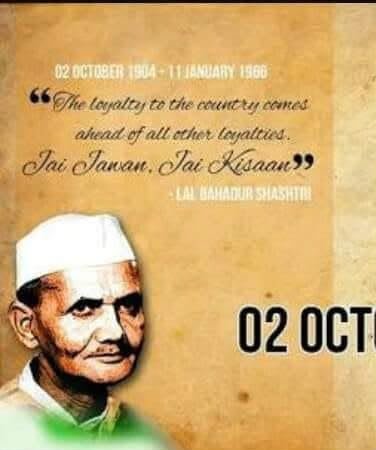
On October 2, as the nation pays homage to Mahatma Gandhi, it also marks the birth anniversary of another son of the soil whose life embodied the Mahatma’s ideals with rare fidelity. Lal Bahadur Shastri, born in 1904 in the modest town of Mughalsarai in Uttar Pradesh, rose from humble beginnings to become India’s second Prime Minister. In a tenure of just nineteen months, he left an imprint far larger than his slight frame suggested—through moral courage, unyielding integrity, and a simplicity that remains a rebuke to excess in public life.
The Making of a Man of Character
Shastri’s early years were shaped by adversity and principle. Orphaned of his father while still a toddler, he grew up under his mother’s care and absorbed the values of thrift and self-reliance. As a schoolboy he swam across the Ganges with books tied to his head rather than spend scarce coins on a ferry. He dropped his caste surname, adopting “Shastri” after earning the title of scholar at Kashi Vidyapith. Drawn into the freedom struggle by Gandhi’s call, he spent years in British prisons, emerging with a steely resolve tempered by gentleness.
After Independence he served with distinction in Uttar Pradesh and later in the Union Cabinet—Railways, Transport, Commerce, Home Affairs—always preferring quiet competence to theatrical display. When a major rail accident occurred on his watch as Railway Minister, he resigned, accepting moral responsibility even though no personal culpability was established. Jawaharlal Nehru accepted the resignation not as punishment but as an example of ethical standards. That sense of accountability never left him.
Power Without Privilege
As Prime Minister, Shastri continued to live by the same rules he expected of ordinary citizens. He wore simple khadi, the fabric of the freedom movement, and his household expenses were met strictly from his salary. Family accounts record that when clothes grew too worn to mend, they were cut into handkerchiefs rather than discarded. He declined the trappings of office that others took for granted.
One telling episode involved the official car. When his sons used the government vehicle for a private outing, Shastri checked the logbook, noted the exact distance—fourteen kilometres—and insisted that the cost be calculated and repaid into the public exchequer from his own pocket. No exception was made for the Prime Minister’s family.
Even more striking was his decision to buy a personal car. In 1964, after family pressure for a vehicle of their own, he discovered that a Fiat cost around ₹12,000. His bank balance stood at roughly ₹7,000. Rather than seek special treatment or divert official resources, he approached Punjab National Bank for a loan of ₹5,000—exactly as any citizen would. The loan was sanctioned promptly. When he learned of the speed, he is said to have reminded the bank that the common man deserved the same efficiency. The cream-coloured 1964 Fiat, registration DLE 6, became the family’s modest conveyance. After Shastri’s sudden death in Tashkent in January 1966, his widow Lalita Devi declined any official waiver and repaid the outstanding amount from her family pension. That car still stands at the Lal Bahadur Shastri Memorial in New Delhi—a silent monument to absolute honesty.
Leadership in Crisis
Shastri’s brief premiership coincided with two existential tests: acute food scarcity and the 1965 war with Pakistan. He met both with clarity and resolve. Faced with drought and shortages, he appealed to the nation to forgo one meal a week so that the saved grain could reach the needy; his own household observed the fast. He backed Agriculture Minister C. Subramaniam and scientist M.S. Swaminathan in introducing high-yielding seeds, institutional support for farmers, and the Agricultural Prices Commission (now the Commission for Agricultural Costs and Prices). These steps laid the foundation of the Green Revolution that would later free India from chronic dependence on food imports.
Simultaneously he supported the cooperative dairy model pioneered in Anand, Gujarat. His visit there convinced him of its potential; the National Dairy Development Board was established under his watch, setting the stage for the White Revolution that transformed India into the world’s largest milk producer.
When war came in 1965, the soft-spoken leader proved decisive. He authorised the Indian forces to cross the international border, refusing to allow the conflict to remain confined to Kashmir. His rallying cry—“Jai Jawan, Jai Kisan”—united the nation, honouring both the soldier defending the frontier and the farmer feeding the people. The slogan remains a living expression of national solidarity. The war ended with the Tashkent Declaration of 10 January 1966. The following day, Shastri died of a heart attack, leaving the nation in mourning and a legacy of quiet strength.
An Enduring Standard
Shastri was posthumously awarded the Bharat Ratna. Yet his true memorial is not only in awards or statues but in the example he set. Institutions he helped create or strengthen—the Border Security Force, the Central Vigilance Commission, the Food Corporation of India—continue to serve the republic. More important still is the moral standard he embodied: power exercised without privilege, office held as trusteeship rather than entitlement.
In an age often marked by ostentation and entitlement, Shastri’s life reminds us that greatness requires neither wealth nor spectacle. It requires character strong enough to repay fourteen kilometres of private travel from personal savings, to take a bank loan rather than demand favours, and to ask the nation to share hardship while sharing it oneself.
On this shared birth anniversary with the Father of the Nation, Lal Bahadur Shastri stands as proof that the highest office can be occupied with the simplest of means and the purest of motives. His Fiat still waits at the memorial, a quiet invitation to measure public life not by what is acquired but by what is returned.

~Hasnain Naqvi is a former member of the history faculty at St. Xavier’s College, Mumbai….
The opinions expressed here are solely those of the author.