

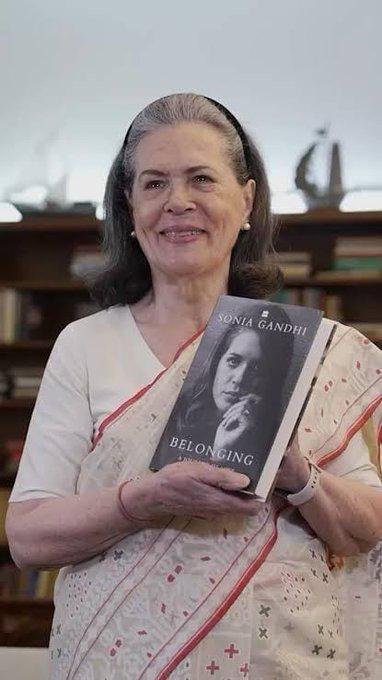
In her long-awaited memoir, Belonging: A Journey of Love, Sonia Gandhi trades political score-settling for a meditative portrait of assimilation, grief, and the heavy inheritance of a dynasty.
For nearly three decades, Sonia Gandhi has occupied a singular space in the Indian political imagination: an omnipresent yet deeply inscrutable figure whose public utterances were calibrated to the syllable and whose interior life remained fiercely guarded. In Belonging: A Journey of Love , the 79-year-old Congress matriarch finally breaks that silence. Published amid a highly publicized parting of ways with Penguin Random House India over editorial interventions before HarperCollins and Knopf assumed stewardship, this 544-page volume arrives weighted with expectation. Yet what unfolds across its pages is less a conventional political treatise than a contemplative chronicle of cultural translation, devastating loss, and reluctant duty.
From Piedmont to the Nehru-Gandhi Household
Sonia Gandhi conceives her narrative not as a political ledger, but as an intimate romance that collided, almost inadvertently, with modern history. Nearly four hundred pages elapse before she formally steps into electoral politics in 1997. It is within this expansive prelude that the book discovers its truest literary register. Tracing an arc from a post-war childhood in the Piedmontese town of Orbassano to a chance, life-altering encounter with Rajiv Gandhi in Cambridge in 1965, she writes with unhurried warmth about learning the grammar, customs, and emotional cadences of an adopted homeland.
Her rendering of domestic life inside the Nehru-Gandhi household offers rare, humanizing glimpses of figures routinely flattened by hagiography or vitriol. She lingers over the quiet years of raising two children while Rajiv worked as a commercial pilot, framing that fleeting normalcy against the encroaching shadows of statecraft. Her portrait of her formidable mother-in-law, Indira Gandhi, is drawn with striking nuance and filial tenderness, capturing the subtle domestic rituals beneath the austere public persona.
“It may leave historians wishing for greater candour on the mechanics of power, but as a human document of an outsider who anchored one of the world’s most turbulent political dynasties, it is an absorbing and poignant read.”
Bloodshed and Private Battles
The prose acquires a stark, visceral urgency when confronting the tragedies that cleaved her life in two. Gandhi recounts Indira Gandhi’s 1984 assassination with harrowing clarity—from the agonizing drive to the hospital cradling a mortally wounded mother-in-law to the chilling discovery of grenades inside their residential compound in the wake of Operation Blue Star.
Equally affecting are her reflections on the 1991 suicide bombing that claimed Rajiv’s life, a catastrophe that solidified her resolve to shield her children from public office. In one of the memoir’s most candid disclosures, she also chronicles her fiercely private battles with breast and pancreatic cancer in 2010 and 2011, revealing how the relentless glare of the Indian press compelled her to seek treatment abroad in secrecy to preserve a shred of personal dignity.
The Guarded Stateswoman
When the narrative finally pivots to her tenure as the longest-serving president of the Indian National Congress, the register shifts perceptibly from intimate reflection to guarded statesmanship. She revisits her consequential decision to decline the prime ministership in 2004, framing the choice as an act of personal conviction and maternal instinct rather than tactical calculation.
In these closing movements, Gandhi sets aside her customary restraint to deliver pointed critiques of Prime Minister Narendra Modi’s administration, the ideological ascendancy of the Rashtriya Swayamsevak Sangh, and New Delhi’s posture along the disputed border with China.
Omissions and Editorial Slips
Yet it is precisely in this final third that the book’s architectural seams begin to show. While her ideological indictments of the current dispensation are sharp, readers seeking forensic accountability regarding the internal fractures, policy missteps, and coalition dilemmas of the United Progressive Alliance decade will find her treatment frustratingly elliptical.
Moreover, the manuscript is marred by avoidable lapses in editorial rigour. Noticeable factual inaccuracies—including misstating the founding year of the RSS, compressing the timeline of the Anna Hazare anti-corruption movement, and misremembering the year her closest political confidant, Ahmed Patel, passed away—diminish the authority of a work twelve years in the making.
The Verdict
Ultimately, Belonging succeeds most where it resists the impulse to function as an exhaustive political history. By anchoring her narrative in personal resilience and the quiet toll of public life, Sonia Gandhi offers a compelling counter-narrative to decades of caricature. It may leave historians wishing for greater candor on the mechanics of power, but as a human document of an outsider who anchored one of the world’s most turbulent political dynasties, it is an absorbing and poignant read.
Belonging: A Journey of Love Author: Sonia Gandhi Publishers: HarperCollins India / Alfred A. Knopf / William Collins Extent: 544 pages (Hardcover) Price: 71,299/ £25.00

We are a multimedia news network. Website : www.7xnews.com Based in New Delhi (India)
Youtube : umakantlakheraspeaks@gmail.com