

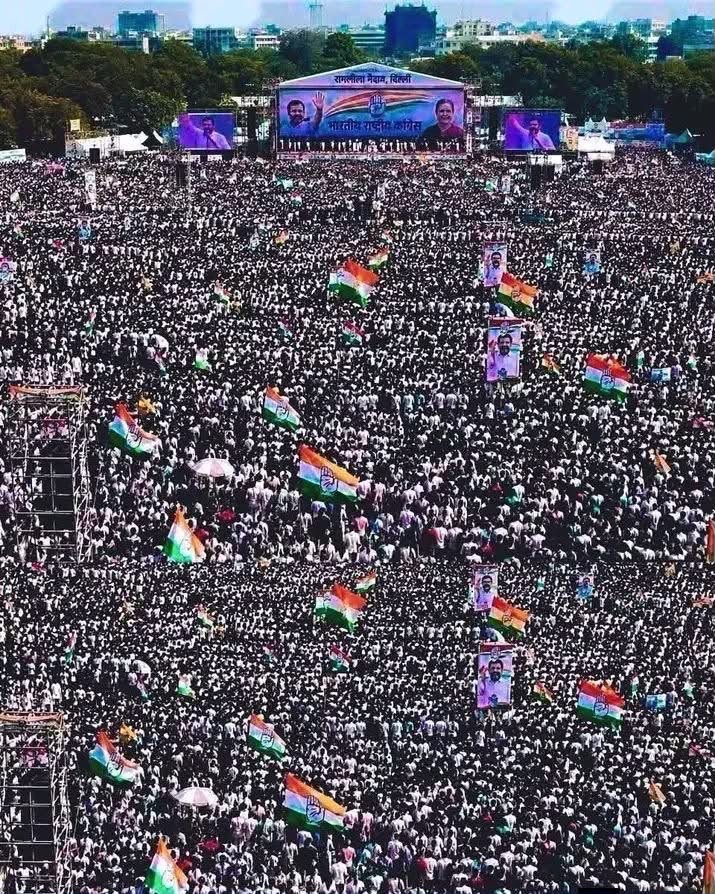
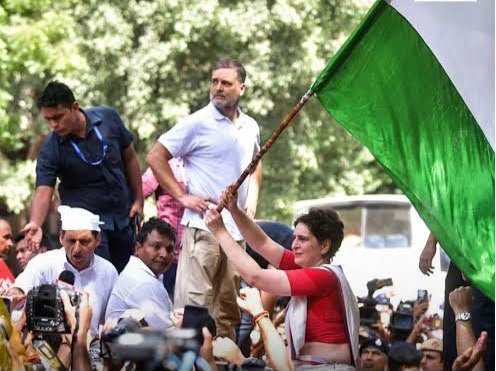
On a rain-soaked Sunday that turned Delhi’s historic Ramlila Maidan into a living tableau of dissent, the INDIA bloc staged one of its most significant mobilisations in recent years. Under the banner “Vote Bachao, Desh Bachao,” tens of thousands converged from across the country, transforming the ground and its surrounding streets into a dense sea of party flags, placards and determined faces. What began as a focused protest against alleged electoral irregularities evolved into a broader assertion of democratic anxiety, exposing both the strength and the fault lines of opposition politics in contemporary India.
The Scale and the Spectacle
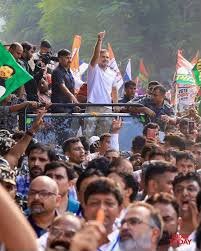
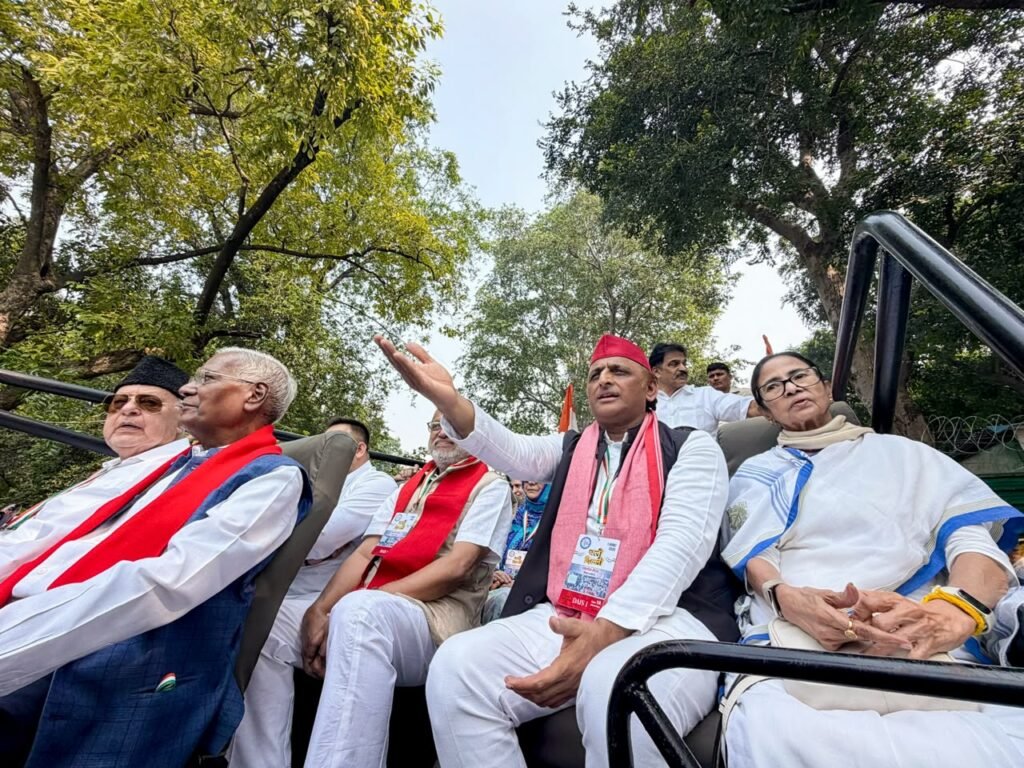
Supporters arrived by sleeper buses after long journeys, by trains booked strategically to bypass bulk-reservation restrictions, and even on foot from hospital wards. Farmers in traditional attire, students carrying Constitution booklets, workers, women activists and ordinary citizens filled the muddy expanse. Crowds spilled far beyond the formal seating arrangements, with many still approaching long after the formal programme had begun. The march from the Minto Road-Connaught Place junction to the Maidan itself became a moving demonstration, leaders riding open vehicles amid a continuous chorus of slogans: “Vote chor, gaddi chhod” and “Vote bachao, desh bachao.”
The visual was unmistakable—a rare convergence of Congress, Samajwadi Party, Trinamool Congress, Left parties, National Conference, PDP and others sharing one platform. Rahul Gandhi, Mallikarjun Kharge, Mamata Banerjee, Akhilesh Yadav, Tejashwi Yadav, Sonia Gandhi, Priyanka Gandhi Vadra, Farooq Abdullah and Mehbooba Mufti stood together, projecting an image of solidarity that the opposition has struggled to sustain consistently. The presence of student and youth organisations added energy, turning the gathering into something larger than a conventional political rally.
Yet the optics invited immediate contestation. While organisers spoke of a massive, even lakh-plus turnout and claimed the ground overflowed, critics pointed to vacant chairs and unoccupied pockets of the venue. Such disputes over numbers are familiar in Indian politics; what mattered more was the visible determination of those who made the journey and the political message they carried.
The Core Charge: Electoral Integrity Under Strain
At the heart of the protest lay the Special Intensive Revision of electoral rolls. Opposition leaders alleged that the exercise had resulted in the deletion of an enormous number of names—figures in the range of 13 crore cited repeatedly—threatening the fundamental right to vote of large sections of the citizenry. Rahul Gandhi framed the issue in stark terms, describing the alleged removals as “treason” and “the rarest of rare” theft of the people’s voice. He accused the Election Commission of enabling manipulation and warned that both the Chief Election Commissioner and the highest political leadership would eventually face legal consequences. Mallikarjun Kharge charged that the process selectively targeted women, youth and Dalits, asserting that the opposition would not rest until accountability was enforced.
The demands were clear and non-negotiable in the alliance’s telling: halt the SIR exercise, restore names of eligible voters wrongly deleted, and secure the resignation of Chief Election Commissioner Gyanesh Kumar. Speakers linked the electoral question to a deeper crisis of institutional trust, arguing that without free and fair rolls, every subsequent election risked losing legitimacy.
The gathering did not remain confined to the electoral domain. Farmers spoke of agrarian distress, students of unemployment and educational access, women of safety, and workers of inflation and livelihood insecurity. The Manipur crisis and the rights of marginalised communities also found expression. In this sense the rally functioned as a broader platform for accumulated grievances, allowing diverse sections to locate their specific concerns within a shared narrative of democratic defence.
Unity on Display, Absences That Spoke
The presence of multiple parties under one canopy was significant. In an era of intense polarisation and frequent fragmentation, the ability to stage a joint show of strength at the national capital carried symbolic weight. It signalled that, at least on the question of electoral integrity, the opposition could still close ranks. The sight of flags of traditionally rival formations fluttering side by side underscored a tactical convergence born of necessity.
Equally revealing were the absences. Certain parties and formations that have at times positioned themselves as champions of democratic rights or of particular social constituencies chose to stay away. Their non-participation highlighted the persistent difficulty of translating shared concerns into complete organisational unity. Politics, even when framed in the language of constitutional rescue, remains shaped by calculation, regional priorities and competitive self-interest. The rally therefore revealed both the potential and the limits of opposition cohesion.
Political Ramifications and the Road Ahead
The immediate impact of the Ramlila Maidan gathering lies in its contribution to a sustained campaign questioning the conduct of electoral processes. By bringing the issue to the national capital with visible public participation, the opposition has kept the spotlight on institutional accountability. The event forms part of a longer sequence of protests, petitions and public hearings that have sought to force a national conversation about how voter lists are prepared and revised.
For the ruling establishment the challenge is twofold: to defend the integrity and necessity of the revision exercise while simultaneously managing the political optics of large-scale dissent. For the Election Commission the pressure is institutional—to demonstrate transparency and fairness in a manner that reassures rather than further alienates sceptical sections of the public. For the opposition the test is sustainability.
A successful single-day mobilisation must be translated into continuous organisational work, credible documentation of grievances, and the ability to maintain internal discipline.
There are also longer-term implications. When large numbers of citizens travel long distances to assert that their names have disappeared from the rolls, the question ceases to be purely administrative. It becomes a test of democratic confidence. In a country where the right to vote remains the most widely exercised form of political participation, any sustained perception of exclusion carries the risk of eroding the foundational legitimacy of the electoral system itself.
The Ramlila Maidan rally of 1 November did not resolve the underlying disputes. It did, however, make them impossible to ignore. In the muddy grounds of central Delhi, under fluttering flags of many colours, a significant section of the political opposition and a determined body of citizens declared that democracy is not a finished achievement but a continuous practice requiring vigilance. Whether that declaration translates into institutional reform, renewed public trust, or merely another cycle of competitive rhetoric will depend on the responses that follow in the weeks and months ahead. The voices raised on that November Sunday will echo for some time yet.

~Hasnain Naqvi is a former member of the history faculty at St. Xavier’s College, Mumbai….
The opinions expressed here are solely those of the author.