

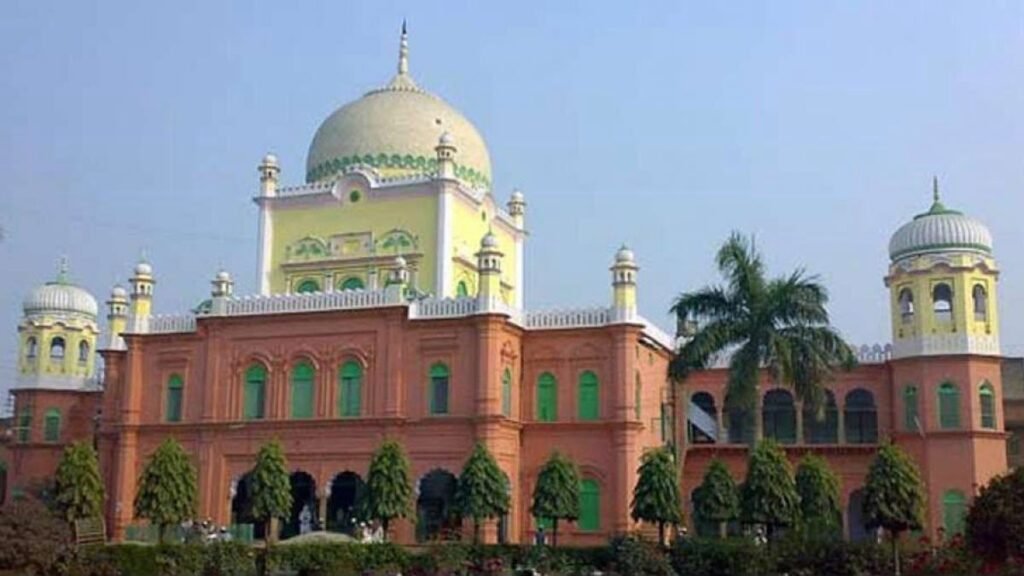
The proposed Ganga-water procession is not an act of faith but a test of whether the rule of law still restrains majoritarian provocation
The proposed visit of the Hindu Raksha Dal to Darul Uloom Deoband on August 11 is being presented as a religious act: a group carrying Ganga water from Haridwar to offer it at a prominent Islamic seminary. But beneath this supposedly devotional gesture lies something far more dangerous—a publicly announced attempt to enter a functioning religious institution on the strength of an unverified allegation that a Shivling lies beneath its premises.
That is not faith. It is intimidation dressed up as piety.
The report on the proposed action establishes only that the Hindu Raksha Dal has made a claim. It does not produce an archaeological report, a court order, a historical record, a land document, a photograph, an expert opinion or any other evidence demonstrating the existence of a Shiva temple or Shivling beneath Darul Uloom. The claim, therefore, remains precisely what it is: an allegation made by a political-religious organisation. It cannot be elevated into fact merely because it has been repeated in a video message or circulated by news platforms.
According to the PTI report, Lalit Sharma, the organisation’s Uttarakhand president, says that the group had approached the Saharanpur administration seeking an inquiry and, alleging inaction, has decided to travel to Deoband with Ganga water. The same report also records the police warning that nobody will be permitted to disturb law and order and that legal action will follow any attempt to create tension.
That warning is welcome—but it must not remain a warning issued after the mobilisation has already been announced. The state’s responsibility is preventive, not merely reactive.
Evidence cannot be replaced by mobilisation
India is a constitutional democracy, not a marketplace in which the loudest claimant wins. If an organisation believes that an offence has occurred or that a historical structure lies beneath a religious site, it may approach the competent authority with evidence. It may seek a judicial remedy in accordance with law. What it cannot do is announce a march into another community’s religious institution and claim the right to perform a ritual there.
The proposed offering of Ganga water is not an innocent symbolic act. It is intended to assert a religious claim over land presently occupied by an Islamic seminary. The symbolism is unmistakable: arrive in a group, carry a sacred object, make a public claim and force the authorities to manage the consequences. This is the familiar grammar of communal confrontation, where provocation is marketed as devotion and law enforcement is left to clean up the damage.
The burden of proof lies with those making the allegation. Until credible evidence is produced and examined through a lawful process, the claim deserves no more institutional recognition than any other rumour. A video message cannot substitute for archaeology. A procession cannot substitute for a judicial finding. And an organisation’s conviction cannot substitute for proof.
The law is not a ceremonial accessory
The Places of Worship (Special Provisions) Act, 1991, was enacted precisely to prevent the endless reopening of religious claims. Its stated purpose is to prohibit the conversion of places of worship and preserve their religious character as it existed on August 15, 1947. Section 4 declares that the religious character of a place of worship existing on that date shall continue to be the same. The law also bars fresh proceedings concerning the conversion of such religious character, subject to narrowly defined exceptions.
The law was born out of the recognition that India cannot survive as a republic if every shrine, mosque, temple, church, monastery or dargah becomes the subject of retrospective excavation and competitive historical grievance. Parliament understood that a society built on religious contestation would never arrive at social peace. The statute’s purpose was therefore not to erase history but to prevent history from being weaponised against the present.
The Supreme Court has also described the law as intrinsically connected with the obligations of a secular state and the equality of all religions. In its December 2024 proceedings, the Court stayed the registration of further suits seeking surveys of places of worship and restrained courts from passing effective orders, including survey orders, in pending matters until further directions. The constitutional challenge to the law remains pending.
That legal position should make one point clear: self-appointed groups cannot conduct their own surveys, excavations or ritual occupations. If courts are being asked to exercise restraint while the constitutional validity of the law is examined, street organisations cannot claim a parallel jurisdiction for themselves.
Deoband is not an empty symbol
Darul Uloom Deoband was founded in 1866, in the aftermath of the upheavals that followed the revolt of 1857. Its own historical account records that the seminary began modestly but grew into a major centre of Islamic learning, attracting students from across the subcontinent and beyond. Whatever one’s view of its theological positions, it is a historic educational institution with a recognised place in the intellectual and social history of South Asia.
Reducing Darul Uloom to a suspected “structure beneath the premises” is an act of deliberate historical impoverishment. The seminary is not merely a plot of land waiting to be reclaimed by whichever group produces the most inflammatory claim. It is a living institution, used by students, teachers, staff and worshippers. Any attempt to enter it forcibly or conduct an unauthorised ritual there would not be an archaeological exercise; it would be trespass, provocation and an assault on the constitutional right of a religious community to manage its institution.
The Constitution protects freedom of conscience and the right to profess, practise and propagate religion, subject to public order, morality and health. It also protects the rights of religious denominations to establish and maintain institutions and manage religious affairs. Those rights are not granted only to the majority. They are constitutional guarantees, and their value is measured precisely when they protect an unpopular or politically vulnerable minority.
The police must act before the cameras arrive
The Deoband Circle Officer has correctly said that no one will be allowed to disturb the atmosphere. But neutrality does not mean treating a threatened intrusion and the threatened institution as equally responsible for a conflict. The state must identify who is announcing the mobilisation, what route and assembly plans are being circulated, whether permission has been sought, and whether the proposed act violates criminal law or local restrictions.
The Supreme Court has repeatedly stressed that authorities must act against hate speech and communal incitement without waiting for a formal complaint. In its 2023 directions, it called for suo motu action in appropriate cases, irrespective of the religion of the speaker, to preserve India’s secular character. That principle should guide the administration now.
The government must prevent the proposed entry, secure Darul Uloom and prosecute any unlawful attempt to breach the peace. It must also make public whether any formal complaint exists, what evidence has been submitted and whether a competent authority has found grounds for inquiry. Transparency can defeat rumour; passivity only rewards it.
Faith does not need a police escort
The Ganga is sacred to millions of Hindus. But its sanctity cannot be invoked to legitimise trespass into another community’s institution. No faith is honoured when its symbols are converted into instruments of threat.
The real issue in Deoband is not whether a Shivling exists beneath a seminary. The real issue is whether every allegation against a Muslim institution will now be transformed into a procession, a media event and a test of administrative courage. If the answer is yes, then the country is not defending heritage; it is manufacturing permanent conflict.
India’s civilisational strength lies not in excavating every disputed memory but in refusing to let disputed memories destroy the living present. Darul Uloom Deoband must be protected—not because any institution is above scrutiny, but because scrutiny belongs to evidence, law and courts. The street has no right to replace any of them.

~Hasnain Naqvi is a former member of the history faculty at St. Xavier’s College, Mumbai….
The opinions expressed here are solely those of the author.