
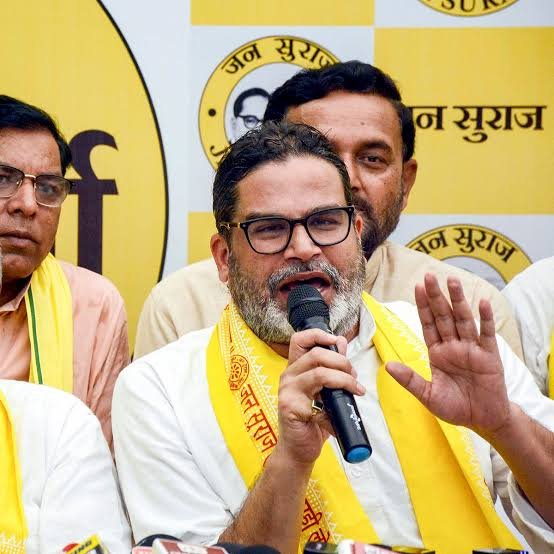
photo courtesy : The New Indian Express
The Bankipur Assembly by-election on 30th July has become much more than a contest for a single legislative seat. It is increasingly being viewed as a test of whether Bihar’s politics is entering a new phase ; one driven less by traditional political calculations and more by the aspirations of a younger generation.
At the nucleus of this debate stands Jan Suraaj Supremo Prashant Kishor whose campaign has generated considerable public attention among people from all castes including the Kayasthas which has so far been the vote bank of BJP since 1995. Supporters argue that his appeal is cutting across conventional political and social boundaries thereby attracting young voters, women and sections of different caste groups who are looking for an alternative to the state’s established political order. Whether this perception is reflected in the final voting figures will only become clear after the counting of votes. Nonetheless its impact on the political narrative is already unmistakable.
As is well known, for decades, Bihar’s elections have revolved around caste equations, coalition arithmetic and established political loyalties. Those factors remain important and are unlikely to disappear overnight. Yet there are visible signs that a growing section of voters, particularly Generation Z(Genz), is placing increasing importance on issues such as education, employment, governance, corruption, migration and administrative accountability.
This change did not emerge overnight. The prolonged student-led movement—-initially began from Delhi’s Jantar Mantar and spreading almost countrywide—-led by members of Cockroach Janata Party demonstrated that young citizens were prepared to organise, protest and persist until their voices were heard. The movement resulted in important political consequences. The government, not ever willing to seek resignations from their ministers on any issues of malfeasance committed by them, was forced by Genz to remove Union Education Minister Dharmendra Pradhan and take action on several demands raised during the agitation.
Regardless of one’s political preferences, the episode reinforced the belief among many young Indians that peaceful democratic mobilisation can influence public policy.
That confidence now appears to be finding expression in electoral politics.
Prashant Kishor has attempted to build his campaign around governance rather than personality politics. His speeches repeatedly emphasize education, economic development, administrative reforms and opportunities for Bihar’s youth. Unlike conventional campaigns that rely heavily on identity-based mobilisation, his message seeks to appeal to aspiration and performance.
If this strategy succeeds, it could have consequences far beyond Bankipur. Political parties across Bihar—and perhaps elsewhere in India—may be compelled to rethink how they engage with younger voters. GenZ is digitally connected, politically aware, outspoken and less willing to accept traditional political narratives without question. They expect results, transparency and accountability from those seeking public office.
From all available political and electoral indicators, the BJP, despite its strong organisational structure and electoral experience, seems to be facing an unusually competitive contest. This should not be interpreted as a verdict on the party’s overall popularity. Rather, it reflects the reality that no political party can take voters for granted in a rapidly changing democratic environment ; and as of now ushered in by GenZ’s movement.
There are no two opinions over the fact that every election presents new challenges, new expectations and new political equations. But undeniably in this case of Bankipur’s by-election, revolutionary changes are in the offing.
A case in point : women voters in Bankipur. Women voters, as is well known, have been supporting JD(U) till the last assembly elections in 2025. But this time around, the visuals of women marching in hordes on the streets of Bankipur and their sloganeering in favour of Prashant Kishor speaks volumes about their emergence as a decisive factor in this by-election. If women in Bankipur are indeed responding positively to the promise of governance-oriented politics, it would mark another important shift in Bankipur’s electoral volte face which is highly unlikely.
However, caution is equally necessary. Political enthusiasm during an election campaign does not always translate into votes. Large public meetings, social media popularity and energetic volunteers are important indicators of momentum.
But elections are ultimately decided inside polling booths. Bihar’s political history is filled with contests where public perception and electoral outcomes have differed significantly. Bihar’s assembly elections 2025 may be cited as a case in point. In the final analysis, it could be said that Bankipur, which is largely inhabited by intellectuals and not by the ones who may sell their votes by pocketing Dushazaria(Ten thousand rupees), is agog about change which is likely to validate the issue–based politics being espoused by Prashant Kishor.

The writer is a Delhi-based senior journalist and commentator.