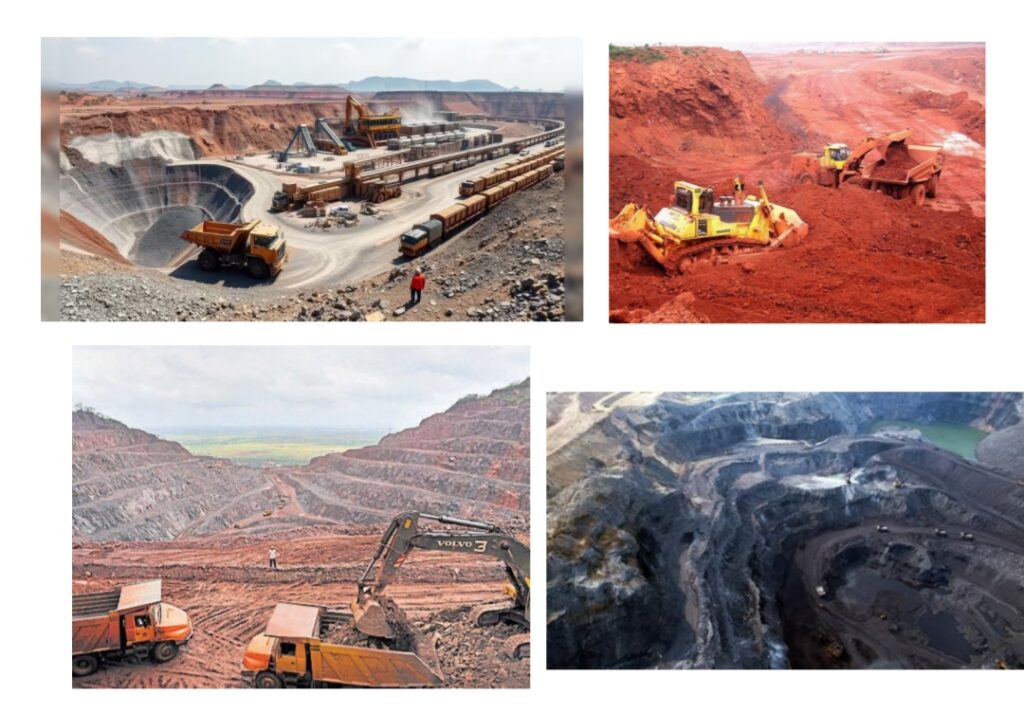
Bhubaneswar, 2MAY2026 , India has apparently lost about three lakh crore in mining revenue in the last 10 years due to the invisible leakages in the ongoing e-auction of mines across the country.
Earlier to that between 2005 and 2015, estimates suggest a notional loss of ₹5 Lakh Crore to ₹10 Lakh Crore on current prices due to a lack of competitive price discovery.
Despite holding over 80 billion tons of untapped reserves, the sector remained shackled by the “First-Come-First-Served” (FCFS) regime till 2015. Under FCFS, mineral allocation was discretionary, opaque, and fiscally stagnant. The state was capturing only basic royalties, while the true economic rent was being diverted elsewhere.
After Narendra Modi took over the reins of power in 2014, things started moving and the 2015 Amendment to the MMDR Act (1957) notched up a paradigm shift by transforming the fiscal landscape through mandatory e-auctions.
The new e-auction system introduced the “Auction Premium”- a percentage of the mineral value paid over and above the royalty. In high-value sectors like Iron Ore in Odisha, premiums have soared to 100%–150%, in some cases even more.
“India moved from allocation inefficiency to auction efficiency—but not yet to discovery efficiency,” observes Dr. Nirmal Kumar Senapati, a natural resource upstream industry veteran (geoscientist and researcher). “The 2015 reforms gave the State a bigger pie, but nearly 30% of that pie is still being lost to sophisticated reporting fraud “TheGrade-Slippage: The Invisible Leak.”
The apparent success of the auction regime has created a dangerous sense of complacency. While the State is pleased to receive ₹1,000 today compared to ₹200 in the FCFS era, it ignores the fact that based on actual volume and grade, it should be receiving ₹1,400.
A critical performance audit by the CAG (Comptroller and Auditor General) on Odisha’s minerals highlights a disturbing trend: While Pre-Auction, 83% of production was reported as high-grade (62-65% Fe), Post-Auction (2020-22), it crashed to 16%, when low-grade ore (below 60% Fe) jumped from 11% to over 60% of total production respectively.
The Table below clearly exposes the revenue leakages.
| Leakage Type | CAGEstimatedLoss(Odisha) | DataPeriod |
| Grade Manipulation | ₹4,162.77Crore | 2020–2022(6keymines) |
| ExcessVolume | ₹3,618.50Crore | Post-Auction Cycle |
| EC/StatutoryViolations | ₹1,699.05Crore | 2015–2022 |
| TOTALSHADOWLOSS | ₹9,480.32 Crore+ | (AggregatedCAG Findings) |
A top former mining official requesting anonymity said that the auction regime has virtually compelled the successful bidders (both merchant miners and steel producers) to misreport grades of minerals, manipulate volume and deliberately indulge in statutory violations to recoup high auction premiums.
If we apply a conservative 15–20% “Grade-Volume Gap” across the top 5 mineral- producing states (Odisha, Chhattisgarh, Rajasthan, Karnataka, Jharkhand), the estimated annual loss is staggering. Bidders are misreporting high-grade ore as “sub-grade” or “waste,” significantly lowering the royalty base. This “Grade-Bleeding,” combined with volume overloading (e.g., 12 tons dispatched on a 10-ton e-Challan), results in a ₹25,000 Crore to ₹30,000 Crore annual loss to the treasury.
The details of estimated losses are given in the table below.
NationalMineralLeakageEstimate(Post-2015)
| Component | EstimatedAnnual Loss (National) | Logic / Basis |
| GradeArbitrage | ₹15,000–₹18,000Cr | Intentionaldowngradingtolower Royalty/Premium base. |
| Volume Bleeding | ₹8,000–₹10,000Cr | Overloading&”Invisible”dispatches (unrecorded transit). |
| Associated Minerals | ₹2,000– ₹4,000Cr | Non-reportingofstrategicsecondary minerals. |
| TOTAL ESTIMATE | ₹25,000–₹32,000Cr/Year | Cumulative10-yearloss:~₹2.5-3 Lakh Crore |
While India possesses a vast and diverse geological base, a historical gap exists between our mineral wealth and its contribution to the Gross Domestic Product (GDP). India’s mining sector has hovered at a meagre 2% of GDP, a stark contrast to resource-rich peers like South Africa (6%) and Australia (10%).
To bridge the “Grade-Volume Gap,”the Modi government must move beyond the auction gavel toDigital Integrity Layers. With the Layer 1 (The IoT Layer), replacing manual reporting with IoT-enabled sensors and automated labs at the pit-head and the Layer 2 (The Blockchain Layer): Converting physical ore into Digital Mineral Tokens at the moment of extraction.
By embedding tokenization into the concession design, the state creates an immutable “Digital Passport” for every ton of ore. If a state like Odisha collects ₹50,000 Crore in revenue, plugging a mere 10% leakage through tokenization would recover ₹5,000 Crore of “Hidden Revenue” – enough to fund critical state missions in AI or infrastructure without adding a rupee of debt.
The 2015 Amendment was a job half-done. It brought transparency to who gets the mine, but not to what comes out of it. Strengthening governance through tokenization will ensure that India finally receives its due, turning our mineral reserves into a transparent, bankable, and sovereign asset.
“The treasury has its source in the mines.”Chanakya also known as Kautilya – one of the earliest known political thinkers and king makers, has said this in Arthasasthra. Minerals bring revenue to the government and the state owns all the minerals above or under the ground.
Mineral resources in India are adequately rich, widespread and are of huge varieties which provide the nation with a strong industrial base. The observation by Chanakya remains the bedrock of resource economics. In the eyes of the State, minerals are not merely raw materials; they are the sovereign wealth of the people. Tokenisation can prevent revenue leakages in real time.