

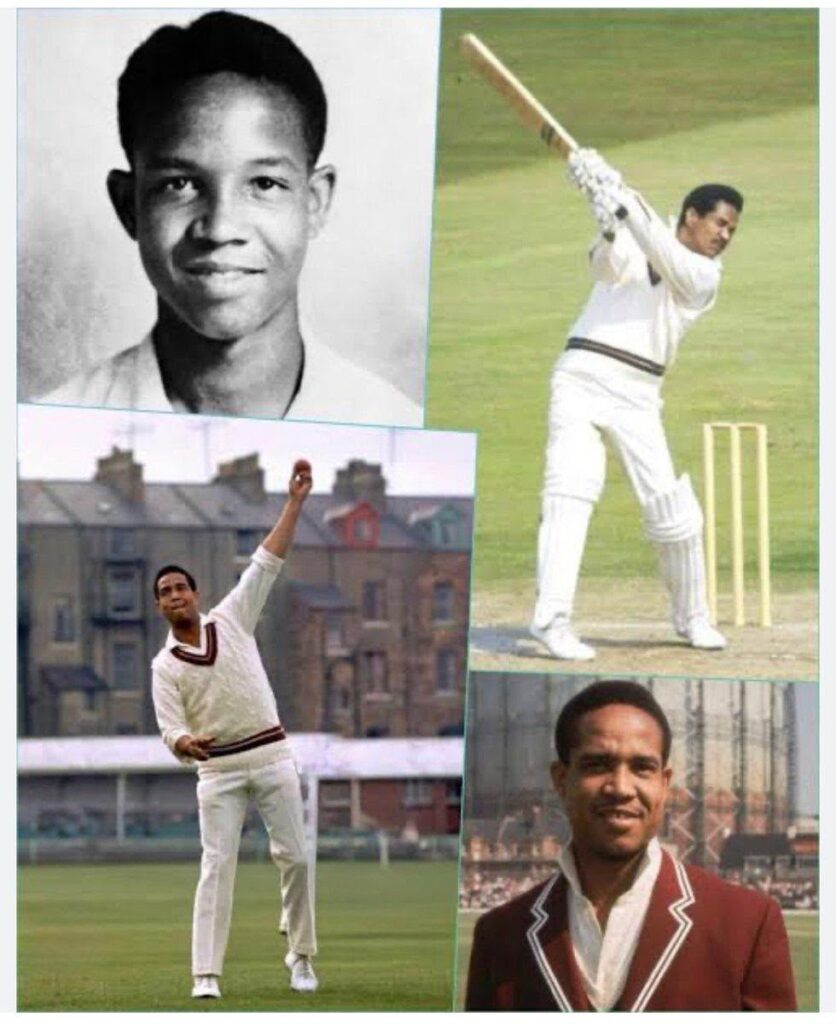
Sir Garfield Sobers (1936–2026): The Immortal All-Rounder Who Redefined Cricket
The global cricketing fraternity has fallen into a profound, reverent silence. The passing of Sir Garfield St Aubrun Sobers at his home in Barbados at the age of 89 marks the departure of the definitive titan of the sport. Widely and unequivocally celebrated as the greatest all-rounder in the history of cricket, Sir Garry was a figure who did not merely play the game—he elevated it to a high art. For two decades, spanning from the mid-1950s to the mid-1970s, his presence on the field transcended the boundaries of international sport, breathing a spectacular, localized joy into an era that was otherwise frequently characterized by defensive, slow-paced Test cricket.
To understand the magnitude of Sir Garry’s genius is to recognize a cricketer who was the ultimate multi-dimensional threat. He was not a jack-of-all-trades, but rather a master of every conceivable discipline. With the bat, he possessed a majestic, flowing strokeplay that decimated bowling attacks with consummate ease and unparalleled panache. With the ball, he was an unparalleled chameleon, capable of opening the attack with genuine, menacing left-arm fast-medium seam, and then seamlessly transitioning into slow orthodox left-arm spin or highly deceptive unorthodox wrist-spin. In the field, his predatory reflexes allowed him to pluck half-chances out of thin air from the close-in slip positions, or cover vast swathes of ground in the deep with breathtaking athletic grace. He was, as the legendary Sir Donald Bradman famously remarked, a “five-in-one cricketer,” a singular marvel who encapsulated everything beautiful about the sport.
The Architecture of a Genius
Born in the modest neighborhood of Bay Land, St. Michael, Barbados, in 1936, Sobers’ journey was forged through early adversity. Having lost his father at sea during the Second World War, he honed his supernatural skills on the hard pastures of the Caribbean using improvised equipment. His innate physical talent was apparent from childhood; born with an extra finger on each hand—which he remarkably removed himself as a boy using a sharp knife—his dexterity and hand-eye coordination were destined for legend.
When he made his international debut for the West Indies at the tender age of 17 against England in 1954, it was primarily as a bowler. Yet, his technical evolution into the finest batsman in the world remains a masterclass in sporting dedication. Sir Garry possessed an expansive backlift, a lightning-fast trigger movement, and a pull shot of devastating power that came to define the visual language of West Indian cricket dominance. For decades after his retirement, no batsman could top the ICC rankings for Test batsmen for more matches, a testament to his prolonged, unflinching excellence against the most fearsome bowling alignments of his generation.
“He was the most sublime sportsman I ever laid eyes on. He could do everything on a cricket field, and he did it with a natural elegance that money could not buy and opponents could not replicate.”
— Richie Benaud, Former Australian CaptainA Monumental Legacy in Numbers
While statistics can never truly capture the romanticism of his play, the numbers Sir Garry left behind remain staggering. At the time of his retirement in 1974, he stood as the leading run-scorer in the history of Test cricket, accumulating 8,032 runs at an astronomical average of 57.78 across 93 Test matches. His magnum opus occurred in 1958 at Sabina Park in Kingston, Jamaica, where a 21-year-old Sobers dismantled the Pakistan bowling attack to score an unbeaten 365.
That monumental innings did not just eclipse Sir Len Hutton’s long-standing all-time Test record; it was crafted with such youthful exuberance and flawlessness that it remains the highest maiden Test century ever scored in the international arena. To this day, the sheer endurance and focus required to maintain that unbeaten total over ten grueling hours stands as an iconic chapter in sporting folklore.
Memorable feats abounded: a majestic 226 against India in partnership with Frank Worrell, explosive contributions in the tied Test against Australia in 1960-61, and innings of rare beauty Down Under. Sir Donald Bradman described Sobers’ 254 for the Rest of the World against Australia in 1971 as perhaps the greatest exhibition of batting ever seen in that country.
Simultaneously, his contribution with the leather was equally historic. Sir Garry claimed 235 Test wickets, concluding his career as the second-highest wicket-taker for the West Indies at that time. His versatility meant he was a captain’s ultimate luxury, breaking partnerships when matches seemed destined for stalemates. Furthermore, his safe hands in the slips and short-leg secured 109 catches, placing him third on the all-time list of catches by fielders upon his departure from the game.
His first-class record remains staggering: more than 28,000 runs, over 1,000 wickets and hundreds of catches—a statistical monument unlikely ever to be replicated.
Six Strokes of Immortality
Beyond the international arena, Sir Garry’s exploits in domestic cricket achieved a legendary, almost mythical status. On August 31, 1968, while captaining Nottinghamshire against Glamorgan at Swansea, he achieved a feat that immortalized him in the cultural lexicon of Great Britain and beyond. Facing the left-arm spinner Malcolm Nash, Sobers unleashed an unprecedented assault, becoming the first batsman in the history of first-class cricket to hit six sixes in a single over.
The final ball of that over was hit so cleanly that it flew out of the St. Helen’s ground, landing in the adjacent roadway. Fortuitously, television cameras were present to capture the historic sequence, ensuring that future generations could witness the effortless power and fluid swing of his heavy bat. It was an exhibition of pure, unadulterated dominance that encapsulated his flair and willingness to entertain the masses.
The Spirit of Caribbean Panache
As a leader, Sir Garry inherited the mantle of West Indies captaincy following the pioneering tenure of Sir Frank Worrell. He championed a brand of cricket that rejected cynicism. His philosophy was rooted in the belief that the game must be kept alive, vibrant, and highly competitive. This ethos was perfectly mirrored in the historic 1960–61 tour of Australia, which featured the legendary Tied Test in Brisbane—a series widely credited with reviving global interest in Test cricket during a period of severe stagnation.
His sportsmanship was legendary; he famously gambled on bold declarations, preferring to risk a defeat if it meant giving the spectators a thrilling, dramatic finish. He played with a joyous, sun-drenched freedom, yet beneath that relaxed demeanour lay a fierce, brilliant cricketing intellect that commanded the absolute respect of every opponent.
In recognition of his immense contributions to national identity and global sport, Queen Elizabeth II knighted him on the turf of the Garrison Savannah in Barbados in 1975. Later, he was officially designated as one of the National Heroes of Barbados, cementing his status as a foundational pillar of his country’s heritage.
The Final Walk to the Pavilion
With the passing of Sir Garfield Sobers, the golden age of cricket loses its most radiant sun. He was a gentleman, an icon, and an artist whose canvas was the green turf of the world’s greatest stadiums. Though he has made his final walk back to the pavilion, his legacy is safely preserved in the collective memory of millions, the history books he rewrote, and the enduring spirit of the game he loved so deeply. Cricket will see many fine players in the centuries to come, but it is highly improbable that it will ever look upon the likes of Sir Garfield Sobers again. The ultimate master has rested his willow, leaving behind an eternal, unblemished legacy.

~Hasnain Naqvi is a former member of the history faculty at St. Xavier’s College, Mumbai….
The opinions expressed here are solely those of the author.

