
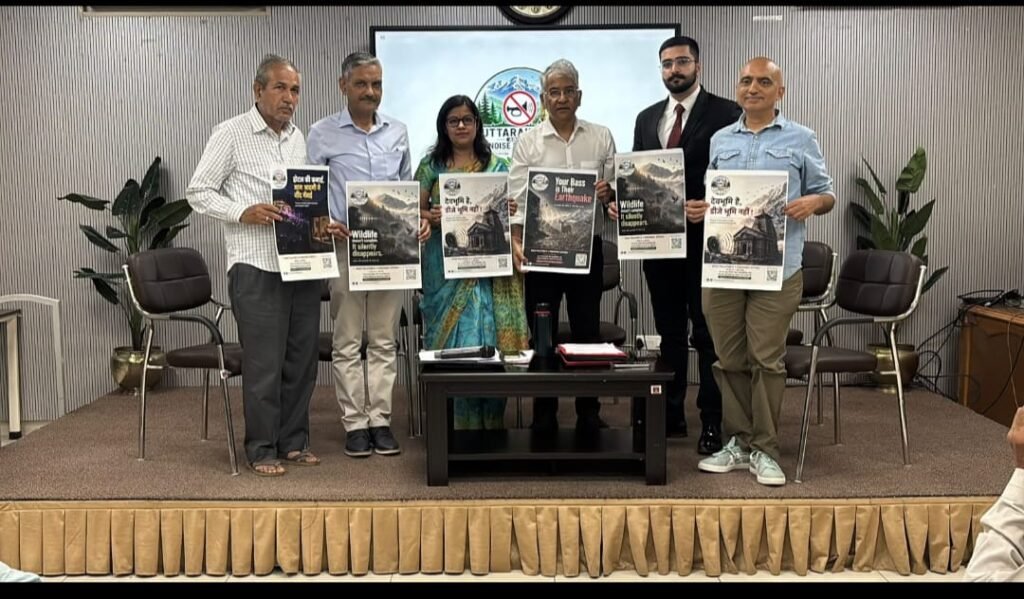
Dehradun, September 24, 2026: Around 100 citizens from different parts of Dehradun participated in a public dialogue on the growing problem of noise pollution, organised at the Doon Library and Research Centre.
The dialogue, held on the theme Noise Pollution: Know the Rules, Know Your Rights, Be Part of the Solution, was organised by Uttarakhand Against Noise Pollution in collaboration with the Doon Library and Research Centre.
Uttarakhand Against Noise Pollution is a recently formed citizens’ group working to raise awareness about noise pollution, encourage compliance with applicable regulations, promote informed citizen participation and facilitate the responsible use of available institutional and legal mechanisms.
The dialogue focused on the impact of excessive and prolonged noise on everyday life, legal provisions relating to noise pollution, citizens’ rights, the role of the police and other concerned authorities, and practical ways of lodging and pursuing complaints in cases of excessive noise.
Speakers said noise pollution was not merely a matter of inconvenience or personal discomfort. Prolonged exposure to excessive noise can affect sleep, concentration, work, mental peace and overall health. Children, the elderly, patients, pregnant women and newborns can be particularly affected by persistent loud noise. In Uttarakhand’s mountainous geography, the sound of loudspeakers, DJs and other sources of noise can travel considerable distances, affecting not only neighbouring localities but also birds and wildlife.
The programme was moderated by Kirti Ahlawat, managing editor of The Unknown India and co-founder of Uttarakhand Against Noise Pollution. Welcoming the participants, she initiated a discussion on how citizens experience noise pollution in their surroundings and what steps they had taken so far when faced with excessive noise.
Nitin Ahlawat, co-founder of Uttarakhand Against Noise Pollution and an innovation entrepreneur, spoke about the various dimensions of noise pollution and the importance of citizen participation in addressing the problem. He said controlling noise pollution could not be the responsibility of the administration or police alone. Citizens, too, have an important role to play by understanding the rules, properly documenting violations and responsibly using the available institutional mechanisms.
He clarified that the campaign was not against weddings, functions, businesses or social events. Its objective, he said, was only to ensure compliance with rules during events and commercial activities so that other citizens were not subjected to prolonged or excessive noise because of any event.
Social activist Anoop Nautiyal explained the objectives and functioning of Uttarakhand Against Noise Pollution. He said the group had been in continuous dialogue with government officials and institutions on the issue and had so far submitted around 30 representations to the Chief Minister’s Office, the Chief Secretary, the Municipal Commissioner, the Uttarakhand Pollution Control Board, as well as District Magistrates and Senior Superintendents of Police in various districts.
Uttarakhand Against Noise Pollution has also raised the issue directly with establishments in and around the Malsi area, including Taj Mussoorie Foothills, Fairfield by Marriott and Nukkad Restaurant and Bar.
Nautiyal said the objective of the group was not merely to encourage people to lodge complaints, but also to help citizens understand how to identify violations, collect appropriate evidence and present their complaints in an organised manner before the competent authorities.
Advocate Pranav Puri conducted an important session during the dialogue, explaining legal provisions relating to noise pollution and various judicial directions. He provided information on the permissible noise limits prescribed for different areas under the Noise Pollution (Regulation and Control) Rules, 2000, as well as restrictions applicable to the use of loudspeakers and sound-amplifying equipment.
He also explained the role of the police and other concerned authorities and informed participants about the procedure for contacting the 112 emergency service in cases of excessive noise. Participants were told that filing complaints in a timely manner and maintaining an appropriate record when the problem persists are important.
The speakers also discussed practical methods of documenting noise pollution. Citizens were advised to maintain a record of the date, time, location, duration and source of excessive noise. Time-stamped photographs and videos, available decibel measurements and written records of complaints can help establish a clear timeline of the problem. Wherever possible, citizens were also encouraged to join hands with other affected residents and raise the issue collectively before the concerned authorities.
Major General Atul Rawat, AVSM (Retd), spoke about the extent to which persistent noise can affect residential life. He said he had spent a considerable amount on soundproofing the windows of his house.
Vinesh Rawat expressed concern over the impact of loud music and fireworks on his young grandchildren. He said several other families in the Malsi area were also facing similar problems.
Karuna Thapliyal shared her experience of living near a homestay in the Kuthal Gate area, where persistent noise became so difficult for her that she eventually had to sell her house and move elsewhere.
Several participants shared their personal experiences, highlighting the ground-level difficulties faced by citizens living near places where loudspeakers, DJs or fireworks are used. These included event venues, religious places, restaurants, homestays and other establishments.
Residents living around Tapkeshwar Temple spoke about the repeated disturbance caused by loud music and loudspeakers. One participant recounted how an elderly person had to spend the night at a neighbour’s house because of the disturbance caused by a loudspeaker installed close to the boundary wall and operating late into the night.
The discussion highlighted that the issue was not confined to individual complaints. It was also about developing a culture of celebrating responsibly and respecting the right of others to live peacefully.
At the concluding session, Anoop Nautiyal and Nitin Ahlawat appealed to citizens to remain vigilant about excessive and unnecessary noise in their surroundings and to responsibly use the legal and institutional mechanisms available to them. Citizens were also informed about ways to join Uttarakhand Against Noise Pollution and participate in neighbourhood-level initiatives.
The organisers said that, in the next phase of the campaign, awareness programmes would be conducted in schools and colleges. The objective would be to sensitise young people about the impact of noise pollution and develop a culture of respecting the right of others to peace and a tranquil environment.
Citizens would also be encouraged to join as neighbourhood-level volunteers and collectively raise persistent noise-related problems.
The programme concluded with an open question-and-answer session, during which participants raised questions concerning permissible noise levels, the procedure for filing complaints, the role of the police and other authorities, the use of loudspeakers and available legal remedies.
Those present at the programme included Vijendra Rawat, Dr VK Dobhal, Jagdamba Prasad Maithani, Programme Officer Chandrashekhar Tiwari, Librarian DK Pandey, Dr Arun Kuksal, Ajay Sharma, Sunder Singh Bisht, Himanshu Ahuja, Jagdish Babla, Alok Sareen and Hari Om Pali, along with members of the library team, readers, researchers and citizens from different parts of Dehradun.

We are a multimedia news network. Website : www.7xnews.com Based in New Delhi (India)
Youtube : umakantlakheraspeaks@gmail.com

