

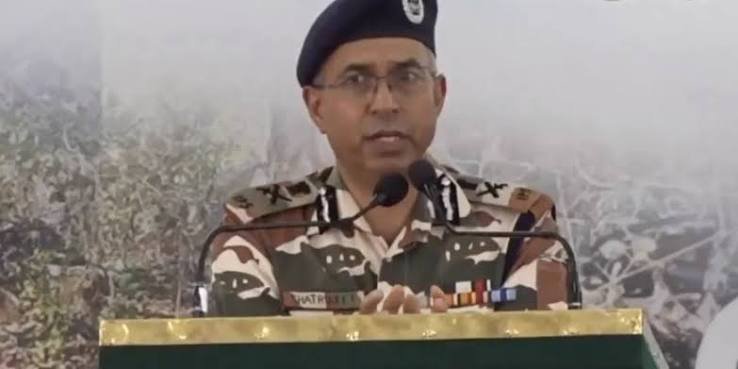
New Delhi, 23 October—After confirmation of face-offs between Indian and Chinese troops at multiple locations in Arunachal Pradesh and that the situation continuing from ITBP Director General Shatrujeet Kapur, Congress President and Leader of the Opposition in the Rajya Sabha Mallikarjun Kharge today asked Prime Minister Narendra Modi to come clean on the crisis.
Calling the developments “deeply alarming”, Kharge questioned the government over national security, economic ties with China, and the outcome of repeated diplomatic engagements between the two countries.
Kapur’s comments came over a month after India and China held talks amid reports of tensions in Arunachal Pradesh’s Taksing area. On September 6, the Corps Commander-level talks were held at the Wacha-Damai border meeting point on the Indian side to address ongoing issues along the Line of Actual Control (LAC) in the area.
Addressing ITBP personnel, known as Himveers, in Alwar on October 22, Kapoor said the force’s Shaurya Commando teams had performed exceptionally well during the confrontations.
“Recently, a situation arose in Arunachal Pradesh where a face-off occurred at several places, which is still on. There, our Shaurya Commando teams have done a tremendous job,” the ITBP chief said.
The statement comes amid reports of multiple skirmishes in Arunachal Pradesh since July, with locals claiming that confrontations had taken place at several locations. The face-offs reportedly continued even during Chinese President Xi Jinping’s visit to India for the BRICS summit in September.
Pointing out to China’s heavy investment in the People’s Liberation Army (PLA) and its media capabilities, Kapur underlined that Beijing had made advances in conventional warfare.
In the same breath, he suggested drones could act as an equaliser in the changing battlefield
Citing the prolonged Russia-Ukraine war, Kapoor said the damage inflicted by a smaller country like Ukraine on Russia over the past four years showed how warfare was evolving. He also referred to Iran as another example of the changing nature of conflict.
In response to the developments, the ITBP is aggressively altering its defensive footprint. The ITBP chief said that strike training for the entire force across units would be completed ahead of late 2027, with essential equipment made available across all forward border outposts to handle Galwan-like situations effectively. ITBP and Indian Army troops remain deployed across key flashpoints in high-altitude border areas to maintain security and defend the frontier.
He added that the ITBP was constructing reinforced underground infrastructure “in a big way” along the frontlines to withstand modern warfare contingencies.
The operational disclosures triggered immediate political reaction, with Congress general secretary Jairam Ramesh criticising the Modi’s administration’s handling of border security and trade relations.
In a post on X, Ramesh accused Modi and his establishment of maintaining a “deafening silence” on active developments along the Line of Actual Control (LAC).
In yet another jibe at the Modi government, the Congress said: “While the self-styled Vishwaguru’s calibrated concessions to China continue, the DG, ITBP, has lauded—and rightly so—its performance in recent face-offs with the PLA in Arunachal Pradesh, on which there has been a deafening silence from the PM and his establishment. Corps commander talks were held at Wacha and Damai in Arunachal Pradesh last month after the Taksing face-off. Locals had reported that patrolling points had been lost once again, as in Ladakh. China continues to rename our towns in Arunachal Pradesh and is building a 60,000-MW dam that threatens our ecological and water security,” Congress Rajya Sabha MP Jairam Ramesh said in a post on X.
.It is indeed surprising that ITBP troops have been deployed in the Union Capital to quell peaceful agitations at Jantar Mantar and other protest sites while they are urgently needed to protect our borders with China, observers said.
Veteran Journalist and Political Commentator