
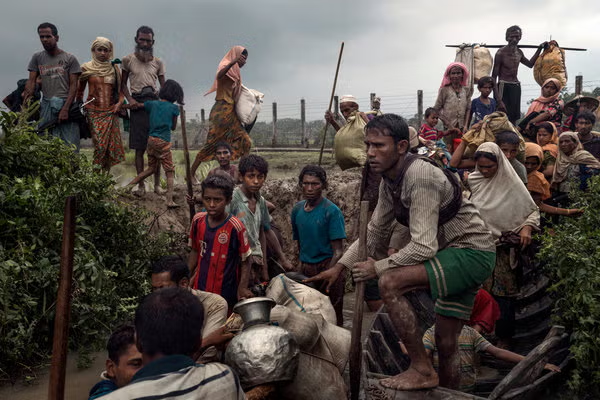
NEW DELHI: Last week the International Court of Justice ruled that a 2016-2017 campaign by Myanmar, which erased more than 400 Rohingya villages, killed at least 10,000 and involved herding women and children into buildings that were then set on fire, constituted state-sponsored genocide.
The finding sets a precedent that will reverberate far beyond the case itself — including in the case accusing Israel of genocide that is now before the same court.
Myanmar is an ethnically diverse country, and for decades, the Rohingya were just one ethnic group among many. They won parliamentary elections, formed student unions and ran businesses.
But over time, the Rohingya, who are Muslim, began facing increasing crackdowns from Myanmar’s Buddhist majority.
In 1982, while the country was under military rule, a restrictive citizenship law effectively rendered most Rohingya stateless. They had lost their freedom of movement and assembly. Their calls to prayer were silenced; many could not attend school. Some were penned in internment camps. Others suffered village burnings and other pogroms.
But it was the events of 2016 and 2017 that were the court’s focus — when Myanmar launched what the court has now called a coordinated campaign to remove the Rohingya that involved killing, raping and razing villages. It succeeded: Eventually more than a million fled to neighboring Bangladesh, where they largely remain today.
The ruling marks the first time a country has been held to account for violating the 1948 Genocide Convention. It has important implications — for international law, and for the genocide case against Israel before the same court. It’s not clear, however, that the ruling will make a major difference in the lives of the people at the center of it — the Rohingya.
The case against Myanmar revolved around the question of intent. Did Myanmar intend to destroy the Rohingya, in whole or in part, as an ethnic or religious group?
Myanmar, which has disputed the charges, argued that its actions constituted a counterterrorism operation — one aimed at Rohingya militants who had attacked its security posts.
The court, looking at a record that included attacks against children and efforts by security forces to systematically shoot at fleeing Rohingya, disagreed.
“The only reasonable inference that can explain Myanmar’s actions is an intention to destroy a substantial part of the group,” Judge Yuji Iwasawa, the president of the I.C.J., read from the ruling.
It will likely be years before the court hands down a decision on whether Israel’s actions in Gaza following the Hamas-led Oct. 7, 2023, attacks constituted a genocide, in a case brought by South Africa in 2023.
Like Myanmar, Israel has fiercely disputed the genocide charge, and argued its actions were a counterterrorism operation aimed at destroying Hamas, who they say systematically operated among Palestinian civilians. Critics have argued that the civilian deaths and overwhelming destruction in Gaza crossed moral and legal red lines.
In ruling against Myanmar, the court determined that a response to an insurgency could still be “animated by genocidal intent,” as one international law professor told Aaron. It also expanded the bounds of what could be used as evidence of genocidal intent, looking at, for example, the history of discrimination against the Rohingya — a decision dissenting judges objected to, saying it didn’t bear directly on the question of genocide. One Israeli professor told Aaron the new ruling could make Israel’s case more difficult.
For now, some in the international law community have celebrated the ruling as a sign that international justice institutions can still have relevance. But the next step, following a ruling like this, is enforcement. And how that will play out is particularly unclear.

We are a multimedia news network. Website : www.7xnews.com Based in New Delhi (India)
Youtube : umakantlakheraspeaks@gmail.com