
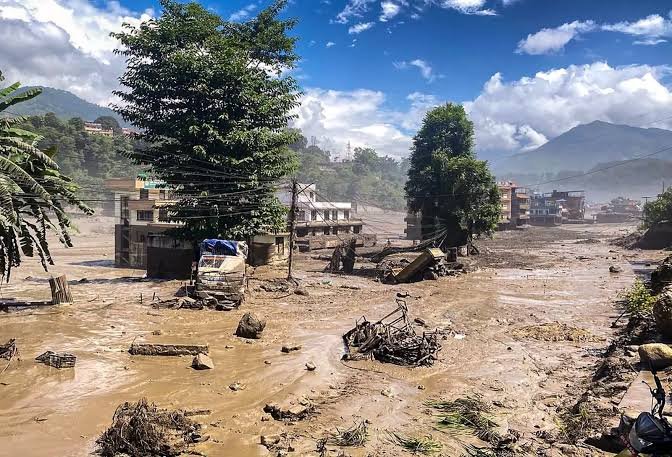
NEW DELHI: The images pouring in since last week are difficult to look away from: floodwaters racing downstream from Nepal, carrying mud, debris, destroyed homes, dead animals and, in some cases, human remains into rivers flowing through Bihar.
The devastating flash floods that struck Nepal on August 26 after a high-altitude glacial collapse have become a cross-border health concern. More than 1,000 people have died and nearly 4,500 remain missing as rescue and recovery operations continue.
The disaster did not stop at Nepal’s borders.
Floodwaters from the Trishuli River have been flowing into Bihar through the Gandak and Kosi, carrying enormous quantities of mud, debris, dead fish, animals and, in some cases, human remains downstream.
Bihar has now advised people not to catch, buy, sell or consume fish from floodwaters until conditions stabilise. The warning comes amid concerns that sewage, dead animals and other contaminants have entered the river system.
But does the presence of human remains mean Bihar is facing an outbreak of disease?
The critical factor to grasp here is that floodwater is rarely just water. It can carry sewage, faecal matter, animal waste, decomposing material, garbage, agricultural contaminants and other pathogens. When such water enters wells, hand pumps, ponds, food chains or household water-storage systems, the health consequences can extend far beyond the period when the river is visibly swollen.
Indian civilization, which has thrived around a large river system, has been aware of this for centuries; but after the Nepal flood disaster, the implications have become alarming.
As Nepal’s flood disaster begins to affect India downstream, experts NDTV Lifeline spoke to say Bihar should remain vigilant, but there is no reason for panic.
Do Bodies In Floodwater Cause Epidemics?
“Human bodies don’t usually cause large outbreaks of disease on their own. The bigger threat in a flood is the contamination of the water as a whole,” said Dr Sabine Kapasi, CEO at Enira Consulting Pvt Ltd, Founder of ROPAN Healthcare Pvt Ltd and a UN Advisor.
Dr Neha Rastogi, Senior Consultant, Infectious Diseases, Fortis Memorial Research Institute, New Delhi, says the movement of floodwater from Nepal into Bihar raises legitimate public-health concerns, but should not trigger panic.
The World Health Organization (WHO) similarly says that dead bodies from natural disasters generally do not cause epidemics. Exceptions can occur when people have died from highly infectious diseases or in settings where such infections are endemic. Bodies can, however, contaminate water with faecal material, creating a route for diarrhoeal disease if that water is subsequently consumed.
That distinction matters. Fear around bodies can overshadow the much more immediate risk: contaminated water entering people’s homes, wells, hand pumps, food chains and possibly drinking-water sources.

We are a multimedia news network. Website : www.7xnews.com Based in New Delhi (India)
Youtube : umakantlakheraspeaks@gmail.com