
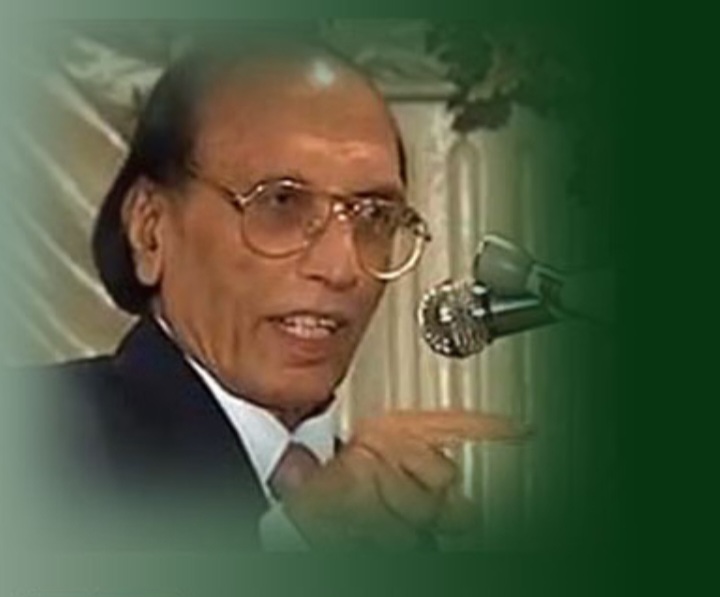
We spend our entire lives in the light of certain memories. Every time we wonder whether they are just memories or the fluttering echoes of our own life force, the poet Bashir Badr comes to mind. Yes, we must keep the light of memories with us. Otherwise, who knows in which dark alley the evening of life will come to an end? As he once said: “Ujala apni yaadon ka hamare saath rehne do” (Let the light of your memories remain with me).
On Thursday, the evening of Bashir Badr’s life also came to a close. Passing away at the age of 91, he was one of those poets who served as a bridge between the social evolution of pre- and post-independence India—a true representative of the country’s composite culture. With his demise, it must be said that an entire generation has almost gone extinct. For the past few years, it was known that he lived like a living corpse, having lost his thoughts and memories, in a state where he did not know who he was or what his poems were. True to his own lines: “Jeevan ke safar mein mujhe koi bhi na mila, hamraah to milte hain safar yaad nahi rehta” (I found no one to stand by me in life’s journey; many walk along the path, but once the journey ends, no one remembers those memories), he vanished along with his memories. And just as he had written: “Umr bhar jagne wala pada sota raha…” (The one who stayed awake all his life now lies fast asleep), he has entered an eternal sleep.
In a way, he was fortunate. He had once lamented that sometimes, it is better not to know what is happening around us: “Koi haath bhi na milayega jo gale miloge” (No one will even shake your hand if you go to embrace them). He had written long ago:
“If you go with deep affection to embrace someone, no one here will even shake your hand. This is the city of a new generation of people; keep a little distance here even when you meet.”
Today, it is not just mechanical living, but the destruction of life itself that reigns supreme. How fortunate he was not to know that the very communal hatred he fled from in Meerut to find peace in Bhopal has now spread across the entire country? He had prayed to God to grant him the strength to forget those who had completely forgotten him: “Tumhe jisne dil se bhula diya, use bhoolne ki dua karo” (Pray to forget the one who forgot you from the heart). Perhaps the Almighty took pity on him and blessed him with Alzheimer’s until his death.
The Scars of Meerut
Indeed, the mention of Bashir Badr’s name brings back memories of the Meerut communal riots. During the 1987 Meerut riots, miscreants destroyed his house and his writings. Those were the days when Bashir Badr, born in Ayodhya—the birthplace of Lord Rama—was working as a lecturer in Meerut. He had never realized that the Ram Janmabhoomi-Babri Masjid dispute would erupt in his birthplace of Ayodhya, and that very conflict would engulf Meerut, where he lived, like a wildfire. Many Hindus and Muslims lost their lives in these riots that took place in May and June of 1987. However, reports emerged that the PAC (Provincial Armed Constabulary) forces, tasked with maintaining law and order, gunned down many Muslims in the villages of Maliyana and Hashimpura in Meerut and threw them into canals. Human rights leader Balagopal was among those who submitted reports on these atrocities at the time. Nearly three decades later, in October 2018, the Delhi High Court sentenced 16 PAC personnel to life imprisonment for killing 42 people.
It was about these Meerut riots that Bashir Badr wrote:
Log toot jaate hain ek ghar banane mein Tum taras nahi khate bastiyan jalane mein (People pour their entire lives into building a single home, but you show no mercy when you burn down entire neighborhoods.)
Bashir noticed back then that if anyone spoke the truth, they were branded as rebels or anti-social elements. He depicted this reality in his ghazal, “Main bolta hoon to ilzaam hai baghavat ka.” He wrote:
“If I speak, they accuse me of rebellion; if I remain silent, a deep sense of helplessness and agony gnaws at my conscience, watching injustice happen before my eyes and being unable to do anything.”
He beautifully captured the plight of an intellectual torn between speaking the truth and enduring it silently in just two lines. He wrote that even the flow of one’s tears finds its own path, just like flowing water.
A Unique Voice in Urdu Literature
At the tender age of 12, the horrors and riots of the 1947 Partition left an indelible mark on Bashir’s mind. Writing poetry since the age of seven, Bashir’s ghazals mirrored the changing political, social, and cultural landscape. Transforming from Syed Muhammad Bashir to Bashir Badr (Bashir the Moon), he demonstrated extraordinary talent in mushairas (poetic symposiums) and poetry competitions as a student, winning numerous awards. While he was still a student at Aligarh Muslim University, some of his poems were included in the M.A. (Urdu) syllabus.
By setting aside the heavy Persian influence on ghazals and choosing a simple language easily understood by the common reader, he earned immense popularity. By introducing Hindi, Braj, and Awadhi dialects, he carved a unique niche for his ghazals among modern Urdu poets. He introduced metaphors that no one had created before. He boldly declared: “My turn is unique in the history of Urdu ghazal. My style itself is the style of the ghazal.” Fluent in Persian, Hindi, Urdu, and English, he was honored with the Sahitya Akademi Award, the Padma Shri, and hundreds of other accolades. His poetry was published in seven volumes.
Transcending traditional boundaries and refusing to be trapped in the frameworks of ideologies like progressivism or modernism, he beautifully and poetically expressed the daily experiences of the common man. He carried forward the trend in India that Faiz Ahmed Faiz had created in Pakistan. He deserves the credit for making poetry a part of the common vocabulary after Ghalib. Bashir Badr’s poems highlight the humane dimension, sensitivity, and love for freedom inherent in humans. He searched for humanity all his life. There were many occasions when he lamented that the paths they once walked together were asking, “Where is your companion (Humsafar)?” He grieved, “I searched for a human being all my life. I asked God to show me a human being in this vast universe, but I could not find one.”
In another poem, he expresses his anguish:
“There are names on houses, and big titles (designations) next to those names. But I searched extensively… and nowhere could I find a ‘human’.”
The Romantic and the Humanist
We often long to look at our loved ones to our heart’s content. We want to talk openly, and the desire to meet haunts us. He yearned: “Na jee bhar ke dekha na kuch baat ki, badi aarzoo thi mulaqaat ki” (Neither did I see you to my heart’s content, nor did we talk; I had a great desire to meet). He anxious sighed: “There are many close friends of mine in the city, but they have no news of me, and I do not know their addresses.” He grieved that despite living among hundreds of people, man is becoming lonely.
Saying “Musafir hain hum bhi musafir ho tum bhi”, Bashir reminded us that we are all travelers and will meet somewhere. He warned those chasing fame: “The peaks of fame are but momentary sights. The branch we have climbed can break at any moment.” He advised finding history in nature: “If you find free time, try to read the writings on water, because every river keeps writing a history (story) of thousands of years through its flow.”
In his poem “Udne do parindon ko abhi shokh hawa mein”, he wrote for elders who worry unnecessarily about children: “Let the birds (children) fly in this playful wind for a while, because the days of childhood, once gone, never return.”
There was also a magnificent romantic poet within Bashir Badr. Beautiful lines resonate through his ghazals:
- “You burn my heart so much, yet you look so beautiful.”
- “Place your lips upon my eyes when I sleep… only then will I believe that the heart beats even behind closed eyelids.”
- “Even when buried in a book, a lover sees nothing but the beloved’s face. That book-like face remained right before my eyes, and so, my studies went beautifully.” (Wo chehra kitabi raha saamne. Badi khoobsurat padhayi hui)
- “Love is like a fragrance (Khushboo) that always walks with us; therefore, no person is ever left truly alone, even in solitude.”
- “If you are angry, do not hide it. Only then will I get a chance to persuade you.”
A Vision of Peace and the Game of Politics
Despite being born amid communal hatred and being deeply affected by it, Bashir Badr desired nothing but friendship between people throughout his life. He said: “The journey of enmity lasts only a step or two, after that (fighting and fighting) you will get tired, and I will get tired too.” He wrote: “Pack hatred (Nafrat) into seven boxes and bury it deep in the earth; today, man desperately needs love (Mohabbat).” He counselled: “Guard the lamps (hopes) carefully in your eyes, because ahead, for a long distance, there will be nothing but darkness.”
His verses frequently find a place on the lips of politicians.
Dushmani jam kar karo lekin ye gunjaish rahe, Jab kabhi hum dost hojayen to sharminda na hona (Carry out your enmity with all your might, but leave this much room—if we ever become friends again, we should not feel ashamed to face each other.)
It is said that when the Simla Agreement was signed between India and Pakistan in 1972, Zulfikar Ali Bhutto reminded Indira Gandhi of this very couplet.
The same poem was read out in Parliament by Congress President Mallikarjun Kharge on September 6, 2018. The very next day, Prime Minister Narendra Modi also replied to Kharge using Bashir Badr’s poetry, taking a satirical jibe: “Jee bahut chahta hai sach bolne, kya karein hausla nahi hota” (The heart desperately wants to speak the truth, but what to do, the courage falls short).
After poets pass away, politicians never hesitate to shamelessly use their poetry for political gains. But when poets are alive, these very leaders trample upon their hearts. Bashir Badr did not write these lines without reason:
“Truth is heavily occupied, from politics to the judiciary. Speak lies; there is still immense love in lies!” (Sach, siyasat se adalat tak bahot masroof hai, jhooth bolo, jhooth mein ab bhi mohabbat hai bahot!)

Krishna Rao is a Delhi-based Senior Journalist and Political Analyst.