

As India marks its 79th Independence Day, the debate over the nation’s name reminds us that our greatest inheritance is not a single word but a civilisation shaped by many histories, many languages and many identities
Every Independence Day invites a nation to reflect not merely on the moment it became free, but on the ideas that continue to hold it together. As India celebrates the 79th anniversary of Independence, one debate has acquired an urgency that extends far beyond semantics: What should this country be called—India or Bharat?
The answer, history suggests, is both.
The controversy surrounding the nation’s name is not simply about language or identity. It is about competing visions of the Republic itself. One seeks to embrace India’s layered past in all its complexity; the other attempts to privilege one historical narrative over many. The irony is that the civilisation we celebrate every August 15 has never possessed a single, immutable identity. Its greatest strength has always been its remarkable capacity to absorb, adapt and evolve.
The land we inhabit has been known by many names across millennia. Among the earliest is Meluha, mentioned in Sumerian records dating to around 2350 BCE, referring to the flourishing Indus Valley civilisation that maintained extensive trade with Mesopotamia. Long before the emergence of modern nation-states, this region was already connected to the wider world through commerce, culture and ideas.
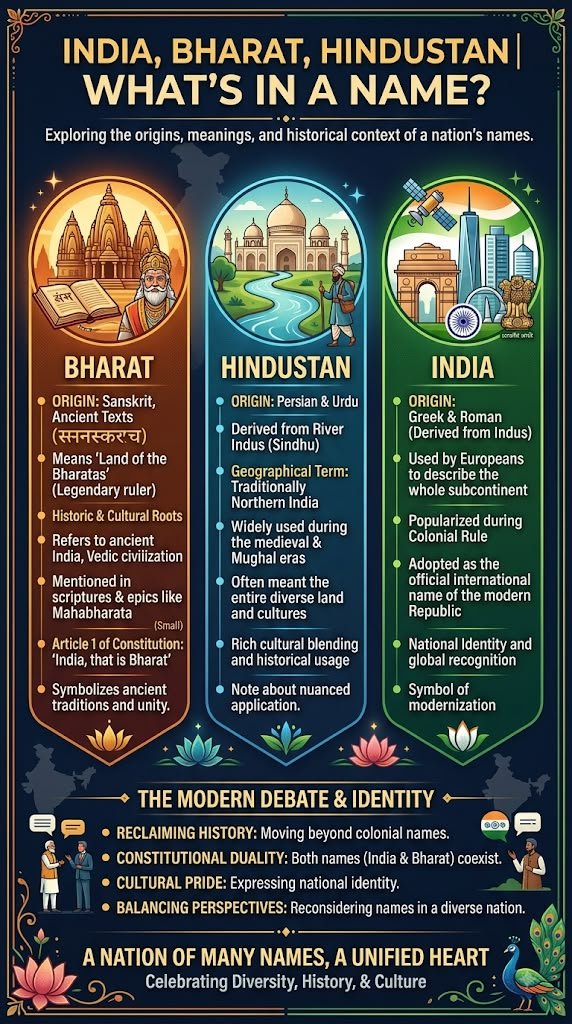
The name “India” has equally ancient foundations. It originates not from colonial invention but from geography. The mighty Sindhu River, known to the Persians as Hindu because the Persian language transformed the Sanskrit “S” into “H”, eventually became Indus in Greek. From this evolved “India”, the term used by Greek writers such as Megasthenes in his Indica and later by Roman geographers.
Far from being a colonial creation, the word “India” had entered global vocabulary nearly two millennia before the arrival of the British. Arab merchants, Persian chroniclers and Central Asian travellers referred to the region as Hind or Hindustan, while European navigators searched for the fabled “Indies”, drawn by its wealth, spices, textiles and learning. Christopher Columbus famously set sail in search of India before landing in the Americas.
By the time the English East India Company received its royal charter in 1600, the name “India” had already acquired worldwide recognition. The British inherited it; they did not invent it.
The story of Bharat is equally significant, though fundamentally different.
The name derives from the legendary Emperor Bharata, celebrated in the Mahabharata and in Kalidasa’s Abhijñānaśākuntalam as the son of Dushyanta and Shakuntala. Over centuries, Bharat Varsha acquired immense cultural and civilisational significance within Sanskrit literature and later Hindu philosophical traditions.
Yet historical evidence suggests that its use as the name of the entire subcontinent was limited. Apart from references such as the Hathigumpha inscription of King Kharavela and literary traditions, ancient administrative and geographical records rarely employed Bharat as a comprehensive political designation. The grammarian Panini referred to the Bharatas as a particular people rather than the inhabitants of the entire subcontinent.
This should not diminish Bharat’s cultural importance. Rather, it reminds us that literary imagination and historical geography often travel different paths. One belongs to the realm of civilisational memory; the other to documented political history.
For much of the medieval period, another name flourished: Hindustan.
Popularised under the Delhi Sultanate and the Mughal Empire, Hindustan combined the Persian word Hind with the suffix -stan, meaning “land”. Contrary to modern political interpretations, the term was primarily geographical rather than theological. It described the lands beyond the Indus, particularly the northern plains, and gradually came to denote much of the subcontinent in Persian, Arabic and Turkic writings.
Travellers including Al-Biruni, Ibn Battuta, Marco Polo, François Bernier, Jean-Baptiste Tavernier and Niccolao Manucci used Hind, Hindustan or India almost interchangeably, reflecting the linguistic diversity through which outsiders understood the region.
The truth is that for most of history, there existed no single political entity stretching seamlessly from Kashmir to Kanyakumari or from Gujarat to Assam. The subcontinent consisted of powerful kingdoms, republics and empires—Cholas, Cheras, Pandyas, Pallavas, Satavahanas, Chalukyas, Rashtrakutas, Palas, Kamrupas and countless others—bound less by political unity than by networks of trade, pilgrimage, scholarship and cultural exchange.
The framers of the Constitution understood this history better than many contemporary politicians.
When the Constituent Assembly debated the name of the newly independent nation, members expressed strong preferences for India, Bharat and Hindustan. Instead of allowing one historical tradition to erase the others, they crafted one of the Constitution’s most elegant compromises.
Article 1 declares: “India, that is Bharat, shall be a Union of States.”
Those six words encapsulate the philosophical genius of the Republic. They reject exclusivity. They acknowledge multiple inheritances. They recognise that a civilisation as old and diverse as ours cannot be reduced to a single historical narrative.
That constitutional formulation was not a reluctant compromise; it was a profound affirmation of pluralism.
Today, however, the growing demand to discard “India” altogether in favour of “Bharat” risks converting history into ideology. The argument that India is merely a colonial label ignores centuries of pre-colonial usage across Greek, Persian, Arab and European sources. Equally, portraying Bharat as the sole authentic expression of national identity overlooks the extraordinary diversity that has always defined this civilisation.
The question is not whether Bharat is legitimate. It unquestionably is. The question is whether any one name should be elevated at the expense of another in a country whose constitutional identity deliberately accommodates both.
Names are never merely linguistic markers. They embody memory, belonging and power. To privilege one historical strand while marginalising others is to simplify a past that has always been gloriously complicated.
India belongs equally to the Vedic tradition and the Buddhist sanghas; to Ashoka and Akbar; to Basava and Kabir; to Guru Nanak and Ambedkar; to Sangam poets and Sufi saints; to Tamil, Kashmiri, Assamese, Marathi, Bengali, Manipuri, Malayalam, Kannada, Odia, Punjabi, Telugu, Gujarati, Urdu and dozens of other linguistic traditions. No single narrative, however ancient or emotionally resonant, can fully encompass this inheritance.
The Republic derives its strength not from historical uniformity but from constitutional plurality.
As the Tricolour rises this Independence Day, the enduring lesson of our history is that India has never been diminished by possessing many names. On the contrary, its greatness lies precisely in its ability to contain multiple memories without demanding that one erase another.
Our national identity was not forged by purity but by encounter; not by exclusion but by accommodation; not by a single civilisation speaking in one voice but by countless communities contributing to a shared inheritance.
The names India, Bharat and Hindustan are not rivals competing for legitimacy. They are successive chapters in the long story of a civilisation that has continually reinvented itself while remaining unmistakably its own.
The challenge before us is therefore not to rename the nation but to remain faithful to the constitutional imagination that gave equal dignity to its many histories. For nations, like people, are remembered not for the names they choose, but for the values they uphold.

~Hasnain Naqvi is a former member of the history faculty at St. Xavier’s College, Mumbai….
The opinions expressed here are solely those of the author.

