

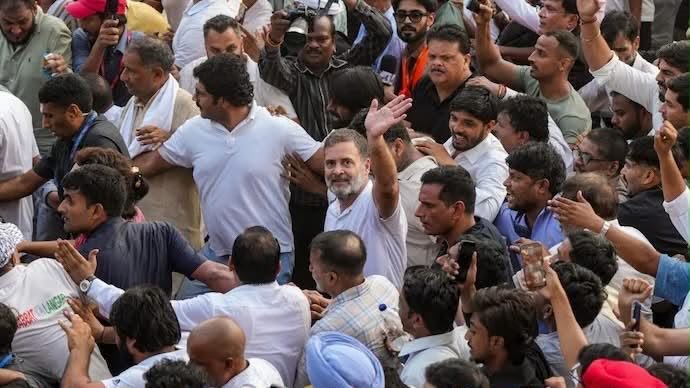
Central Delhi transformed into a sprawling canvas of political resistance on 12 October 2026 as thousands of opposition supporters, citizens, and youth activists flooded the streets, marching decisively toward the Supreme Court. Led by the Leader of the Opposition in the Lok Sabha, Rahul Gandhi, along with senior leaders of the INDIA bloc, the “Chalo Dilli – March for Democracy” effectively disrupted the capital’s high-security corridors. The historic street mobilization immediately followed a high-voltage press conference-cum-presentation titled “India is Marching”, where Gandhi laid bare what the opposition characterizes as a systematic and unprecedented compromise of India’s electoral integrity.
The day’s events marked a critical escalation in a week-long standoff between the political opposition and federal authorities. By shifting the battleground from designated protest zones directly to the doorsteps of the highest judiciary, the opposition alliance has injected immense momentum into ongoing nationwide protests. The massive show of strength has altered the political narrative, posing a formidable challenge to the federal government and the leadership of the Election Commission of India.
The Presentation: Deconstructing ‘Vote Chori’
The day commenced at a tightly packed media briefing hall in central Delhi, where Rahul Gandhi delivered his comprehensive presentation, “India is Marching”. Flanked by Congress President Mallikarjun Kharge and senior alliance leaders, Gandhi utilized digital slides, comparative data, and specific administrative findings to present a granular case of what he termed vote chori (vote theft).
At the centre of the presentation was the controversial Special Intensive Revision (SIR) of electoral rolls. Holding a copy of the Indian Constitution, Gandhi detailed the sweeping revisions to the nation’s voter lists, asserting that millions of names had been arbitrarily scrubbed from the rolls in a politically motivated purge targeting critics of the ruling dispensation. The presentation prominently featured explosive details regarding internal institutional friction, referencing documented objections raised by sitting Election Commissioners against decisions on electoral-roll revisions over a ten-month period.
Gandhi focused heavily on the structural changes brought about by the federal government’s legislative overhaul, particularly the exclusion of the Chief Justice of India from the selection committee responsible for appointing the Chief Election Commissioner (CEC) and other Election Commissioners. He argued that this structural shift dismantled the essential institutional checks and balances necessary for a neutral election umpire, directly resulting in an electoral database vulnerable to partisan manipulation.
The presentation also incorporated data from various states, pointing out glaring inconsistencies where hundreds of thousands of voters found their names unrecorded or permanently expunged under the guise of relocation, absence, or duplicate entries. Gandhi concluded the presentation by reiterating the core demands of the INDIA bloc:
- An immediate halt to the ongoing Special Intensive Revision (SIR) process.
- The immediate resignation of Chief Election Commissioner Gyanesh Kumar.
- An independent audit of the electoral databases by a judicial committee.
- The suspension of Electronic Voting Machines (EVMs) in favor of a return to paper ballots to restore absolute transparency.
“Shiva’s Tandav” and the Call to Action
Addressing the media after the digital presentation, Rahul Gandhi delivered a fiery rhetorical address that framed the escalating protests not as a curated political campaign, but as a spontaneous, decentralised organic movement. Characterizing the nationwide unrest as Lord Shiva’s Tandav, Gandhi asserted that the democratic movement requires no fixed, rigid plan.
He emphasized the inclusive nature of the street agitation, stating that the political choreography of the movement belongs to the people of India and that anyone wishing to protect the democratic fabric of the nation is welcome to join. Gandhi further claimed that serious questions are being raised internally within national security agencies regarding the starkly unequal treatment meted out to peaceful student protesters compared to members of ruling-party-aligned organizations.
The Leader of the Opposition issued a direct challenge to the Chief Election Commissioner, declaring that the alliance would not let the issue rest and would exhaust every constitutional avenue to enforce administrative accountability. This statement set a defiant, uncompromising tone for the street march that immediately followed.
A Sea of Flags: The Barakhamba Junction Convergence
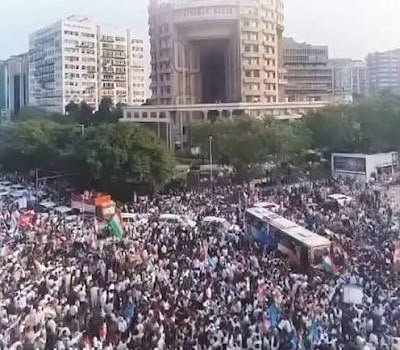
By mid-afternoon, the theoretical arguments of the presentation materialized into a massive human wave on the streets of the capital. The designated assembly point at the Connaught Place–Barakhamba Road junction became an epicenter of unprecedented political mobilization. Breaking through days of strict lockdowns, section restrictions, and preventive detentions, a vast multitude of opposition workers, youth groups, civil society members, and ordinary citizens converged in central Delhi.
The visual scale of the protest was immense. Thousands of demonstrators marched shoulder-to-shoulder, waving the distinct flags of various alliance partners. In a striking display of defiance that quickly captured public attention on social media platforms, scores of young protesters climbed atop the iconic orange public transit buses, waving flags and raising slogans against the Election Commission.
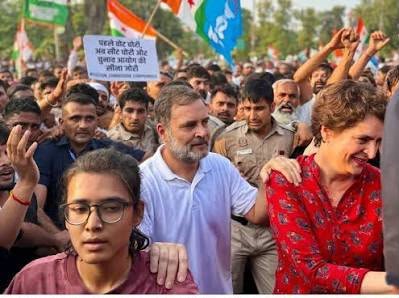
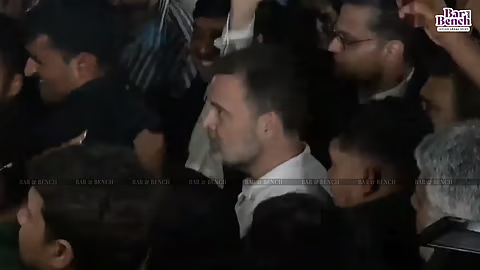
The march was led from the front by a unified line of top-tier leaders. Rahul Gandhi was flanked by his sister and Congress leader Priyanka Gandhi Vadra, left-wing student activist Neha Bora, and prominent regional leaders including Rashtriya Janata Dal leader Tejashwi Yadav, Samajwadi Party MP Dharmendra Yadav, Congress leader Gaurav Gogoi, and Karnataka Deputy Chief Minister D.K. Shivakumar. This powerful display of physical solidarity successfully projected a highly cohesive, unified front against the ruling Bharatiya Janata Party.
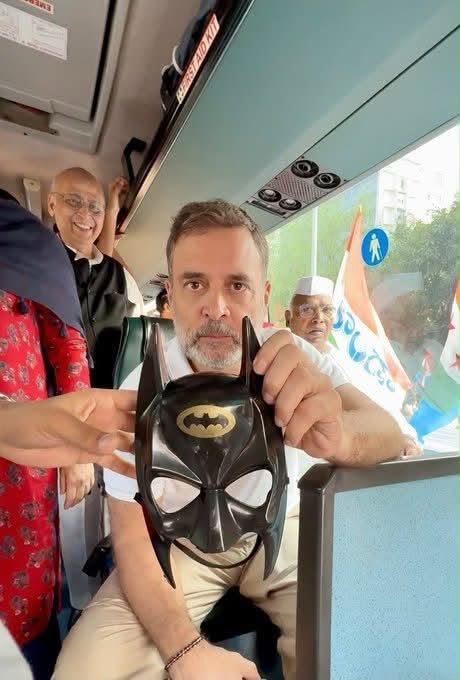
A touch of political theatre added colour to the high-stakes march. In a nod to a recurring popular narrative painting him as a silent guardian of democratic institutional rights, Rahul Gandhi was seen posing with a superhero mask. In a moment of lighthearted camaraderie amidst the tense atmosphere, Gandhi helped Mallikarjun Kharge try on the mask as well, creating visual content that instantly went viral across digital networks and served as a powerful visual anchor for the youth wings leading the street agitation.
Showdown at the Barricades
As the massive column of protesters pressed forward from Barakhamba Road toward the Supreme Court, they encountered a formidable multi-tiered security apparatus deployed by the Delhi Police. Authorities had fortified central Delhi with thousands of heavily armed personnel dressed in riot gear, backed by massive metal barricades, water cannons, and wire fencing.
The administration had also enforced sweeping preventive measures, temporarily closing entry and exit gates at six vital Delhi Metro stations—including Patel Chowk, Janpath, Rajiv Chowk, Mandi House, Central Secretariat, and Barakhamba Road. These closures aimed to choke the supply lines of arriving demonstrators.
Despite these intense measures, the sheer volume of the crowd completely overwhelmed the initial security cordons. The marchers breached the first heavy layer of police barricades near the Bhagwan Das Road stretch, approximately 600 meters ahead of the Supreme Court complex. As passionate workers tried to climb the second line of defense, a tense standoff ensued.
Demonstrators raised resounding chants of “Vote chor, gaddi chhod” and “Democracy not for sale,” matching the aggressive posturing of the security forces. However, the leadership ensured that the demonstration maintained a strictly peaceful posture, avoiding direct physical clashes while demonstrating an undeniable capability to bypass heavily fortified blockades through sheer numbers.
The Judicial Pivot: Moving the Supreme Court Registry
While the streets of central Delhi vibrated with sloganeering, the political battle took a decisive, formal turn toward the judiciary. A prominent legal team representing the INDIA bloc successfully filed a comprehensive writ petition directly before the Supreme Court. The joint petition, filed on behalf of key leaders including Rahul Gandhi, Mallikarjun Kharge, Akhilesh Yadav, Tejashwi Yadav, and Saugata Roy, legally institutionalized the very grievances highlighted in the morning presentation.
The submission of the petition followed an administrative development on the judicial front. Ahead of the march, the opposition had formally requested a personal audience with Chief Justice Surya Kant to submit a memorandum outlining their grievances. The Chief Justice declined the request for an administrative meeting, clarifying that the court could not intervene in matters concerning state governance or electoral procedures via its administrative side, particularly since related electoral disputes were already sub judice. The Chief Justice explicitly stated that the doors of the highest court remain fully open to any litigant approaching the institution through the proper, formal judicial channel.
Taking the cue, the alliance’s legal team approached the Supreme Court Registry. Given the extraordinary nature of the public unrest, the registry was instructed to process the petition immediately, directing the rectification of any procedural defects on the same day so that the matter could be formally listed for an urgent hearing. A bench led by Justice Surya Kant is scheduled to take up the matter for a special hearing on Tuesday, elevating the political battle into a critical constitutional showdown.
The filed petition seeks several critical interventions from the apex court:
- An immediate judicial freeze or halt on the Special Intensive Revision (SIR) process across all affected states.
- The constitution of an independent audit committee, headed by a retired Supreme Court judge, to scrutinize the electoral databases and verify the validity of recent voter deletions.
- A thorough investigation into alleged administrative irregularities within the Election Commission of India.
- Judicial guidelines protecting the fundamental right of citizens to hold peaceful democratic protests without facing blanket administrative lockouts or arbitrary physical crackdowns.
Escalating Ramifications on the National Protest Landscape
The events of 12 October have sent immediate shockwaves across the political landscape, completely re-energizing and altering the dynamics of the ongoing anti-CEC protests. Observers note that by combining a data-driven, analytical presentation with an aggressive, massive display of street power, the opposition has successfully transitioned a localized political dispute into a broad-based, constitutional civil rights movement.
The march has effectively decentralized the agitation, providing a clear blueprint for regional state units to mimic. The strategy of bypassing designated protest venues—such as Jantar Mantar, which had been selectively denotified by authorities—and marching directly toward critical state symbols has heavily pressured regional administrations. Parallel protests have already begun expanding across other major metropolitan centers, with prominent public locations like Mumbai’s Shivaji Park witnessing a surge in solidarity occupations by allied youth and student groups.
Furthermore, the scale of the Delhi march has forced the ruling establishment to adopt a defensive posture. While senior federal ministers have publicly dismissed the march as “pure theatrics” born out of structural frustration over past electoral losses, the visible deployment of thousands of security personnel and the unprecedented shutdown of vital transit infrastructure demonstrate that the administration views the growing movement with immense concern.
By securing an expedited, next-day hearing before the Supreme Court, the INDIA bloc has ensured that the issue of electoral integrity will remain at the absolute vanguard of national consciousness. Whether the apex court grants an interim freeze on the voter list revisions or sets strict parameters for database verification, the opposition has successfully demonstrated that it can command the streets of the nation’s capital.
The “India is Marching” campaign has effectively broken the inertia of past political setbacks, crafting a potent narrative of resistance that bridges the gap between digital data presentation and raw, democratic street power. As the nation awaits the Supreme Court’s crucial observations, one reality remains clear on the ground: the momentum of the ongoing protests has been fundamentally transformed, and the political cost of ignoring the street has risen exponentially for the ruling establishment.

~Hasnain Naqvi is a former member of the history faculty at St. Xavier’s College, Mumbai….
The opinions expressed here are solely those of the author.