

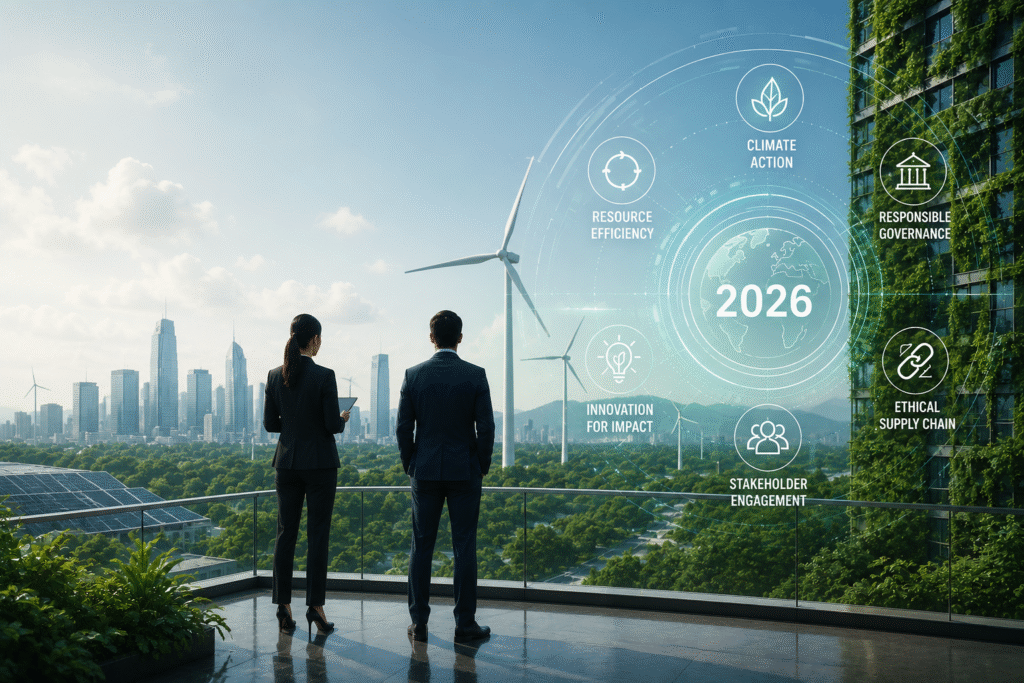
A new era of corporate sustainability is emerging, with a focus on operational execution, infrastructure, and the organizational authority to build both. It is far harder than the old days of voluntary commitments, aspirational targets, and PR strategies. Corporate sustainability leaders across industries are increasingly engaged in hands-on implementation work, while goal setting and corporate communications seem to take a back seat. As sustainability goal calculations have changed, companies have shifted their focus to operational efficiency and cost savings. The looming energy crisis—an obvious result of the American invasion of Iran—threatens to drive up prices for all commodities in the market.
Charlotte Hu, in a compelling Time article dated July 6, 2026, drew attention to the top 20 of the world’s most sustainable companies, starting with Schneider Electric of France, which scored 97.6, down to Tech Mahindra in 20th place with 88.6 percent. To assess which corporations prioritize sustainability in their business practices, Time and data firm Statista partnered on the third annual edition of the World’s Most Sustainable Companies to rank 750 of the world’s largest and most influential firms based on their transparency, accountability, and environmental impact. Pragmatism is coming to the sustainability agenda, both for corporate standard-setters and policymakers. Maria Mendiluce, CEO of the We Mean Business Coalition, believes that many companies are still carrying out their long-term commitments because they realize that climate change and biodiversity loss pose serious threats to business.
Corporate sustainability leaders—whether they work in finance, manufacturing, logistics, real estate, or consumer goods—are intensifying their hands-on work. They seem to focus less on what they intend to do and more on how to do it. For instance, they are now grappling with more concrete issues, such as: Which battery storage configuration is needed for our footprint? How do we get procurement and engineering to agree on AI governance? Where does circularity sit in the organizational chart when it stops being a pilot and starts being a regulatory requirement?
The UN Global Compact Strategy 2026–2030 provides a bold, actionable plan for transformation. Businesses everywhere must seize these opportunities and deliver for people and the planet. Sustainability is a direct driver of competitiveness: 82 percent of companies gain direct economic benefits from decarbonization efforts, with average returns exceeding $221 million per company, and 88 percent identify sustainability as key to generating future value.
Three forces are driving this shift: AI, energy demand, and circularity compliance.
The AI boom is behind the explosion in data center energy consumption, as well as significant investment in new ways to fuel it—grid hardware, energy management software, batteries, and next-generation geothermal. While this energy demand is a complicated variable for companies that spent years building science-based targets, it is spurring unprecedented financial support. Think AI-assisted life-cycle assessment, automated Scope 3 data collection, satellite-based deforestation monitoring, and investor-grade disclosure analysis. At Okta, a cybersecurity company, a team of sustainability, engineering, technology, and global operations staffers is rolling out AI tools that show which models—for tasks like writing, coding, or analysis—are most energy efficient. Alison Colwell, Okta’s Senior Director of Sustainability and Responsibility Technology, states, “The cross-functional team treats sustainability criteria as a design input for technology rather than a reporting obligation attached afterward.”
On the investor side, financial giants like Goldman Sachs and sustainable investment specialists like Parnassus Investments are using AI to surface material risks buried within mandatory filings and voluntary ESG reports at a scale and level of rigor that was previously impossible. By leveraging AI and advanced data analytics, investors can now dissect massive volumes of unstructured data to identify patterns, sentiments, and material risks embedded in corporate communications.
In many markets, renewable energy has become attractive because it is the fastest available path to new capacity. The C-suite is currently making decisions about battery storage, distributed energy resources, power purchase agreements, and on-site generation based on speed-to-power logic as much as emissions logic, because grid interconnection timelines stretch three years or more in many regions. Maersk and Bloom Energy are turning to microgrids, distributed generation, and flexible on-site infrastructure as faster alternatives.
Circularity has become a regulatory reality rather than a voluntary philosophy. Extended Producer Responsibility (EPR) legislation in the U.S. has arrived faster than most corporate sustainability teams anticipated. The focus has shifted to harder operational questions, such as: How do you build a circular fiber supply chain at scale? How do you synchronize supply and demand for recovered electronics? How do you operationalize reverse logistics so that the cost of collecting, storing, and reprocessing materials does not exceed the value recovered?
Data center hardware offers a window into how this is unfolding. iFixit, a longtime advocate for right-to-repair policy, is extending the useful life of devices through open-source repair guides that keep hardware in service longer. Molg is building robotic microfactories to disassemble servers that have reached their “end of life” into components, recovering far more value than conventional recycling allows. Rob Lawson-Shanks, Molg’s CEO, is reported to have said, “We are energized by this generational moment and are converging into a massive opportunity to reshape circular infrastructure and eventually scale it beyond data centers to all electronics.”
In short, sustainability today represents an opportunity to innovate, access financing, and strengthen corporate competitiveness. Companies like Schneider Electric, which provides decarbonization solutions, and luxury clothing brand Moncler, which focuses on recycling, are among the global players interested in acting with a strategic vision that will not only meet regulatory requirements but also lead the transformation toward a more resilient and prosperous future.

The writer holds a Master’s in Public Administration–Environmental Science and Policy from Columbia University, New York.

