
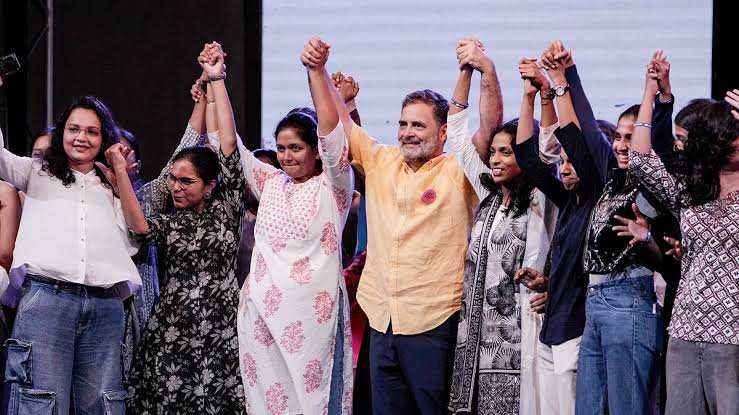
(Photo) Courtesy : National Herald
In a carefully calibrated political foray into Maharashtra top Congress leader and Leader of the Opposition Rahul Gandhi appears to have struck a chord with three critical constituencies- middle-class families, young voters and women. while simultaneously injecting fresh energy into his party and the broader INDIA alliance in the state. His recent engagements in Pune, a city steeped in the legacy of social reformers, have generated significant buzz, leaving the ruling BJP visibly unsettled and prompting an unsuccessful attempt at a cultural counter-narrative.
At the heart of Gandhi’s message was a pointed rejection of patriarchal interpretations drawn from ancient texts. Quoting a verse from the Manusmriti that declares a woman must never be independent, Gandhi offered a sharp contemporary rebuttal: “I believe that women should be independent. You may have a relationship with your father, brother, husband or son, but you do not belong to them. You belong to yourself.” The statement, delivered with characteristic directness, resonated strongly in a city that takes pride in its progressive heritage. Pune is, after all, the land of Mahatma Jyotiba Phule and Savitribai Phule,the pioneering couple who opened India’s first school for girls in 1848 and challenged the rigid social hierarchies of their time. By invoking this history while speaking to the “fairer sex” and Gen-Z audiences, Gandhi positioned himself as an heir to that reformist tradition rather than a distant Delhi politician.
The response on the ground has been notable. Welcome banners lining several Pune streets hailed Rahul Gandhi as “the next Prime Minister of India.” Interestingly, these were not the work of the Congress organisation alone. Reports indicate that many of the banners were put up by Rohit Pawar, the young MLA and grand-nephew of NCP (Sharad Pawar) chief Sharad Pawar. The gesture has fuelled speculation that a sizeable section of the NCP, already navigating complex alliance equations in Maharashtra, may be tilting towards closer cooperation with the Congress. In a state where the INDIA bloc’s cohesion has often been tested by competing ambitions, such public signals from a prominent Pawar family member carry symbolic weight.
Rahul Gandhi’s focus on Gen-Z and women is not accidental. Maharashtra’s urban youth, particularly in Pune’s colleges and IT corridors, have grown increasingly vocal about issues of employment, education quality and gender safety. By addressing them directly and framing women’s autonomy in unequivocal terms, Gandhi has attempted to expand the Congress’s traditional base beyond its core supporters. Middle-class voters, long considered sceptical of the Congress in recent electoral cycles, appear to have found his emphasis on dignity, self-respect and institutional accountability appealing. Party workers and alliance partners privately acknowledge that the visit has re-energised local units that had been struggling with organisational fatigue.
The BJP’s reaction has been revealing. Faced with Gandhi’s growing traction, the ruling party organised a Vande Mataram recitation on the campus of Savitribai Phule Pune University. The choice of venue was deliberate an attempt to reclaim the reformist space and wrap the party’s response in the language of nationalism. Yet the programme failed to capture either media attention or public imagination in the manner intended. Local observers noted that the event came across as reactive rather than organic, and it did little to blunt the impact of Gandhi’s messaging on women’s independence and youth aspirations. In political terms, the episode underscored a familiar pattern: when confronted with a narrative centred on social justice and generational change, the BJP has often reached for cultural symbolism as a counter.
What makes the Pune outreach particularly significant is its layered political messaging. On one level, it is a direct appeal to demographic groups that have been decisive in recent elections. On another, it is an attempt to rewrite the Congress’s image in Maharashtra from a party associated with dynastic politics and organisational drift to one that can speak the language of reform and self-respect. The reference to Savitribai Phule was not mere rhetoric; it allowed Gandhi to root his contemporary argument for women’s autonomy in a local, historically legitimate tradition that even his opponents find difficult to dismiss.
The rumoured movement of NCP leaders towards the Congress adds another dimension. Maharashtra’s politics remains fluid, with the NCP split and the Shiv Sena factions continuing to reshape alliances. Any visible shift by Rohit Pawar or other NCP leaders would strengthen the INDIA bloc’s arithmetic ahead of future contests and simultaneously weaken the BJP’s ability to project a consolidated non-Congress alternative. While no formal announcements have been made, the public display of banners has already altered the political conversation in Pune and beyond.
Critics will argue that one successful visit does not translate into lasting electoral gains. Maharashtra’s voters have repeatedly shown themselves capable of distinguishing between rhetoric and delivery. The Congress still faces the challenge of converting enthusiasm into organisational strength and a coherent state-level narrative. Questions about leadership clarity within the INDIA alliance and the party’s ability to address everyday concerns—jobs, inflation, education—remain relevant. Yet the immediate impact of Gandhi’s Pune engagements is hard to ignore. He has succeeded in dominating the news cycle, forcing the BJP onto the defensive, and demonstrating that a message centred on women’s agency and youth aspirations can cut across traditional political fault lines.
In the broader national context, the episode fits a pattern of Gandhi’s recent outreach—focused, issue-driven, and calibrated to specific regional histories. Whether this momentum can be sustained will depend on consistent follow-up, both in Maharashtra and elsewhere. For now, however, the images from Pune are telling: streets lined with banners projecting Rahul Gandhi as a future prime minister, a pointed rejection of patriarchal orthodoxy delivered in the city of the Phules, and a BJP counter-event that struggled to find resonance. In the competitive politics of 2026, such moments matter. They signal not only a leader’s growing confidence but also the evolving preferences of constituencies that parties can no longer take for granted.
The coming months will reveal whether this Pune chapter marks a genuine shift in Maharashtra’s political balance or remains a well-executed but temporary surge. What is already clear is that Rahul Gandhi has forced his opponents to respond on terrain not of their choosing—and that, in itself, is a measure of political success.

Umakant Lakhera is a Senior Journalist and Political Commentator