

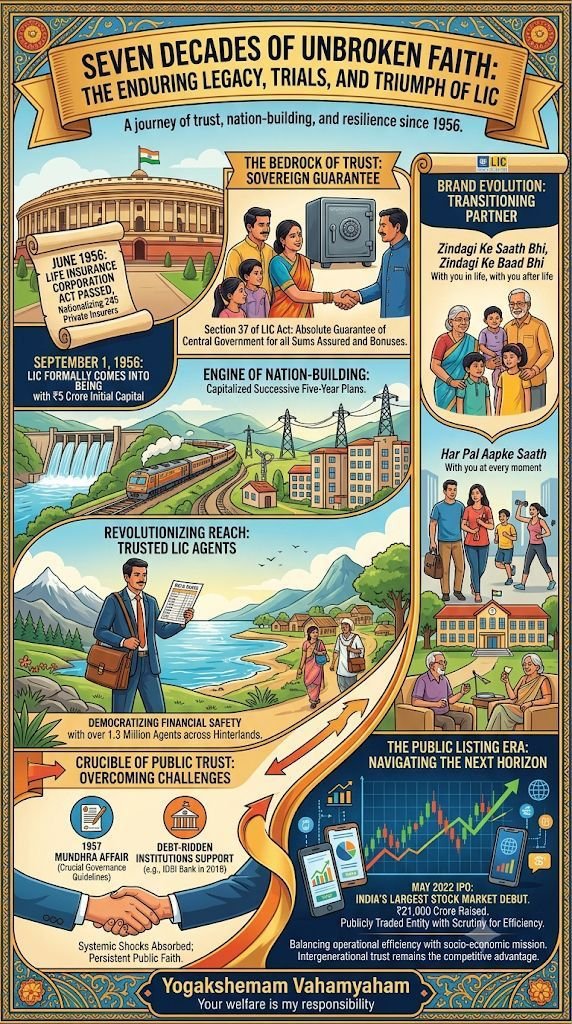
When Parliament passed the Life Insurance Corporation Act in June 1956, nationalizing 245 private insurers and provident societies, it was more than a statutory consolidation—it was an audacious social experiment in state-led financial security.
On September 1, 1956, the Life Insurance Corporation of India (LIC) formally came into being with a modest initial capital of ₹5 crore from the Government of India. Seven decades later, LIC stands as a financial titan whose assets under management rival the national budgets of several middle-income economies. Yet, the saga of LIC is not merely a story of balance-sheet expansion; it is a narrative deeply intertwined with the domestic memory of every Indian family, the infrastructure of nation-building, and the survival of public trust through political and market turbulence.
A Nation Built on Promised Futures
In post-independence India, private insurance was fragmented, urban-centric, and frequently plagued by insolvency and predatory practices. By amalgamating these disparate entities into a single state enterprise, the government sought to democratize financial safety and channel household savings directly into nation-building. Central to this enterprise was Section 37 of the LIC Act, 1956—a unique statutory provision guaranteeing that all sums assured, along with declared bonuses, carry the absolute sovereign guarantee of the Central Government. This statutory bedrock transformed insurance from an elite luxury into an indispensable household ritual.
Beyond individual policyholders, LIC served as the primary engine of India’s public sector investments. Through successive Five-Year Plans, its capital financed mega-projects in housing, rural electrification, water supply, sewage systems, and national railways. Guided by its Sanskrit motto, Yogakshemam Vahamyaham (“Your welfare is my responsibility,” drawn from Chapter 9 of the Bhagavad Gita), the corporation deployed millions of insurance agents across the country’s farthest hinterlands. From remote Himalayan hamlets to coastal fishing villages, the LIC agent—armed with a leather bag and rate chart—became a trusted fixture of Indian domestic life, translating complex actuarial calculations into a promise of intergenerational security.
Scandals, Bailouts, and the Crucible of Public Trust
Yet, LIC’s journey has hardly been an unblemished corporate fairy tale. The institution was barely two years old when it became embroiled in independent India’s first major financial controversy—the 1957 Haridas Mundhra affair. The corporation’s controversial investment of over ₹1.2 crore in fraudulent and financially distressed companies controlled by Mundhra sparked a political storm in Parliament, led by MP Feroze Gandhi. The ensuing Justice M.C. Chagla Commission inquiry exposed political interference in LIC’s investment decisions, forcing the resignation of Union Finance Minister T.T. Krishnamachari and establishing crucial governance guidelines regarding the independence of public financial institutions.
This pattern of leveraging LIC as a financial shock absorber for the state recurred across decades. Time and again, the government turned to LIC to rescue under-subscribed public sector disinvestment offerings or to stabilize troubled financial entities. The most notable intervention occurred in 2018, when LIC acquired a controlling 51% stake in the debt-ridden IDBI Bank—a move heavily debated by corporate governance experts who questioned the utilization of policyholder-backed capital to absorb stressed banking assets.
Despite these controversies, public faith in LIC remained remarkably resilient. Unlike commercial entities whose reputational damage often triggers capital flight, LIC’s unique combination of sovereign backing, consistent bonus distributions, and deep-seated grassroots relationships allowed it to absorb systemic shocks without losing its core customer base.
Navigating Competition and Brand Evolution
The most severe structural test for LIC arrived at the turn of the millennium. Following the Malhotra Committee recommendations, the Indian insurance sector was opened to private and foreign players in 2000 under the regulation of IRDAI. Industry observers predicted that nimble private entrants, backed by global insurance giants and armed with modern digital marketing, would rapidly erode LIC’s market dominance.
While private competitors captured market share in urban and high-net-worth segments, LIC demonstrated remarkable survival instincts. It leveraged its agency force—numbering over 1.3 million—and deep rural footprint to maintain leadership in traditional endowment and savings-linked plans.
This commercial resilience was accompanied by a subtle yet profound evolution in branding. For decades, the iconic slogan “Zindagi Ke Saath Bhi, Zindagi Ke Baad Bhi” (With you in life, with you after life) defined the corporate identity, emphasizing risk protection, legacy, and post-death family security. As India’s socio-economic landscape shifted toward wealth creation, active life planning, and longer life expectancy, LIC evolved its brand communication toward broader lifestyle management, encapsulated in its contemporary philosophy “Har Pal Aapke Saath” (With you at every moment). This reflected a strategic pivot: transitioning from a pure mortality safety net to a partner in health, retirement, children’s education, and long-term financial stability.
The Public Listing Era and the Next Horizon
In May 2022, LIC entered a new era when the Government of India sold a 3.5% stake in a massive Initial Public Offering (IPO), raising ₹21,000 crore and marking the largest stock market debut in Indian history. The transition from a 100% state-owned statutory entity to a publicly traded corporate entity brought unaccustomed scrutiny from equity research analysts, institutional investors, and stock exchanges.
Listing revealed the sheer scale of the titan: managing assets upwards of ₹45–50 lakh crore and holding significant equity stakes across major listed Indian enterprises. However, it also exposed structural challenges—such as lower profit margins on traditional products compared to private market unit-linked plans (ULIPs), the necessity for faster technological modernization, and post-listing stock price volatility.
As LIC navigates its seventh decade, its central challenge lies in balancing two distinct imperatives: satisfying capital market expectations for operational efficiency and return on equity, while retaining the socio-economic mission that made it a national mainstay.
In an era increasingly dominated by instant digital platforms and algorithmic underwriting, LIC’s enduring competitive advantage remains its intergenerational trust. For millions of Indian households, an LIC policy document remains far more than a financial product; it remains a sacred symbol of familial devotion—a gift of security passed down from generation to generation.

~Hasnain Naqvi is a former member of the history faculty at St. Xavier’s College, Mumbai….
The opinions expressed here are solely those of the author.