

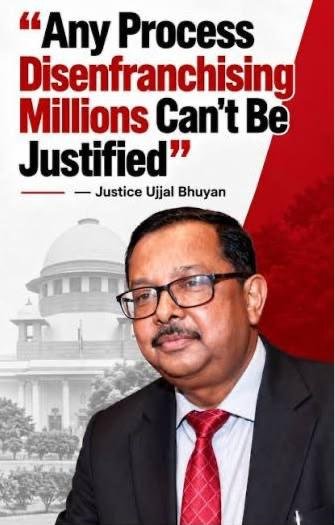
A Constitutional Alarm from the Bench
In recent days, two voices from India’s higher judiciary have cut through the administrative fog surrounding the Special Intensive Revision (SIR) of electoral rolls with uncommon clarity and urgency. Sitting Supreme Court Justice Ujjal Bhuyan and retired Supreme Court Judge Rohinton Fali Nariman have each, in separate public interventions, warned that the scale and manner of voter deletions across the country threaten the very core of India’s democratic compact. Their remarks, delivered at academic and public forums in early October 2026, frame the SIR not as a routine housekeeping exercise but as a structural crisis that risks reducing millions of citizens to “second-class” status in their own republic.
“Taking the Soul from the Body”: Justice Bhuyan on Universal Adult Suffrage
Speaking at the valedictory function of a moot court competition at NALSAR University of Law in Hyderabad, Justice Bhuyan articulated the stakes in starkly moral and constitutional terms. “Detaching an Indian citizen from the right to vote would be akin to taking out the soul from the body,” he said, invoking the foundational promise of Article 326, which mandates elections to the Lok Sabha and state assemblies on the basis of adult suffrage.
He stressed that the Constitution-makers, despite the formidable challenges of literacy, poverty, and logistical complexity at Independence, chose to vest every adult citizen with an equal vote—an “act of faith” in the collective wisdom of the people. “A billionaire and a rickshaw puller have votes of equal value,” he observed, underscoring that universal adult franchise is not a privilege but the structural scaffolding of equality under Article 14.
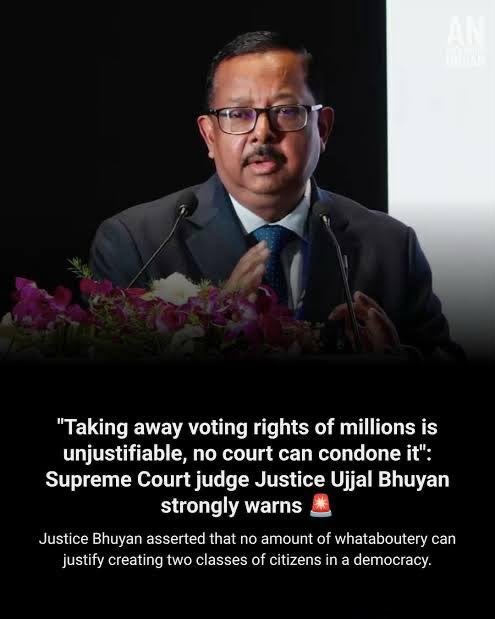
Justice Bhuyan’s most pointed warning concerned the arbitrariness of processes that strip voting rights en masse. “If any process results in disenfranchising millions and millions of Indian citizens—making them second-class citizens in their own country in the sense of being citizens without voting rights—such a process is intrinsically arbitrary,” he said. “No amount of whataboutery can justify it. It strikes at the very heart of the Constitution.”
He further underlined a basic principle of procedural justice: except in the undeniable event of a voter’s death, “the name of a voter once enlisted in the electoral roll cannot be deleted without notice and hearing.” Any departure from this, he implied, transforms a neutral administrative function into an instrument of disenfranchisement.
“An Astounding Figure”: Justice Nariman on the Peril to the Franchise
Former Supreme Court Judge Rohinton Fali Nariman, speaking at Rajkumar College in Rajkot on the theme “The Constitution and the Common Man,” echoed these concerns with equal force. He highlighted the sheer magnitude of deletions, noting that “in the West Bengal election, 90 lakh voters is an astounding figure who were disenfranchised,” and questioned why the Supreme Court had not intervened to stay the process.
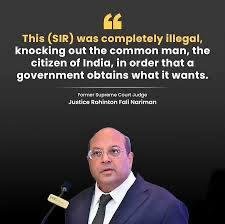
Nariman went further, linking the SIR controversy to broader anxieties about the independence and functioning of the Election Commission. “You can’t have an election commission which functions or malfunctions like this,” he said, urging the apex court to expedite its decision on the constitutional challenge to the 2023 law governing the appointment of election commissioners.
His remarks framed the SIR deletions not merely as bureaucratic overreach but as a politically consequential act. “So, you can imagine this was a completely illegal knocking out of the common man, the citizen of India, in order that a government obtains what it wants,” he said, adding that in West Bengal, the exercise “ousted the government of the day and brought in the government of the Centre.”
The SIR in Numbers: A Pattern of Mass Exclusion
The judges’ concerns are borne out by the available data. Since June 2025, the SIR has been rolled out in phases across 31 states and Union Territories, covering nearly the entire country. Official figures and independent analyses indicate that more than 13 crore names have been removed from draft rolls, with Delhi recording the highest draft-stage deletion rate at 32.78% of its electorate.
In West Bengal, total deletions reached approximately 90.8 lakh voters—about 11.9% of the electorate—including over 27 lakh electors found excludable after judicial adjudication of doubtful cases. In Bihar, the electorate declined from 7.89 crore to 7.42 crore, with about 65 lakh exclusions at the draft stage and a further 3.66 lakh deletions before the final roll.
Crucially, a Right to Information response from West Bengal reveals that 91% of appeals decided by appellate tribunals resulted in the restoration of excluded electors, suggesting that a significant proportion of deletions were erroneous or procedurally flawed.
Procedural Lawlessness and the Basic Structure Doctrine
Both judges anchored their critiques in the Basic Structure doctrine, which holds that certain features of the Constitution—such as free and fair elections—are beyond the reach of ordinary legislative or executive action. Justice Bhuyan explicitly stated: “Therefore, in my view, the right of an Indian citizen to cast his vote is central to the basic structure doctrine itself. In fact, the right of franchise is the very essence of citizenship. It is the only way an ordinary citizen of India can participate in the governance of the country.”
He added that Article 326 “cannot be tinkered with at all. No authority can do it and no court can endorse/condone it. No one is above the Constitution.”
Justice Nariman’s remarks, while less doctrinal in tone, reinforced the same principle: when the machinery tasked with safeguarding elections instead “malfunctions” to exclude millions, the basic structure itself is imperilled. His call for swift judicial resolution of the Election Commission appointment challenge reflects a deeper worry—that without institutional independence, the SIR could be weaponised to reshape electorates in favour of the ruling dispensation.
The Stakes for Indian Democracy
The interventions of Justices Bhuyan and Nariman arrive at a moment of heightened political sensitivity, with major state elections on the horizon and the SIR still underway in several regions. Their warnings are not merely legalistic; they are a reminder that the legitimacy of India’s democracy rests on the integrity of its electoral rolls. When names vanish without notice, when “logical discrepancy” or “voter mapping” becomes a pretext for mass deletion, and when appellate restoration rates suggest systemic error, the promise of “one citizen, one vote, one value” is hollowed out.
The Constitution does not contemplate two tiers of nationals: those who hold the power of the franchise and a secondary class of muted spectators. As Justice Bhuyan put it, to strip an eligible voter of their place on the electoral roll is to perform a violent separation on their civic identity. It is, in his words, akin to taking the soul from the body.
In the face of such a structural crisis, the judiciary’s role is not passive adjudication but active guardianship. The Basic Structure doctrine demands nothing less.

~Hasnain Naqvi is a former member of the history faculty at St. Xavier’s College, Mumbai….
The opinions expressed here are solely those of the author.

