

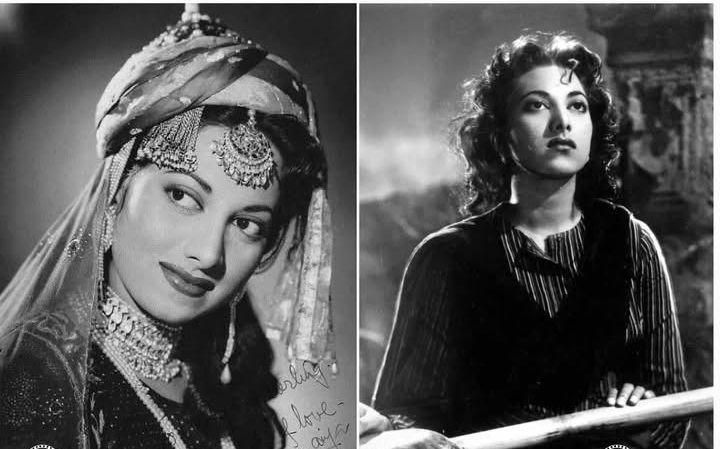
Woh paas rahen ya door rahen, nazron mein samaaye rehte hain*
(“Whether near or far, they remain forever in my sight.”)
Some stars illuminate an era; a rare few become the era itself. Suraiya belonged to that extraordinary category. Nearly seven decades after her peak and more than two decades after her passing, her voice continues to float through the corridors of memory, carrying with it the fragrance of a gentler age of Indian cinema.
Born on June 15, 1929, in Lahore, Suraiya Jamal Sheikh emerged as one of the most beloved and influential figures of Hindi cinema. Actress, singer, cultural icon, and heartthrob of a newly independent nation, she occupied a unique place in film history. She was among the last and greatest representatives of a vanished tradition—the singing star who did not merely lip-sync songs but sang them herself, infusing them with her own emotions and personality.
On her birth anniversary, it is worth remembering not merely a film star but an artist whose life mirrored both the splendour and the melancholy of Indian cinema’s golden age.
The Child Who Grew Up With Cinema
Suraiya’s journey began long before fame arrived. Her family moved from Lahore to Bombay when she was still an infant, settling in the iconic Krishna Mahal on Marine Drive. The city would become both her home and her destiny.
As a child, she participated in programmes on All India Radio alongside two youngsters who would themselves become legends—Raj Kapoor and Madan Mohan. Few could have imagined that these children singing together on radio would later help shape the soundscape of Hindi cinema.
Her first appearance came as a child artist in *Madame Fashion* (1936), and she soon caught the attention of filmmakers. A chance visit to a film set reportedly led to her being cast in *Taj Mahal*, where she played the young Mumtaz Mahal. The camera loved her from the beginning.
More importantly, the microphone loved her too.
Naushad’s Discovery and the Birth of a Star
Suraiya’s singing career took flight when the great music director Naushad recognized the beauty and emotional depth of her voice. At an age when most children were still attending school, she was already recording songs for films.
She sang in *Nai Duniya* (1942) and soon became one of Naushad’s favourite voices. Under his guidance, she delivered memorable songs in classics such as *Anmol Ghadi*, *Dard*, *Dillagi*, and *Dastaan*.
The appeal of Suraiya’s singing lay not in technical virtuosity alone. Her voice carried vulnerability, yearning, innocence, and heartbreak in equal measure. It was a voice that seemed to speak directly to listeners rather than perform for them.
As playback singing became increasingly specialized and singers like Lata Mangeshkar transformed the industry, Suraiya remained among the last major stars who could command audiences as both actress and singer.
The Queen Before the Playback Era Took Over
*Tu mera chaand, main teri chaandni*
(“You are my moon, and I am your moonlight.”)
By the late 1940s, Suraiya had become one of the biggest stars in India. Her popularity rivalled that of any actor or actress of her generation.
She was celebrated as Malika-e-Husn (Queen of Beauty), Malika-e-Tarannum (Queen of Melody), and Malika-e-Adakari (Queen of Acting). Producers competed to sign her. Audiences thronged cinema halls to watch her films. At one point she was among the highest-paid actresses in the country.
Unlike many stars of later decades, Suraiya’s appeal was complete. Audiences came not only to watch her perform but also to hear her sing. She embodied an era when the distinction between actress and playback singer had not yet become rigid.
Her performances in films such as *Dard* (1947), *Pyar Ki Jeet* (1948), *Badi Behen* (1949), *Dillagi* (1949), *Dastaan* (1950), and *Diwana* (1952) established her as the reigning queen of Hindi cinema.
The frenzy surrounding her fame could be overwhelming. During the premiere of *Badi Behen*, enthusiastic crowds reportedly surged towards her in such numbers that the experience left her shaken. Thereafter, she largely avoided attending film premieres.
A Love Story That Became Cinema’s Greatest “What If”
*Kinare kinare chale jayenge…*
(“We shall drift gently along the shores…”)
No account of Suraiya’s life can overlook her legendary romance with Dev Anand.
The two met while filming *Vidya* (1948). During the shooting of a boat sequence, Dev Anand reportedly saved Suraiya from drowning after the boat capsized. Friendship blossomed into love, and soon they became one of Hindi cinema’s most adored on-screen pairs.
Together they starred in films such as *Jeet*, *Shair*, *Afsar*, *Nili*, *Do Sitare*, and *Sanam*.
Yet their love story never reached its intended destination. Strong family opposition, especially from Suraiya’s grandmother, prevented the marriage. Despite deep affection, the relationship ended.
Years later, Suraiya candidly admitted that she lacked the courage to defy her family. Dev Anand would remember the relationship with tenderness and regret throughout his life.
Theirs remains one of Indian cinema’s most poignant unfinished love stories—a romance immortalised not through wedding photographs but through songs, memories, and unanswered possibilities.
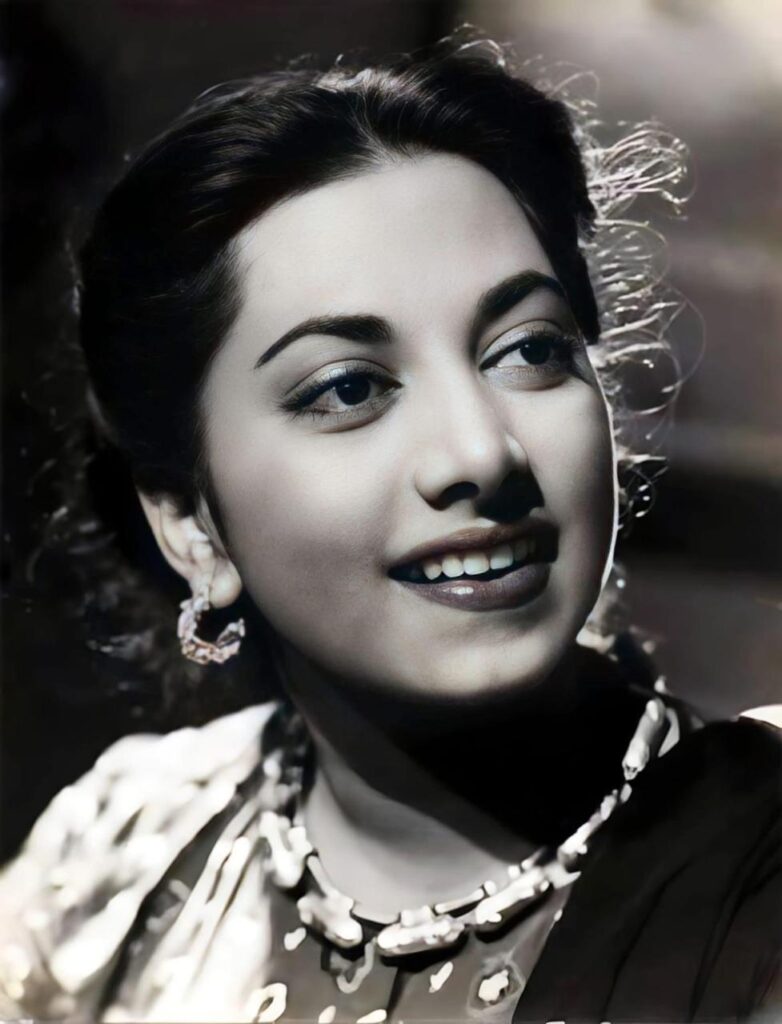
The Woman Who Brought Ghalib to Life
*Dil-e-naadaan tujhe hua kya hai?*
(O innocent heart, what has happened to you?”)
If one film encapsulates Suraiya’s artistic greatness, it is undoubtedly Mirza Ghalib.
Playing the courtesan Chaudhvin opposite Bharat Bhushan as the legendary poet, Suraiya delivered one of the finest performances in Indian cinematic history. Her renditions of Ghalib’s ghazals—including *Dil-e-Naadaan Tujhe Hua Kya Hai*, *Nuktacheen Hai Gham-e-Dil*, and *Yeh Na Thi Hamari Qismat*—remain benchmarks of poetic expression in film music.
The film won the National Award for Best Feature Film, and its impact was profound.
When Prime Minister Jawaharlal Nehru watched the film, he famously told Suraiya: “You have brought Mirza Ghalib’s soul back to life.”
Few compliments in Indian cinema have carried greater weight.
Songs That Refuse to Fade
*O door jaanewale, waada na bhool jaana*
(“O traveller going far away, do not forget your promise.”)
Suraiya’s songs continue to resonate because they were never merely performances; they were emotional experiences.
Whether it was the aching loneliness of *O Door Jaanewale*, the romantic charm of *Tu Mera Chaand Main Teri Chaandni*, the wistful melancholy of *Woh Paas Rahen Ya Door Rahen*, or the tragic beauty of *Ae Ishq Hamen Barbaad Na Kar*, her voice carried an intimacy that modern recording technology often struggles to recreate.
In an age increasingly dominated by playback specialists, Suraiya remained a complete performer. Her songs emerged from the character she portrayed, creating an unusual unity between screen presence and musical expression.
A Quiet Exit From the Spotlight
The rise of a new generation of actresses and playback singers gradually altered the landscape of Hindi cinema. Suraiya’s final film, *Rustam Sohrab* (1963), marked the end of an extraordinary career.
Unlike many stars who sought reinvention, she chose withdrawal.
After the death of her parents and with the passage of time, she increasingly retreated into privacy at Krishna Mahal. Friends such as Tabassum, Nimmi, and Nirupa Roy remained among the few who stayed in touch.
There was something deeply poetic about her solitude. The woman whose voice once echoed from every cinema hall eventually preferred silence.
Yet even in her final years, she retained the wit and literary sensibility that had always defined her personality. When asked how she was doing, she reportedly responded with a couplet lamenting that people often ask how time passes but seldom ask how one endures it.
The End of an Era
When Suraiya passed away in Mumbai on January 31, 2004, at the age of seventy-five, Indian cinema lost more than a legendary actress.
It lost a bridge to its formative years.
She belonged to a generation that witnessed the transition from silent films to talkies, from live recording to playback singing, from studio-era glamour to modern stardom. She represented a rare moment when acting and singing flourished within the same artist.
Today, historians remember her as one of the defining female stars of the 1940s and 1950s. Music lovers cherish her voice. Cinema enthusiasts revisit her films to understand an age when elegance, restraint, and emotional sincerity defined screen performance.
*Yeh kaisi ajab daastan ho gayi hai…*
(“What a strange and wondrous tale this has become…”)
Indeed, Suraiya’s life became an extraordinary tale—of immense fame, immortal music, great love, quiet heartbreak, and enduring grace.
The crowds that once waited outside cinema halls have disappeared. The studios where she worked have changed. The world she knew belongs to history.
Yet every time her voice emerges from an old recording, Suraiya returns.
Not as a relic of the past, but as the last great singing star of Hindi cinema—still enchanting, still moving, and still impossible to forget.

~Hasnain Naqvi is a former member of the history faculty at St. Xavier’s College, Mumbai….
The opinions expressed here are solely those of the author.