

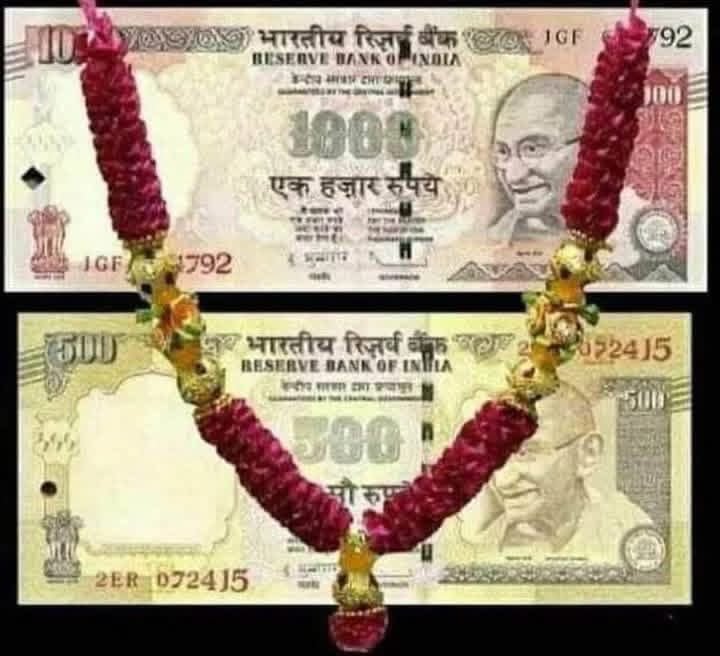
The Midnight Announcement
Ten years ago, on the night of 8 November 2016, India was told that its Rs 500 and Rs 1,000 notes would cease to be legal tender from midnight. The announcement was presented as a “surgical strike” on black money, counterfeit currency, and terror financing. In practice, it became one of the most disruptive economic interventions in independent India’s history: 86 per cent of currency in circulation by value was invalidated overnight, while banks, markets, small businesses, and households were left to absorb the consequences.
The stated objectives were ambitious. The government argued that withdrawing high-denomination notes would expose unaccounted wealth, cripple counterfeiters, push India towards a less-cash economy, and expand the formal financial system. A decade later, the record is difficult to defend. The cash did return; the informal economy suffered; digital payments expanded, but not principally because of the note ban; and counterfeit currency did not disappear.
A Medieval Echo
The comparison with Sultan Muhammad bin Tughlaq’s fourteenth-century token-currency experiment is often invoked as political satire. Yet the analogy captures a serious institutional lesson: a monetary measure cannot succeed merely because the state commands it. Tughlaq’s token currency failed because the state could not prevent counterfeiting and later had to accept the tokens at face value, draining the treasury.
Demonetisation in 2016 shared a fatal weakness: the government launched a vast currency transition without sufficient new notes, recalibrated ATMs, banking capacity, or a credible plan to protect daily-wage earners and small traders. The result was not a clean strike against illicit wealth, but a nationwide liquidity shock.
The Human and Social Cost
For weeks, India witnessed scenes that belonged less to a modern financial reform than to an emergency. People stood for hours outside banks and ATMs to withdraw capped amounts of their own money. Farmers struggled to buy seeds and fertiliser; daily-wage workers lost work when construction and informal trade slowed; small retailers faced collapsing cash sales; hospitals and transport operators faced acute difficulty in accepting payments.
The human cost was real. Contemporary reporting recorded deaths linked to exhaustion and medical emergencies while people waited in queues, as well as the deaths of bank officials working under extreme pressure. These were not incidental inconveniences; they were the direct social price of a policy whose implementation had not matched its ambition. Restrictions on withdrawals persisted for months, hitting hardest where cash was not a preference but a necessity: informal labour markets, rural credit, small manufacturing, street vending, and micro-enterprises.
The Black-Money Paradox
The central claim of demonetisation was that large stocks of untaxed cash would be forced into the open. The Reserve Bank’s final accounting punctured that expectation. Of Rs 15.42 lakh crore in specified banknotes in circulation on 8 November 2016, Rs 15.31 lakh crore—99.3 per cent—returned to the banking system. Only about Rs 10,720 crore did not return.
This did not prove that every rupee returned was clean; it showed that holders of illicit cash had enough time, channels, and ingenuity to convert, split, deposit, or launder much of it. The policy’s central premise—that a sudden ban would trap black money in obsolete paper—was undermined by its own outcome.
What the Data Showed
When examining the empirical data, the gap between the launch promises and the reality that followed becomes stark. Far from extinguishing black money, the near-total return of cash proved that illicit wealth had simply re-entered the banking system. Rather than emerging stronger, the economy sustained measurable losses: the government’s own Economic Survey 2016-17 estimated that demonetisation reduced nominal GDP growth by 0.25 to 1 percentage point and real GDP growth by 0.25 to 0.5 percentage point relative to baselines.
The Survey also recorded a 10 per cent increase in demand for MGNREGS employment, signaling widespread income loss among rural and informal workers. Later district-level research confirmed contractions in employment, bank credit, and output (measured through nightlights) in the quarter following the shock. Finally, the promise that cash dependence would end proved illusory, as cash usage quickly recovered while digital adoption grew primarily through broader structural shifts.
Counterfeiting Was Not Defeated
One of the more persistent myths is that demonetisation delivered a decisive blow to fake currency. In reality, detection rose: the RBI reported that 762,072 counterfeit notes were detected in the banking system in 2016-17—a 20.4 per cent increase from the 632,000 pieces detected in 2015-16. Detection of fake Rs 1,000 notes rose sharply, while counterfeit new-design Rs 500 and Rs 2,000 notes soon appeared as well.
Disruption is not elimination; criminal networks adapted, showing that fake currency requires sustained enforcement and financial intelligence, not a one-time shock.
Digital India’s Real Engine
Supporters often credit demonetisation with India’s digital-payments revolution, but that claim confuses correlation with causation. Digital transactions did accelerate after November 2016, but the deeper transformation came from the Unified Payments Interface (UPI), expanding smartphone and data access, interoperable payment systems, merchant acceptance, and regulatory support.
Demonetisation may have given consumers an involuntary first exposure to digital payment, but a temporary cash crisis is a poor foundation for a durable payments culture. India’s digital progress owes far more to public digital infrastructure and private innovation than to the weeks of queues outside banks.
A Double Shock for Small Enterprise
The note ban was soon compounded by the Goods and Services Tax (GST). While GST was a long-pending structural reform with a legitimate objective, its flaws lay in design and execution—multiple rates, compliance burdens, and frequent rule changes.
For many small enterprises, the sequence was brutal: demonetisation drained working capital, and GST arrived months later with complex compliance demands. Calling GST the “Gabbar Singh Tax” may be rhetorical shorthand, but the underlying criticism was serious: a reform intended to simplify business became another source of uncertainty and cost for an already fragile informal sector.
The Political Economy of Spectacle
Demonetisation endured politically because it was framed as a moral crusade against corruption. The imagery of sudden action and national sacrifice proved powerful. But good governance cannot be judged by the intensity of a gesture; it must be judged by whether the measure achieved its stated objectives at a proportionate cost.
By that test, the record is poor. The principal measurable objective—removing black cash—largely failed, while the economic disruption fell heaviest on informal workers, small traders, farmers, and cash-dependent households.
A Lasting Lesson for Governance
The tenth anniversary should not become an exercise in nostalgia for either side. Demonetisation was a high-risk policy deployed with inadequate preparation, weak sequencing, and unrealistic assumptions about how black wealth, counterfeit networks, and the informal economy actually operate.
India’s experience offers a lasting lesson: economic reform is not theatre. Ten years later, the queues have gone, but the question remains: what did the country gain that could justify what it endured? The honest answer is not a decisive victory over black money or counterfeit currency, but a cautionary tale about the danger of confusing disruption with reform and political spectacle with economic strategy.

~Hasnain Naqvi is a former member of the history faculty at St. Xavier’s College, Mumbai….
The opinions expressed here are solely those of the author.