
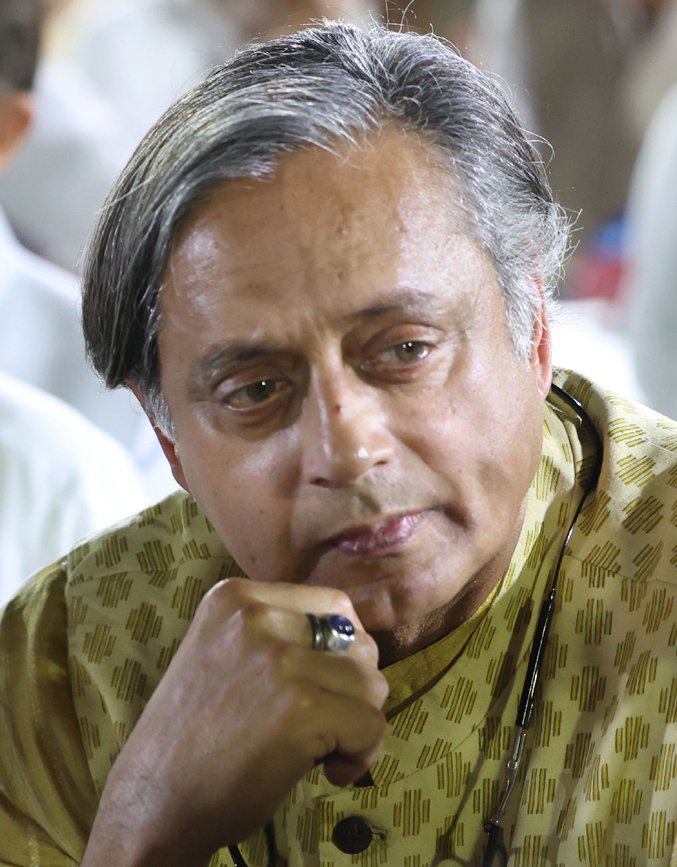
NEW DELHI: Congress MP Shashi Tharoor on Saturday acknowledged that Rahul Gandhi’s Chhatron Ki Goonj outreach failed to generate the kind of response seen during the recent Cockroach Janta Party (CJP)-led protests, prompting a pointed question within the party: Did Congress fail to listen to Gen Z?
Speaking at the 15th anniversary celebrations of the International Movement to Unite Nations (IIMUN) in Mumbai, Tharoor said several of the issues that later became central to the CJP’s protests at Jantar Mantar had already been raised by Congress and Rahul Gandhi through the party’s ‘Chhatron Ki Goonj’ campaign.
“Interestingly, the issues taken up by the CJP and the Jantar Mantar protesters had been taken up by us earlier. We had a Chhatron Ki Goonj thing where Rahul Gandhi was addressing students about the paper leaks, about the things and so on. And that didn’t resonate as much as this did,” Tharoor said.
He said the Congress needed to look beyond the issues it was raising and examine why its outreach had failed to connect with young people in the same way.
“We need to ask ourselves, what did we fail to do? Did we fail to listen? Did we fail to tap into the old clich of having our finger on the pulse of the people? Was our finger missing from the pulse of Gen Z?” he said.
The Congress leader also pointed to the gap between identifying issues affecting young people and turning those concerns into a movement that resonates with them.
“Yes, there is a problem in education. Yes, there’s a problem with climate change. Yes, there are glaring loopholes in Indian democracy. But this somehow is not resonating,” he said.
Tharoor said the problem extended beyond Congress and reflected a larger challenge for established political parties, which he argued had failed to create meaningful avenues for young people to enter and shape politics.
“All the opposition parties, we didn’t provide a route into our parties for the kinds of people who were in Jantar Mantar last month,” Tharoor said, adding that established parties needed to examine how young people could enter political organisations dominated by “hierarchies, entrenched establishments, dynastic considerations and political networks”.
He questioned whether young entrants were being given opportunities to shape politics or were merely expected to “stand behind the established leaders”, participate in mass rallies and perform “foot soldier work”.
Furthermore, Tharoor warned that established parties could lose their relevance if they failed to adapt to the voices and concerns of a younger generation.
“Let not our epitaph be that we were bypassed or became irrelevant because we failed to listen,” he said, urging political parties to “wake up and smell the coffee”.

We are a multimedia news network. Website : www.7xnews.com Based in New Delhi (India)
Youtube : umakantlakheraspeaks@gmail.com

