

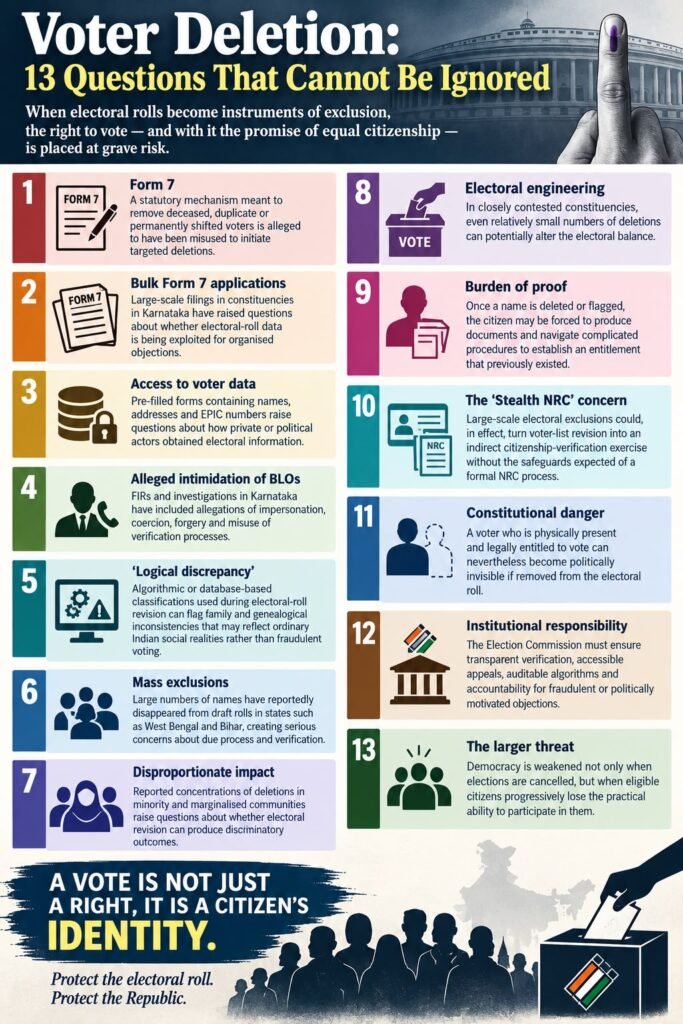
When electoral rolls become instruments of exclusion, the right to vote—and with it the constitutional promise of equal citizenship—is placed at grave risk
In a constitutional democracy, the right to vote is not merely a political privilege. It is one of the most tangible expressions of citizenship—the means through which citizens affirm their place in the Republic and exercise their constitutional voice. Yet, under the guise of routine electoral-roll maintenance, a disturbing administrative shadow appears to be spreading across India.
From Karnataka to West Bengal and Uttarakhand, allegations of large-scale manipulation of electoral rolls have raised serious questions about whether bureaucratic procedures and technological systems intended to protect the integrity of elections are instead facilitating exclusion. Particularly troubling are allegations that Muslim voters and other marginalised communities have been disproportionately affected.
The danger lies not simply in individual deletions. It lies in the possibility that regulatory loopholes, opaque data-processing systems and partisan interventions can combine to produce a “voteless citizenry”—citizens who remain physically present and legally entitled to vote but find themselves erased from the electoral register.
The Weaponisation of Bureaucracy: The Form 7 Question
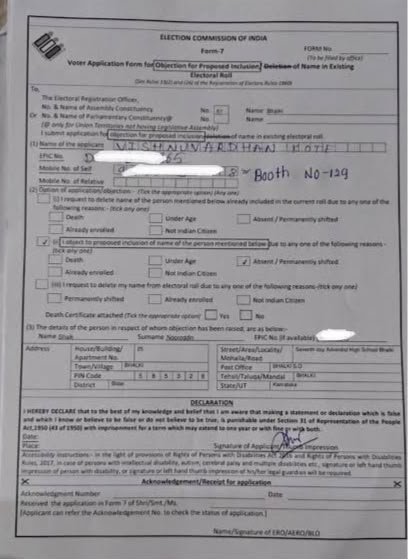
The most visible instrument in this controversy is Form 7, the statutory mechanism provided by the Election Commission of India for objecting to the inclusion of a name in the electoral roll or seeking its deletion. Properly used, it serves a legitimate purpose: removing the names of deceased voters, duplicates and persons who have permanently shifted residence.
The concern arises when a safeguard against electoral malpractice itself becomes an instrument of exclusion.
In Karnataka, during the Special Intensive Revision (SIR) of electoral rolls, large numbers of Form 7 applications were reportedly filed across several constituencies, including Babaleshwar, Bhalki, Belagavi and Mysuru. Investigative findings have raised particularly disturbing questions about the manner in which some of these applications were generated.
In several instances, the forms were reportedly pre-filled with the names, addresses and Electoral Photo Identity Card (EPIC) numbers of Muslim voters, while the names of purported objectors—some allegedly associated with political workers—were added manually.
The obvious question is: how did private individuals or political actors obtain the electoral data necessary to prepare such targeted applications in bulk?
Police investigations and FIRs in Belagavi, Bidar and Mysuru have added another dimension to the controversy, with allegations involving forgery, cheating and intimidation of Booth Level Officers (BLOs). There have also been allegations that individuals impersonated senior election officials over the telephone, pressuring election personnel to sign pre-filled deletion forms or surrender verification One-Time Passwords.
The Election Commission has emphasised that the filing of Form 7 does not automatically result in deletion and that applications are subject to verification. That safeguard is important. But it does not answer the larger institutional question: what happens when the mechanism designed to initiate scrutiny is itself systematically abused?
Reports of thousands of applications being concentrated in particular constituencies and minority-dominated pockets expose a vulnerability that cannot be dismissed as a series of isolated administrative lapses. Even if individual cases are ultimately rejected after verification, the scale and targeting of such objections demand transparent investigation and accountability.
The Technology of Exclusion: When ‘Logical Discrepancy’ Becomes a Filter
The controversy over Form 7 represents the manual dimension of electoral exclusion. A parallel concern arises from the increasing use of algorithmic and database-driven systems in electoral-roll revision.
During SIR exercises in states such as West Bengal and Bihar, large numbers of names were reportedly excluded from draft electoral rolls on grounds described as “logical discrepancy”.
Such classifications are ostensibly designed to identify inconsistencies in electoral data. They can include unusual age differences within families, inconsistencies in genealogical relationships or anomalies emerging from the mapping of family and ancestral records.
The problem is that algorithms do not live in the social world they attempt to organise.
India’s rural and semi-urban society contains millions of families whose documentation across generations is incomplete, inconsistent or simply unavailable. Joint families may have complex structures; women may change surnames after marriage; birth dates may have been recorded inaccurately decades ago; names may be spelt differently across documents; and entire generations may have grown up without uniform documentary records.
A database may identify such variations as anomalies. A human being may recognise them as ordinary features of Indian social life.
The consequences can be profound. In West Bengal, nearly 91 lakh names were initially reported as removed from the rolls, while Bihar saw more than 47 lakh names excluded during the exercise. Reports from the ground have raised concerns that deletions were concentrated in areas with substantial minority populations, including Murshidabad.
Among those affected were reportedly long-time residents and families possessing legacy electoral records extending back to the first general election of independent India in 1952.
The stated objective of such exercises is to eliminate “ghost voters” and ensure the integrity of the electoral roll. No democracy can object to that objective. The question is whether the cure is becoming more dangerous than the disease.
A citizen who is physically present, traceable, documented and otherwise entitled to vote cannot be reduced to a data anomaly merely because an algorithm finds the structure of his or her family unusual.
Electoral Engineering: When Deletion Becomes a Political Strategy
The stakes are particularly high in closely contested constituencies, where a few thousand votes can determine the outcome of an election.
This is why allegations of disproportionate deletions among Muslim, Dalit and backward-class voters cannot be treated as a purely technical issue. If electoral-roll revisions systematically remove or place obstacles before voters belonging predominantly to particular social groups, the process can acquire the character of electoral engineering.
The danger becomes even greater when names are classified under categories such as “Absent/Permanently Shifted” without the voter’s knowledge or meaningful opportunity to contest the decision.
The consequences become visible only at the polling station.
A voter arrives believing that the most basic act of citizenship—the casting of a ballot—is available to them, only to discover that their name has disappeared or their status has been questioned. At that moment, an administrative decision made weeks or months earlier becomes an irreversible political reality.
This is why the integrity of the electoral roll is inseparable from the integrity of the election itself.
A voter who has been silently removed from the register cannot exercise a right that has already been administratively extinguished.
If such deletions are deliberately concentrated in constituencies or communities likely to support particular political formations, the issue moves beyond voter-list management. It becomes a question of whether the machinery of electoral administration is being used to reshape the electorate before citizens even reach the polling booth.
The Stealth NRC: When Electoral Deletion Becomes a Question of Citizenship
The implications extend well beyond a single election.
There is a disturbing structural relationship between mass electoral deletions and the larger debate over citizenship documentation, particularly the National Register of Citizens (NRC). A nationwide NRC remains politically contentious and legally unresolved. But an electoral system in which citizens are first removed from the voter list and then required to produce increasingly burdensome documentation risks creating a similar effect through the back door.
For many vulnerable citizens, inclusion in the electoral roll is among the strongest forms of state recognition they possess.
When a name disappears because of an alleged “logical discrepancy”, a disputed Form 7 objection or a questionable determination that a voter has shifted residence, the burden effectively moves from the state to the citizen.
The affected person must then prove what was previously presumed: that they exist, that they reside where they say they reside and that they are entitled to participate in the political life of the Republic.
For the poor, the elderly, women, migrant workers and socially marginalised communities, this burden can be devastating. It may involve repeated visits to government offices, retrieval of decades-old documents, corrections to records and prolonged legal proceedings.
Where appeals and disputes accumulate into massive backlogs, the process can stretch for years.
The consequence is a form of civic limbo. A citizen may remain physically present, socially rooted and legally entitled to vote, yet be treated administratively as though his or her claim to citizenship requires renewed proof.
This is why electoral-roll revision must never become a surrogate citizenship-verification exercise without the strongest constitutional safeguards.
The voter list must remain a democratic instrument—not a de facto register of suspected aliens.
The Bigger Danger: A Republic Without Electoral Equilibrium
To dismiss the misuse of Form 7, mass deletions or algorithmic exclusions as isolated bureaucratic errors would be to underestimate the seriousness of the issue.
The central question is not whether every deletion is politically motivated. It is whether the architecture of electoral administration contains sufficient safeguards to prevent political actors, administrative failures or technological systems from collectively producing discriminatory outcomes.
That distinction matters.
A democracy does not require us to assume conspiracy where evidence is absent. But neither does it permit institutions to dismiss patterns that demand investigation.
The creation of a “voteless citizenry” need not occur through one dramatic constitutional rupture. It can happen incrementally—through a series of administrative decisions, unexplained deletions, opaque algorithms, unverified objections and procedural barriers.
The cumulative effect can be as consequential as an overt assault on democratic rights.
If entire communities begin to believe that their names can be removed through a combination of partisan intervention, administrative discretion and opaque technology, faith in the electoral process will inevitably erode.
The damage is both political and constitutional.
Politically, a community deprived of effective voting power loses its ability to influence governments and legislation. Constitutionally, the equal citizenship promised by the Republic becomes increasingly hollow if some citizens must struggle merely to remain visible on the electoral register.
India’s democratic legitimacy ultimately rests on the sanctity of the ballot—and before that, on the sanctity of the electoral roll.
The Election Commission, therefore, must ensure that every deletion is traceable, reviewable and capable of being challenged through an accessible process. Any allegation of organised misuse of Form 7 must be investigated transparently. Algorithmic classifications such as “logical discrepancy” must be intelligible, independently auditable and subject to meaningful human verification. Most importantly, no citizen should lose the practical ability to vote merely because a database has failed to understand the complexity of Indian society.
The constitutional promise is simple: citizenship cannot depend on the efficiency of a software system, the discretion of a bureaucrat or the political intentions of an intermediary.
If the gatekeepers of democracy—the electoral machinery and the institutions responsible for judicial oversight—fail to prevent the weaponisation of electoral rolls, India risks becoming a democracy in which citizens retain the formal right to vote but increasingly lose the practical ability to exercise it.
That is the real danger of a voteless citizenry.
It does not arrive with the abolition of elections.
It arrives when citizens reach the polling booth and discover that democracy has already deleted them.

~Hasnain Naqvi is a former member of the history faculty at St. Xavier’s College, Mumbai….
The opinions expressed here are solely those of the author.