

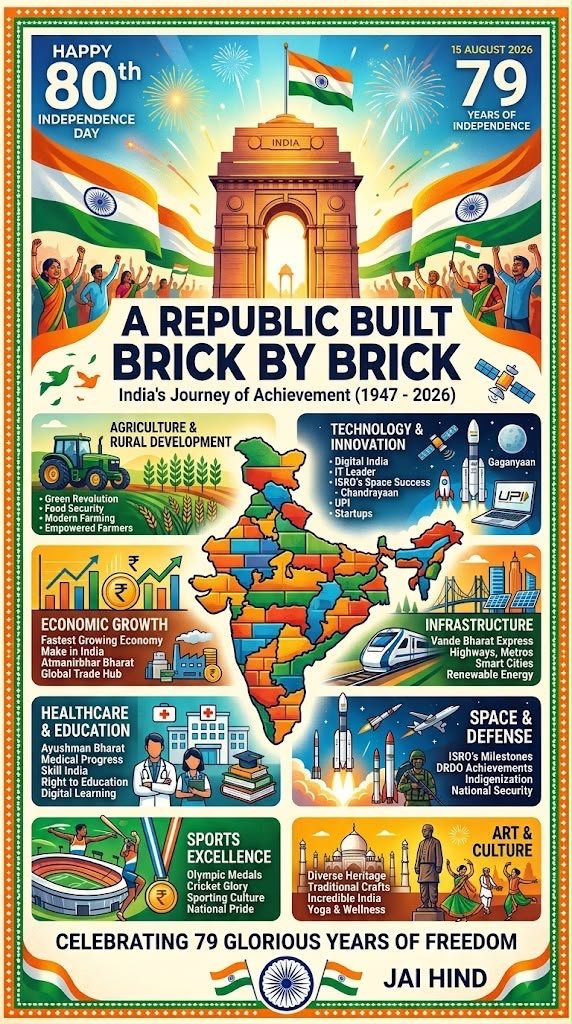
As India celebrates its 80th Independence Day on August 15, 2026, the rhetoric of our public square is frequently dominated by a narrative of total rupture.
A political discourse has taken root that suggests the nation’s true history began only in recent memory, portraying the preceding decades as a period of inertia or drift. Yet, no nation—least of all a modern republic born out of a devastated colonial economy—is built overnight, nor is it built in a vacuum.
To suggest that a country of India’s scale emerged out of nowhere in the 21st century is to ignore the monumental civilizational and structural brickwork laid since 1947.
As we reflect on our nationhood today, it is worth revisiting how an impoverished, illiterate, and deeply fractured subcontinent was transformed, institution by institution, into the world’s fastest-growing democracy.
The Bedrock of Nationhood and Governance
The starting line of independent India was defined by existential peril. In August 1947, a partitioned nation faced catastrophic poverty, widespread illiteracy, and the staggering task of integrating more than 600 princely states into a single political body. Under the leadership of Prime Minister Jawaharlal Nehru and the founding fathers of the republic, the first step was to construct a durable democratic framework. The adoption of the Constitution established universal adult franchise, codifying a bold experiment in secular democratic governance, while the abolition of the zamindari system redistributed agrarian power, and the enactment of the Hindu Code Bills reformed personal laws to advance gender rights and social equity.
To govern a land lacking basic infrastructure, the state systematically established enduring administrative, intellectual, and cultural institutions. Democratic governance was anchored by the Union Public Service Commission, specialized civil service academies, and the Election Commission. Concurrently, the republic invested in preserving its rich heritage and knowledge systems through the creation of the National Library in Kolkata, the National Museum in New Delhi, the National Archives in Delhi, the Sahitya and Lalit Kala Academies, and zonal cultural centres designed to foster unity across diverse traditions.
Education, Science, Technology, and the Industrial Spine
A republic cannot survive on governance alone; it requires educational and scientific self-reliance, and heavy industrial capability. In the early decades, when private capital was scarce, the Indian state took on the massive financial burden of founding premier educational and research bodies, building a comprehensive institutional ecosystem across scientific, medical, and managerial disciplines.
Technical progress was driven by the Indian Institutes of Technology, the Council of Scientific and Industrial Research, the Bhabha Atomic Research Centre, the Defence Research and Development Organisation, and the Indian Space Research Organisation. Healthcare and agriculture were transformed through institutions like the All India Institute of Medical Sciences, the Indian Council of Medical Research, and the Indian Agricultural Research Institute, while higher education and managerial excellence were cultivated through the Indian Institutes of Management, the University Grants Commission, the National Council of Educational Research and Training, and the National Institute of Design.
To power this sovereign leap, state-led public investments simultaneously constructed an indispensable industrial spine. Heavy industrial capability was established through major steel plants in Bhilai, Rourkela, Durgapur, and Bokaro under the Steel Authority of India, supported by energy and engineering powerhouses like Bharat Heavy Electricals Limited, the National Thermal Power Corporation, and the Oil and Natural Gas Corporation. This was reinforced in defence and high-tech manufacturing by the Heavy Engineering Corporation, Hindustan Aeronautics Limited, and expanded Ordnance Factories. Crucially, these industries were fuelled by monumental multi-purpose river valley projects—such as Bhakra Nangal, Hirakud, and Nagarjuna Sagar—which Nehru famously termed the “temples of modern India.”
Agrarian Transformations and Human Development
When India gained independence, it was crippled by severe food shortages and heavily dependent on foreign aid to feed its 320 million citizens. The path to self-reliance required a dramatic structural transformation. Beginning with early land reforms and massive state-funded irrigation projects, the nation systematically built the infrastructure for modern agriculture. The Indian Agricultural Research Institute pioneered high-yielding crop varieties, while the Food Corporation of India established a nationwide distribution network.
This coordinated strategy sparked the Green Revolution, transforming India from a food-deficit nation into a self-sufficient agricultural power. This success was soon matched by the White Revolution, which organized smallholders into dairy cooperatives, ultimately elevating India to the world’s top milk producer and an exporter of agricultural goods.
This economic stabilization was matched by steady, long-term improvements in human capital over subsequent generations. Through rural health networks and expanded public schooling systems—such as the Kendriya Vidyalayas and Navodaya Vidyalayas—literacy climbed dramatically, while life expectancy rose from under 32 years in 1947 to over 67 years. In later years, these foundational efforts were further cemented through progressive social legislation, including the Right to Education, the Right to Food, and the Mahatma Gandhi National Rural Employment Guarantee Act, which codified social welfare and economic security into fundamental legal entitlements.
Economic Liberation and Global Integration
The foundational state-led investment model laid the groundwork for a dynamic private sector. The radical economic liberalisation initiated under Prime Minister P.V. Narasimha Rao and Finance Minister Dr. Manmohan Singh in 1991 transformed the Indian economic landscape. By establishing regulatory frameworks like the Securities and Exchange Board of India and introducing automated trading through the National Stock Exchange, India opened its equity markets to global capital. The subsequent telecom, computer, and automotive revolutions unleashed private enterprise, fueling an era of unprecedented wealth creation.
The economic reforms of 1991 were not a rejection of the early republic’s investments, but their ultimate payoff—transforming state-built industrial capacity into a competitive global market. Over the decade of UPA governance, average annual GDP growth reached 7.4%, lifting tens of millions out of poverty and expanding the nation’s middle class. Strategic initiatives like the “Look East” policy integrated Indian commerce into ASEAN and regional trade networks, while major infrastructure projects—from state-of-the-art airports to metro systems—solidified India’s modern urban landscape.
A Legacy to Build Upon, Not Erase
Political narratives may shift, but historical facts remain immutable. The achievements of modern India—from its status as a nuclear state and space power to its position as a global economic engine—rest upon a multi-generational edifice built brick by brick over eighty years.
As we look toward the future on this Independence Day, true patriotism lies not in disowning the past for contemporary political expediency, but in honouring the institutional strength that made current progress possible. Progress is cumulative, not coercive. Recognizing the architects of our foundational institutions does not diminish present achievements; it provides the context that makes them meaningful.

~Hasnain Naqvi is a former member of the history faculty at St. Xavier’s College, Mumbai….
The opinions expressed here are solely those of the author.

