

On the 62nd anniversary of his passing, we remember the leader who shaped modern India and whose absence left a nation in profound grief.
It was around 2:00 PM on May 27, 1964, when telephones began ringing urgently in government offices across Delhi. Employees at All India Radio rushed to their studios as a sense of chaos gripped the corridors of Parliament House.
Minutes later, a solemn voice echoed across the nation on radio: “Prime Minister Pandit Jawaharlal Nehru is no longer amongst us.”
With India’s population at approximately 460 million, millions realised for the first time that a nation could indeed feel orphaned.
The Final Moments at Teen Murti Bhavan
That morning at around 6:20 AM, Nehru had confided in his daughter Indira Gandhi about experiencing severe back pain. Soon after, he whispered faintly, “I think I am finished.”
Dr. B.N. Chugh, Dr. Talwar, and other senior physicians arrived promptly. Oxygen was administered along with injections, but at 1:44 PM, his heart stopped beating. Indira Gandhi was by his side.
Gulzarilal Nanda was immediately summoned. Outside Teen Murti Bhavan, unease had already spread as staff sensed the gravity of the situation. Many long-serving employees, some who had been with Nehru since before Independence, wept inconsolably.
An elderly gardener repeatedly murmured, “Pandit-ji is gone… who will come here now to inspect the garden in the morning?”
A Nation in Mourning
In Delhi, cinema halls halted screenings midway. Shops in Connaught Place shut down spontaneously. At Old Delhi Railway Station, passengers gathered around radios. In villages without electricity, people converged at post offices and village squares to hear the broadcasts.
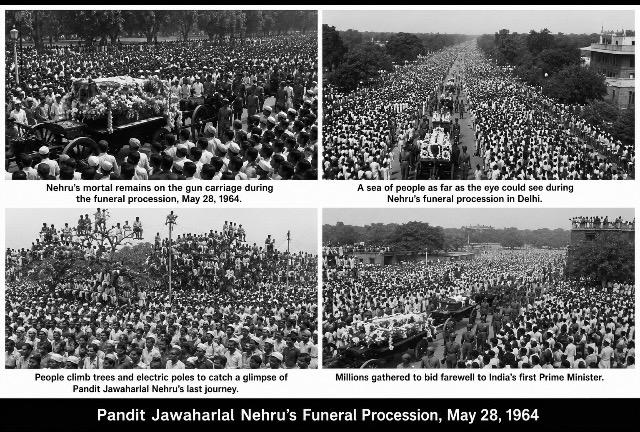
On the morning of May 28, 1964, the funeral procession began from Teen Murti Bhavan. Nehru’s mortal remains, adorned with white flowers, were placed on an army gun carriage that moved slowly forward. Indira Gandhi wept intermittently during the journey, accompanied by her sons Rajiv Gandhi, then 19, and Sanjay Gandhi.
An Unprecedented Outpouring
Historians and newspaper accounts recorded more than 1.5 million people lining the streets of Delhi, with some foreign reports estimating up to 2 million. People climbed trees and electric poles for a final glimpse. Women lifted children onto their shoulders. Many fainted in the massive crowd, challenging the army’s efforts to maintain order.
An elderly farmer who had travelled from Agra said simply, “I have come to see, for the last time, the man who gave us the power of the vote.”
Prominent leaders in the procession included President Dr. Sarvepalli Radhakrishnan, Acting Prime Minister Gulzarilal Nanda, Lal Bahadur Shastri, Morarji Desai, Jagjivan Ram, Kamaraj, Indira Gandhi, V.K. Krishna Menon, and Chief Ministers from across the country. Representatives from nations worldwide paid their respects.
Lord Mountbatten arrived from Britain. Both the Soviet Union and the United States sent messages of condolence. Egyptian President Gamal Abdel Nasser described Nehru as the “Voice of Asia and Africa,” while Yugoslavia’s Marshal Tito noted that the world had lost a great leader of peace.
A Final Wish Fulfilled
In his will, Nehru had requested that a portion of his ashes be immersed in the Ganges at Allahabad, with the remainder scattered from an aircraft over the fields of India. This wish was honoured by the Indian Air Force, reflecting his deep bond with the soil of the nation he served.
The End of an Era
Nehru’s death triggered not just a political succession crisis but widespread public apprehension about India’s future. He had held together a fractured nation after Independence, established a Constitution-based democracy, and laid the foundations of modern India through pioneering institutions like the IITs, AIIMS, Bhakra Nangal Dam, the early vision for ISRO, the nuclear programme, major public sector industries, and scientific research institutes.
On May 27, 1964, as the first dream of independent India burned on the funeral pyre, the nation felt truly alone for the first time.
Sources:
• Contemporary reports from The Times of India and Hindustan Times (May 1964)
• Official records from All India Radio archives
• Biographical accounts including Nehru’s own writings and will
• Historical documentation by the Nehru Memorial Museum and Library

~Hasnain Naqvi is a former member of the history faculty at St. Xavier’s College, Mumbai….
The opinions expressed here are solely those of the author.

