

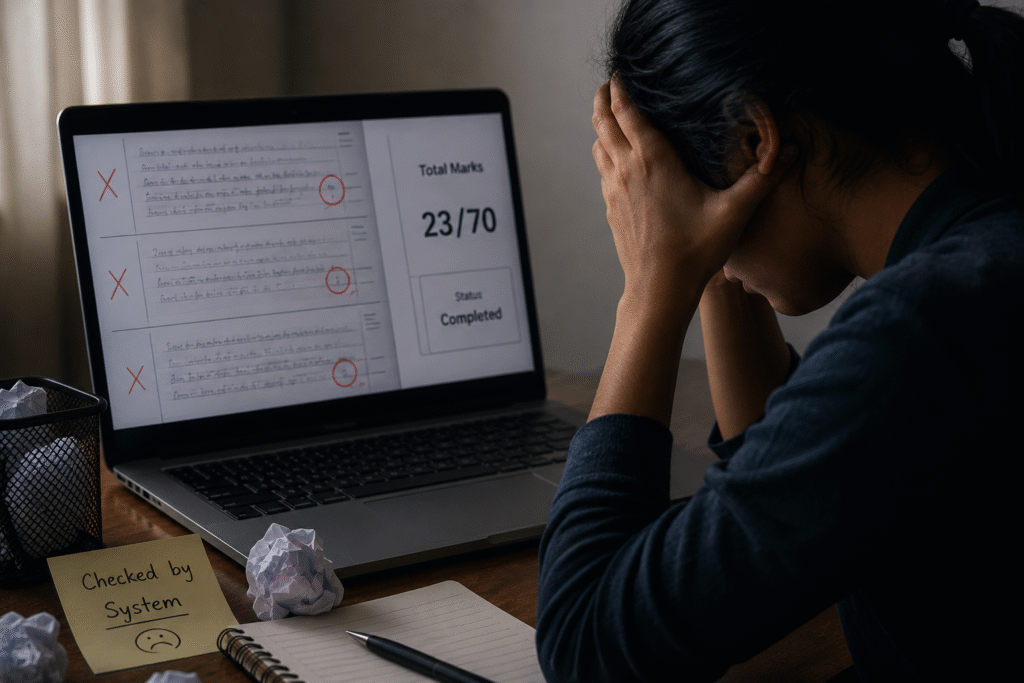
The high-stakes world of Board examinations in India has long been a pressure cooker for millions of adolescents, but this year, the systemic failures of the Central Board of Secondary Education (CBSE) have turned it into an outright crisis. Following closely on the heels of national entrance exam debacles, the introduction of the digital On-Screen Marking (OSM) system for Class XII has triggered a catastrophic fallout.
Designed under the banner of modernizing education through tech-driven “transparency, efficiency, and objectivity,” the system has instead plunged the futures of approximately 18.5 lakh students into jeopardy. A steep drop in the overall pass percentage to 85.20%—down from last year’s stable 88.39%—is not a reflection of a sudden decline in student intellect, but a glaring symptom of a rushed, glitch-ridden, and deeply compromised digital experiment.
In a dramatic escalation of the crisis, Union Education Minister Dharmendra Pradhan stepped forward to accept full moral responsibility on behalf of the government for the widespread discrepancies plaguing the system. Acknowledging the profound distress caused to families, the Minister admitted that the maiden nationwide rollout of this digital system across CBSE’s 22 regional offices exposed severe institutional shortcomings. However, while the government has scrambled to contain the political fallout by roping in experts from IIT Kanpur and IIT Madras to overhaul the re-evaluation infrastructure, the structural faults of this botched rollout demand a deeper, forensic examination.
Efficiency Over Empathy: The Evaluator’s Nightmare
The bedrock of any credible examination system is the diligence of its evaluators. Yet, the massive operation—which required the scanning and processing of approximately18.5 lakh answer booklets comprising nearly 40 crore individual pages—was executed with a reckless disregard for ground realities. Minutes from a governing body meeting in June 2025 reveal that members explicitly cautioned the Board, suggesting that OSM be implemented only after thorough pilot projects were conducted across various regional offices.
Instead of heedful piloting, CBSE bypassed regional trials, opting for a token two-day dry run in January involving just 100 teachers from five Delhi schools.
The consequences of this administrative hubris were felt immediately at evaluation centres. Thousands of teachers were deployed to evaluate live answer scripts without formal training on the software, forced to navigate an unfamiliar interface on the fly. Compounding the issue, evaluators were burdened with rigid daily targets. In the race to meet quotas, speed triumphed over meticulous reading. Teachers reported severe screen fatigue, low scan resolutions that blurred text, and catastrophic software glitches where entire answers were skipped. When a digital system values rapid clicks over step-marking and careful comprehension, it ceases to be an evaluation tool; it becomes a lottery.
Mismatched Scripts and Online Venom: The Human Cost
The real-world victims of this digital failure are the students, over four lakh of whom have been forced to swamp the Board with re-evaluation applications. The systemic loopholes are starkly highlighted by absurd anomalies: students who successfully cleared the ultra-competitive IIT-JEE Advanced exams were declared “failed” in core subjects like Mathematics, Physics and Chemistry.
The crisis took a darker, institutional turn during the post-examination process. In a horrifying breakdown of data management, students applying for digital copies of their answer sheets were provisioned the scripts of complete strangers. The case of Vedant Shrivastava, a Class XII student, exposed the fragility of the entire operation. When Vedant flagged on social media that the Physics script uploaded under his credentials featured handwriting that was clearly not his own, CBSE was forced into a corner, eventually admitting to the mix-up and emailing him the correct sheet.
However, the institutional failure quickly translated into societal trauma. For the simple act of demanding transparency, Vedant and his family were subjected to vicious online trolling, with miscreant elements labeling the teenager “anti-national” and a “Pakistani.” This toxic fallout highlights a grim reality: when state institutions fail to protect data integrity, vulnerable students are left to bear the brunt of public malice.
The Corporate Shadow and Security Breaches
Beyond operational incompetence lies a more troubling narrative of corporate accountability and digital vulnerability. The contract for the nationwide OSM implementation was awarded to COEMPT Edutech. This procurement immediately ignited a political firestorm, with Leader of the Opposition Rahul Gandhi fiercely questioning the government’s vetting process. The firm allegedly operated previously under the name Globarena—a company that was severely scrutinized and had its contract terminated following catastrophic evaluation disasters in Telangana. While CBSE has scrupulously maintained that the tender complied strictly with General Financial Rules and government procurement policies, the striking similarity between past state-level failures and the current national crisis raises hard questions about systemic oversight.
The operational anxiety is further compounded by staggering cybersecurity revelations. Nisarga Adhikary, a 19-year-old cybersecurity researcher, exposed fundamental architectural vulnerabilities within a CBSE-linked portal. The flaws he uncovered point to an alarming lack of basic digital hygiene:
*Exposed Master Passwords:*
A hardcoded master password was left exposed in the frontend JavaScript code, theoretically allowing anyone to log in as any examiner.
*Bypassed Authentication:*
One-Time Password (OTP) verification was handled entirely on the client-side browser, meaning it could be bypassed easily using basic developer tools.
*Broken Authorization (IDOR):*
The system lacked robust route protections, allowing direct access to internal pages and enabling unauthorized users to act as examiners via the API to potentially tamper with marks.
Though independent hackers confirmed these vulnerabilities, and reports were sent to the Indian Computer Emergency Response Team (CERT-In) months prior to the rollout, many of these critical gaps reportedly remained unpatched during the testing cycle. While the Board has issued strong counters, clarifying that the live evaluation core remained insulated from malicious breaches and that the leaks involved a sample-data testing portal, the public trust deficit remains immense.
A Systemic Reckoning
The Class XII OSM fiasco cannot be swept under the rug as a teething problem of digital transition. When a public board gambles with the mental health, academic records, and career trajectories of millions of youth, accountability must be absolute.
The demand by opposition leaders for an independent judicial probe and the immediate formation of a Special Investigation Team (SIT) to fix accountability is entirely justified. While Minister Pradhan’s admission of responsibility and his promise that “no student’s query will remain unaddressed” marks a necessary rhetorical shift away from institutional denial, words must translate into structural reform. Technology should be deployed to minimize human error, not amplify it. Until CBSE conducts a transparent, independent audit of this year’s digital evaluation process, enforces strict penalties on compromised vendors, and listens to its own advisory bodies, the OSM system will stand not as a monument to progress, but as a cautionary tale of bureaucratic arrogance in the digital age.
Given that the government has now acknowledged these operational failures and roped in top-tier technical institutions like the IITs to audit the process, what immediate safeguards must be implemented to ensure the ongoing massive re-evaluation drive remains completely error-free before college admission windows close?

~Hasnain Naqvi is a former member of the history faculty at St. Xavier’s College, Mumbai….
The opinions expressed here are solely those of the author.