

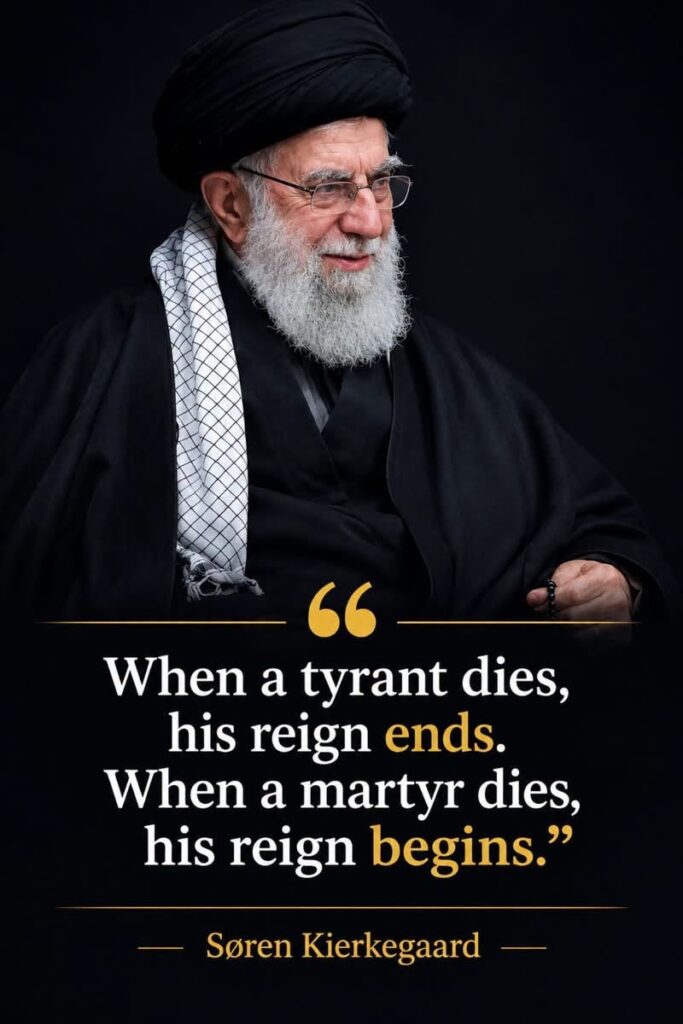
In the sweltering heat of Tehran, millions converged not merely to mourn but to affirm an unyielding resolve. The six-day state funeral for the martyred Supreme Leader of Iran, Ayatollah Ali Khamenei, who was killed on February 28, 2026, in a joint U.S.-Israeli airstrike, concluded with his burial on July 9 in his birthplace, Mashhad. Meticulously choreographed, the funeral procession—stretching from Tehran to Qom, onward to the Iraqi holy cities of Najaf and Karbala, before returning to Iran—transcended the boundaries of ritual. It evolved into a profound political and spiritual statement, invoking the memory of Imam Hussain and his stand at Karbala in 680 CE, where a small band of the faithful chose martyrdom over submission to tyranny.
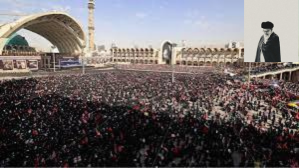
Khamenei, described as the 40th-generation descendant of Imam Ali, embodied this spirit of defiance throughout his decades of leadership. Warned on the very first day of the war that he had become a prime target, he reportedly rejected the safety of underground bunkers, choosing instead to remain alongside his family and senior military commanders as U.S. and Israeli strikes claimed their lives. Yet Iran did not collapse. Instead, its resilient response—strengthened by advanced missile and drone capabilities—drew the world’s foremost military power into an increasingly costly confrontation, exposing what many viewed as the limits of hegemonic power. According to reports by outlets such as BBC, CNN, and The New York Times, public participation, with estimates from state media and independent observers running into the millions across the funeral route, surpassed even the funeral of Ayatollah Ruhollah Khomeini in 1989.
A Procession Steeped in Sacred History
The funeral’s carefully designed choreography intertwined national mourning with enduring Shia symbolism. Beginning at Tehran’s Khomeini Mourning Hall and Grand Mosalla, the flag-draped coffins of Khamenei and his slain family members drew immense crowds chanting slogans such as “Death to America” and “Death to Israel,” scenes widely documented by international media, including Sky News, France 24, and Reuters. The processions continued through Tehran on July 6 and 7 before moving southward to Qom, Iran’s theological heartland.
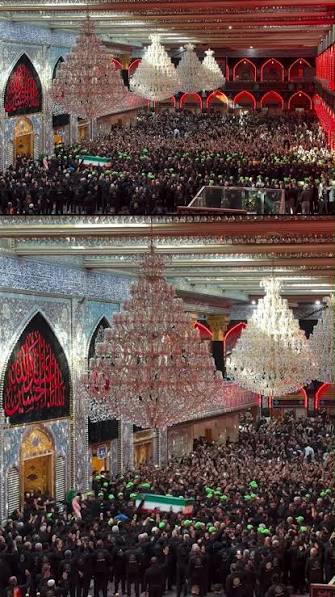
On July 8, the funeral convoy crossed into Iraq, stopping first at Najaf, home to the shrine of Imam Ali, and then at Karbala, where Imam Hussain and his brother Abbas ibn Ali embraced martyrdom while resisting the forces of the Umayyad Caliphate. Reports by Al Jazeera and The Washington Post described vast crowds filling these sacred cities, with Iraqi officials estimating attendance in Najaf alone at anywhere between several hundred thousand and more than two million during the declared public holiday.
Mourners beat their chests in traditional expressions of grief, reinforcing the symbolism that Khamenei’s “supreme sacrifice” echoed Hussain’s own stand: principled resistance against overwhelming odds and an unwavering refusal to yield to imperial power.
The journey concluded on July 9 in Mashhad at the shrine of Imam Reza, where Khamenei, born in 1939, was laid to rest. International publications, including DW News and The Economist, observed that the funeral was managed with extraordinary precision, projecting institutional continuity under his son, Mojtaba Khamenei, amid heightened security concerns while temporarily suspending sensitive diplomatic negotiations to preserve national unity.
Global Solidarity and the Rejection of Sanctions and Threats
Despite four decades of U.S.-led sanctions and explicit warnings directed at governments considering participation, delegations from between 70 and 100 countries attended the funeral. High-level representatives arrived from Russia, China, Pakistan, Türkiye, and even Saudi Arabia, whose Deputy Foreign Minister’s presence reflected a remarkable easing of long-standing regional tensions.
Al Jazeera reported that carefully selected Qur’anic verses were recited for different visiting delegations, conveying distinct diplomatic messages: perseverance and victory for Hamas and Hezbollah, solidarity with China, and reflections intended for the Saudi delegation. Against this backdrop, the absence of most European governments appeared to underscore the shifting contours of global geopolitical alignments.
Gulf News and Khaleej Times described the funeral as a moment that strengthened the so-called “Axis of Resistance,” reinforcing Iran’s regional influence despite the devastation of war. Iranian media outlets, including Press TV and Mehr News, portrayed the unprecedented turnout as evidence that the nation had remained unbroken, with its people rallying in extraordinary numbers despite immense human and material losses.
Defiance Forged into a New Geopolitical Order
The funeral was far more than a ceremonial farewell; it became an unmistakable display of political defiance and national mobilisation. Crowds burned American and Israeli flags and displayed posters targeting prominent U.S. leaders, scenes reported by CNN and Fox News. Iranian officials also used the occasion to reiterate warnings against external interference in the strategically vital Strait of Hormuz.
The New York Times and The Wall Street Journal situated these developments within the broader context of an evolving international order, interpreting the funeral as emblematic of a Global South increasingly committed to sovereignty rather than submission to external pressure.
Khamenei’s legacy, as assessed even by publications such as The Economist, encompasses both Iran’s pursuit of strategic self-reliance and his insistence on nuclear restraint through religious decree, while also attracting sustained criticism over domestic political restrictions. Yet, in death as in life, he continued to symbolize resistance to what his supporters describe as American hegemony.
His martyrdom—evoking the memory of Karbala’s timeless struggle for justice—has become a powerful symbol for many Iranians and their regional allies, reinforcing the conviction that military pressure and external intervention generate not surrender but deeper national resolve.
As the funeral procession came to its final resting place in Mashhad, its message resonated far beyond Iran’s borders: that Iran endures, its people remain mobilised, and an increasingly multipolar international order is taking shape in which resistance and sovereignty carry renewed significance. For his supporters, Khamenei’s blood, like that of Imam Hussain centuries earlier, nourishes the enduring tree of resistance.
The world now watches as mourning gives way to political purpose. Whether viewed as a profound act of national resilience or as a defining geopolitical moment, the funeral marked more than the burial of a leader. It became a declaration that, in the eyes of his followers, the age of unquestioned hegemony is giving way to one of sovereign assertion across the Global South. In mourning one man, millions affirmed what they believe to be the unbowed spirit of a nation. History may ultimately remember not only the burial of Ayatollah Ali Khamenei, but also the beginning of a renewed chapter in Iran’s political and ideological journey.

~Hasnain Naqvi is a former member of the history faculty at St. Xavier’s College, Mumbai….
The opinions expressed here are solely those of the author.