

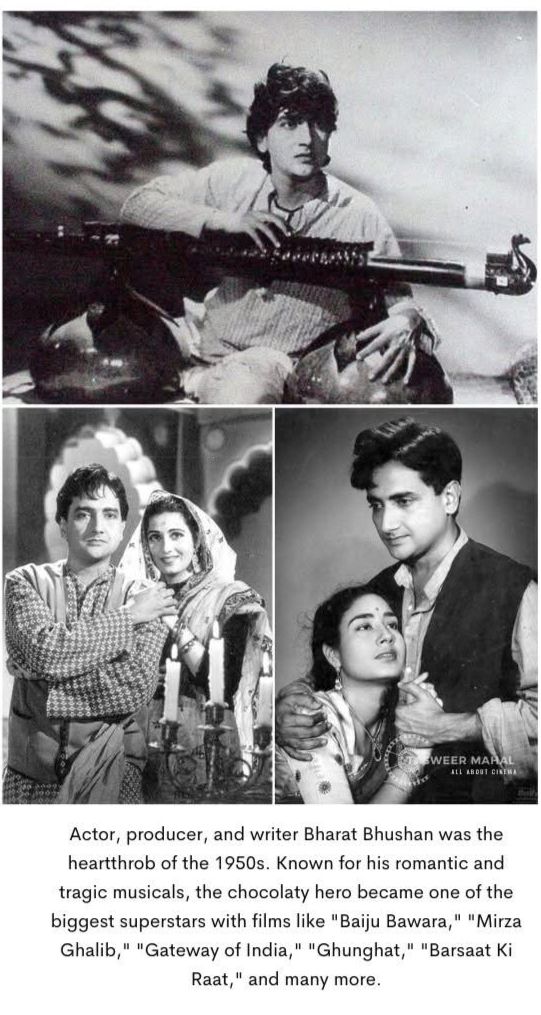
June 14 marks the birth anniversary of Bharat Bhushan, the gentle, chocolate-faced superstar of the 1950s who came to personify the very soul of tragic romance and classical music on the silver screen. In an era dominated by the legendary trio of Raj Kapoor, Dilip Kumar, and Dev Anand, Bharat Bhushan carved out a unique, irreplaceable niche for himself. He was cinema’s ultimate intellectual romantic—a man who did not just lip-sync to immortal melodies, but lived them on screen with an unmatched, poetic vulnerability.
“Man Tadpat Hari Darshan Ko…”* – The Rise of a Musical Phenomenon
Born on June 14, 1920, into an affluent family in Meerut, Uttar Pradesh, Bharat Bhushan’s early life was shadowed by personal loss. Having lost his mother when he was just two years old, he grew up in Aligarh under the care of his grandfather. His father, Raibahadur Motilal, was a distinguished government pleader and a Supreme Court judge, providing an environment rich in education and culture. After graduating from Dharam Samaj College, Aligarh, the young dreamer bypassed a conventional career path to seek his fortune in the shifting sands of show business.
His cinematic journey began under the tutelage of the legendary Kidar Sharma with *Chitralekha* (1941). Though films like *Bhakta Kabir* (1942) brought him early recognition—even earning the cast silver bricks from the government for promoting communal harmony—stardom eluded him for a decade.
The definitive turning point arrived in 1952 with Vijay Bhatt’s musical masterpiece, *Baiju Bawra*. As the tormented musician seeking spiritual and creative vengeance, Bhushan delivered a performance of breathtaking intensity. The film became a cultural phenomenon, catapulting him to overnight superstardom alongside actress Meena Kumari, maestro Naushad Ali, and playback singer Mohammad Rafi.
Sur Na Saje Kya Gaoon Main…– The Golden Era of the Screen Poet and Saint
“Sur na saje kya gaoon main, sur ke bina…”
The poignant lines from *Basant Bahar* mirrored Bharat Bhushan’s unmatched ability to portray the agonizing pursuit of artistic perfection.
Following the success of *Baiju Bawra*, Bharat Bhushan became the definitive face of historical, biographical, and devotional cinema. He possessed a rare, serene screen presence that made him perfectly suited to play saints and poets. In 1953, his moving portrayal of the 16th-century saint in *Shri Chaitanya Mahaprabhu* earned him the *Filmfare Award for Best Actor*.
Soon after, he delivered what many consider the definitive portrayal of India’s greatest Urdu poet in *Mirza Ghalib* (1954) opposite Suraiya. His performance was so layered and deeply felt that it became a textbook benchmark for historical characterizations in Indian cinema.
Beyond his acting prowess, Bharat Bhushan was a deeply cultured individual and an accomplished writer. He actively shaped the narratives of some of his biggest hits, contributing to the scripts and stories of:
*Basant Bahar* (1956)
*Barsaat Ki Raat* (1960)
*Dooj Ka Chand* (1964)
*Nai Umar Ki Nai Fasal* (1966)
His on-screen chemistry with Madhubala in romantic dramas like *Gateway of India* (1957), *Phagun* (1958), and the legendary *Barsaat Ki Raat* (1960) remains etched in gold. He was the fortunate muse for the finest playback voices of India’s golden age—whether it was Mohammad Rafi’s soaring vocals, Mukesh’s soulful depth, or Talat Mahmood’s ghazal-infused melancholy.
*“Phir Whoi Shaam, Vahi Gam, Vahi Tanhayee Hai…”* – When Life Mirrored Art
The tragic intensity that Bharat Bhushan projected on screen eventually, and heartbreakingly, mirrored his real life. He was a man of profound intellect who owned one of the largest personal libraries in the film industry, boasting over 100,000 rare books and literature. Yet, the fickle nature of showbiz spared no one.
In the mid-1960s, he turned producer alongside his brother Ramesh Chandra. Their ambitious venture *Dooj Ka Chand* (1964) collapsed spectacularly at the box office. The financial aftershocks were catastrophic. Once counted among the wealthiest stars of Indian cinema—owner of sprawling bungalows in Bombay and Pune, and a fleet of imported luxury cars—Bhushan went entirely bankrupt.
In a heartbreaking turn of events, he was forced to sell his assets, including his beloved collection of books, which he reportedly had to part with for mere pennies. The industry, notoriously unforgiving of failure, largely turned its back on him. Personal tragedies mounted as his first wife, Sarla, passed away due to childbirth complications, though he later found companionship with his *Barsaat Ki Raat* co-star, Ratna, whom he married in 1967.
*“Jab Jab Bahaar Aaye, Mujhe Tum Yaad Aaye…”* – An Enduring Legacy
*“Zindagi bhar nahin bhulegi vo barsaat ki raat…”*
Much like the immortal lyrics from his timeless romantic hit, the memory of Bharat Bhushan remains indelible in the hearts of cinephiles.
Reduced from a towering superstar to a junior artist, Bharat Bhushan spent his later years taking up minuscule, often painful-to-watch character roles in films like *Gomti Ke Kinare* (1972), *Khoon Pasina* (1973), and *Umrao Jaan* (1981) just to sustain himself. Yet, he faced his financial ruin with a quiet, dignified stoicism, often seen commuting by local buses and trains in Bombay—a poignant living testament to life’s stark unpredictability.
When he passed away on January 27, 1992, it marked the end of an era. With nearly 200 films to his credit, Bharat Bhushan’s true legacy does not lie in the material wealth he lost, but in the timeless cultural wealth he left behind. Every time a monsoon rain falls and Rafi’s voice echoes *“Zindagi bhar nahin bhulegi,”* or a soul searches for the divine through *“Man tadpat Hari darshan ko,”* Bharat Bhushan comes alive once more. On his birth anniversary, we look back not just at the tragedy of his final years, but at the glorious, melodious height of a true legend of the silver screen.

~Hasnain Naqvi is a former member of the history faculty at St. Xavier’s College, Mumbai….
The opinions expressed here are solely those of the author.

