

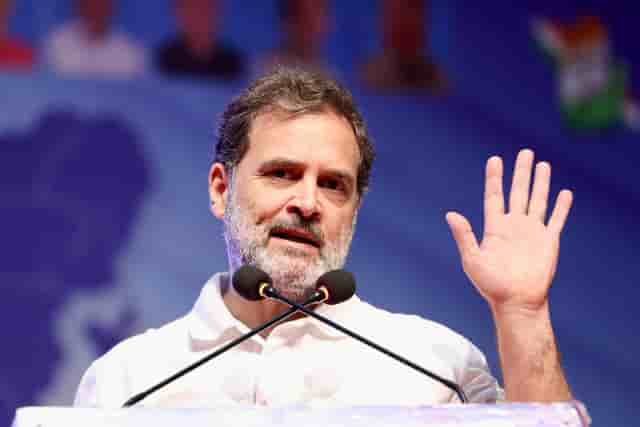
At the INDIA alliance meeting in New Delhi on June 8, 2026, Rahul Gandhi delivered an address that was less a conventional political briefing and more an existential recalibration of the opposition’s grand strategy. By invoking the Shaiva myth of *Neelakantha*—the blue-necked deity who swallows poison to save the cosmos—Gandhi signaled a profound shift in his role within the coalition. He positioned the Congress not as a dominant hegemon, but as an ideological shock absorber willing to bear internal humiliation to forge a unified front.
Beyond the optics of alliance management, the speech offered a stark diagnostic of India’s current political reality and a radical prescription for the future: the declaration that conventional electoral politics is dead, and the era of total resistance has begun.
The Diagnostic: The Myth of the Level Playing Field
The core challenge facing the opposition, according to Gandhi, is a fundamental delusion among its constituent partners. Parties like the Trinamool Congress (TMC), Samajwadi Party (SP), and Rashtriya Janata Dal (RJD) are accused of operating on an outdated playbook, assuming that traditional political instruments still function. Gandhi’s diagnosis is uncompromising: the neutral state no longer exists.
The Institutional Capture
The primary challenge is not merely a formidable political opponent, but the systemic absorption of the state apparatus by the ruling dispensation. Gandhi outlined a multi-layered institutional capture:
*The State Machinery:* The bureaucracy, intelligence agencies, and the legal system are no longer neutral arbiters but active arms of the ruling party’s ideological framework.
*Electoral Integrity:*
The democratic playing field has been fundamentally warped, with Gandhi asserting that elections are systematically manipulated and “stolen,” rendering standard electoral confidence a “dreamland” fantasy.
*Digital and Media Stifling:* The battlefield of public discourse has been algorithmically and structurally rigged. Citing the suppression of his own massive digital footprint, Gandhi warned that the architecture of social and mainstream media is structurally aligned against dissent.
> *”These instruments only worked when the Indian state provided a fair field for them to operate in. That field does not exist anymore… The entire architecture—media, social media, the legal system, bureaucracy, intelligence agencies—is aligned to keep this government in power.”*
>
The Prescription: From Electioneering to Radical Resistance
If the state is captured and the electoral machinery compromised, how does an opposition fight back? Gandhi’s solution is a deliberate regression to the Congress Party’s pre-1927 institutional DNA: transitioning from a standard political party into a decentralized mass resistance movement.
This strategic evolution marks a fundamental departure from the traditional mechanics of representative democracy. In a functioning polity, conventional electoral politics operates on the presumption of a neutral playing field, relying heavily on institutional fairness, balanced media coverage, and autonomous state organs to adjudicate the popular will. However, when systemic institutional capture erodes that neutrality, this traditional framework collapses under its own weight, rendering routine campaigning and standard parliamentary maneuvers entirely ineffective.
To counter this asymmetric deficit, the opposition must pivot toward a model of radical mass resistance. This paradigm relies not on the indulgence of state infrastructure, but on the unyielding spirit of public morality, decentralized citizen action, and spontaneous everyday mobilization. By stripping away the reliance on a compromised political architecture, the struggle is transfigured from a transactional contest for votes into a widespread social movement powered by a shared refusal to accept systemic injustice.
Weaponizing Everyday Grievances
To operationalize this shift, the opposition must pivot from macro-political campaigns to organic, issue-based resistance on the ground. Gandhi explicitly identified contemporary flashpoints as the new frontiers of political warfare:
*Educational Injustice:* Organizing mass movements around the structural failures and leaks in national examinations like *NEET* and *CBSE*.
*Ecological and Tribal Rights:* Converting environmental fights, such as the controversial infrastructure push in *Great Nicobar*, into battlegrounds for constitutional values.
*The Spirit of the Street:* Emulating the physical, mass-mobilization model of the *Bharat Jodo Yatra* to bypass institutional blocks and connect directly with public anger.
Shifting the Cognitive Framework
The strategy demands an internal psychological overhaul within the INDIA alliance. Gandhi argued that the obsession with “winning the next election” is a false premise; public anger is already potent enough to unseat the government. The real challenge is surviving and fighting in an era where free and fair elections are denied. The mindset must shift from defensive defeatism to an absolute, unshakeable belief in victory, regardless of the state’s asymmetrical power.
Navigating the Contradictions of the Coalition
For this strategy of total resistance to succeed, the INDIA alliance must overcome its own internal structural friction. Gandhi addressed these vulnerabilities with a mix of pragmatism and ideological rigidity.
Absorbing Friction, Maintaining Flexibility
Gandhi’s *Neelakantha* metaphor is a direct response to the fractured egos inherent in a multi-party coalition. By offering to happily swallow criticism and humiliation from allies, he attempts to neutralize internal rivalries.
Crucially, he advocated for a multi-tiered approach to alliance dynamics:
*Macro-Unity:*
Total alignment on the overarching “Idea of India” and resistance against the RSS framework.
*Micro-Flexibility:* Acknowledging that local political realities remain messy. Gandhi openly admitted the impossibility of cosmetic unity in states like Kerala, where localized political battles must continue, arguing that the alliance must be flexible enough to accommodate regional conflict without splintering national cohesion.
The Verdict: A High-Stakes Ideological Gamble
Rahul Gandhi’s address represents a definitive break from conventional political pragmatism. By framing the battle against the current regime not as a political contest but as a “spiritual duty,” he is attempting to elevate the opposition’s struggle above the transactional nature of seat-sharing and poll arithmetic.
It is a high-stakes gamble. For regional satraps accustomed to leveraging state power and fighting localized turf wars, the call to abandon traditional political architecture in favor of a nebulous “spirit of resistance” may sound overly idealistic, even dangerous. However, if Gandhi’s diagnosis of absolute institutional capture holds true, this pivot from standard electioneering to relentless, decentralized mass mobilization may well be the only viable path left for the survival of India’s democratic opposition.

~Hasnain Naqvi is a former member of the history faculty at St. Xavier’s College, Mumbai….
The opinions expressed here are solely those of the author.