

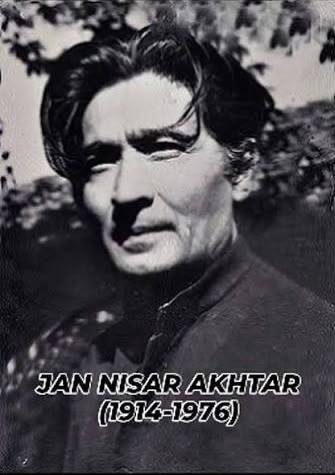
Remembering Jan Nisar Akhtar on His 50th Death Anniversary
Half a century after his passing, the legendary Urdu poet and lyricist remains a monument to poetic integrity, bridging the revolutionary fervour of the progressive movement with the tender romance of Hindi cinema.
On August 19, 2026, half a century has elapsed since Jan Nisar Akhtar departed from the mortal stage, leaving behind a literary legacy that continues to resonate across the cultural landscape of South Asia. To measure his footprint merely as a successful film lyricist of Hindi cinema’s Golden Era, or as the patriarch of a distinguished literary lineage through his son Javed Akhtar, would be to compress a monument into a miniature. Jan Nisar Akhtar was, above all else, a custodian of poetic grace. He belonged to that rare breed of creators who refused to leave poetry at the studio door, treating the silver screen not as a compromise, but as an expansive canvas for literary excellence.
An Inheritance of Verse and Progressive Fire
Born Syed Jaan Nisar Husain Rizvi on February 18, 1914, in Gwalior, verse was both his inheritance and his destiny. His father, Muztar Khairabadi, was a revered Urdu poet, ensuring that young Jan Nisar grew up in an atmosphere drenched in classical cadence and intellectual debate. Moving from his steeped family household to the intellectually vibrant campus of Aligarh Muslim University, he earned his Master’s degree in Urdu before taking up teaching assignments in Gwalior and Bhopal.
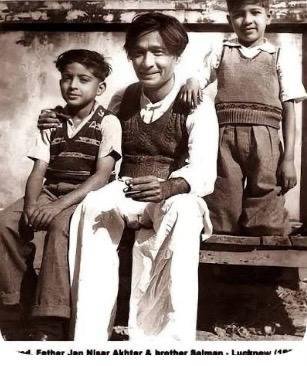
However, the quiet corridors of academia could not hold a mind attuned to the socio-political transformations of a nation on the brink of independence. Akhtar aligned himself with the Progressive Writers’ Movement, forging deep intellectual comradeships with literary luminaries like Mulk Raj Anand, Ali Sardar Jafri, Rajinder Singh Bedi, Kaifi Azmi, Sahir Ludhianvi and Ismat Chughtai. Yet, while many progressives leaned heavily into overt political rhetoric, Akhtar mastered the art of embedding social consciousness within profound personal intimacy.
Cinema as a Testing Ground for Poetic Integrity
When Akhtar transitioned into the Hindi film industry, he brought with him an unyielding reverence for the written word. He famously operated on a singular philosophy:
“Shayari ke baghair main koi geet nahin likh sakta…”
(“Without poetry, I cannot write a song…”)
This was not high-minded pretension; it was his professional credo. When iconic composer O.P. Nayyar once suggested that a lyric contained “too much poetry” for a commercial film, Akhtar reportedly offered a swift, iconic response: “Main film chhod sakta hoon, shayari nahin” (“I can leave films, but never poetry”).
His debut in cinema surfaced with Anarkali (1953) through the delicate track:
“Aa jaane wafa, aa…”
(“Come, O beloved of fidelity, come…”)
Though only one of his songs remained in the film’s final cut, it carried a lyrical delicacy that became his hallmark. His breakthrough arrived with A.R. Kardar’s Yasmin (1955), scored by C. Ramchandra. Songs such as “Mujh pe ilzaam-e-bewafai hai…” (“I stand accused of faithlessness…”) and “Ab woh raatein kahan…” (“Where are those nights now…”), predominantly rendered by Lata Mangeshkar, compressed longing, accusation, and memory into simple yet resonant lines.
Across his career, Akhtar penned only around 151 film songs—a modest output compared to his contemporaries—yet every lyric bore the stamp of a master craftsman unwilling to dilute his diction. From the playful romantic exchanges of C.I.D. (“Aankhon hi aankhon mein ishara ho gaya…” / “In the language of glances, a signal was sent…”) and the classical contours of Ragini (“Man mora bawra…” / “My heart has turned whimsical…”) to the existential melancholy of Kalpana (“Bekasi had se jab guzar jaaye…” / “When helplessness crosses all limits…”), his range was vast. His partnership with Khayyam reached transcendent heights in Noorie (“Aa ja re mere dilbar aa ja…” / “Come back, my beloved, return…”) and the posthumously released Razia Sultan, where “Ae dil-e-nadaan, arzoo kya hai…” (“O innocent heart, what is this longing?”) remains a masterclass in philosophical lyricism.
The Anatomy of a Ghazal: Fire Concealed in Words
Parallel to his cinematic journey, Akhtar’s literary stature flourished through seminal collections such as Nazr-e-Butaan, Salaasil, Javidaan, Pichhle Peher, Ghar Aangan, and his magnum opus, Khaak-e-Dil. Awarded the Sahitya Akademi Award in 1976, Khaak-e-Dil cemented his place in modern Urdu literature as a poet who simplified diction without stripping it of musicality or depth.
Akhtar viewed the ghazal not as a rigid relic of the past, but as a living form capable of modern expression:
“Har chand naya zehan diya maine ghazal ko,
Par aaj bhi dil paas-e-rivayat kare hai…”
(“Though I gave the ghazal a new sensibility,
My heart still honours tradition…”)
For Akhtar, the true craft of the ghazal lay in economy, warmth, and intensity:
“Hum se poocho ke ghazal kya hai ghazal ka funn kya hai,
Chand lafzon mein koi aag chhupa dee jaye…”
(“Ask me what a ghazal is, what constitutes the art of the ghazal:
It is to conceal a burning fire within a handful of words…”)
His command over expression and sensuous imagery was equally distinct:
“Har lafz tere jism ki khushboo mein dhala hai,
Yeh tarz, yeh andaz-e-sukhan hum se chala hai…”
(“Every word is molded in the fragrance of your body;
This cadence, this style of expression began with us…”)
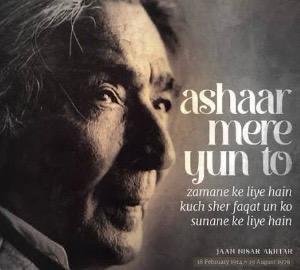
Nowhere is his ability to balance universal human experiences with quiet, intimate rebellion more apparent than in his masterly ghazal “Ash’aar mere yun toh zamane ke liye hain”:
“Ash’aar mere yun toh zamane ke liye hain,
Kuch sher faqat unko sunane ke liye hain…”
(“Though my verses are meant for the world at large,
A few couplets are reserved only for her ears…”)
“Ab yeh bhi nahin theek ki har dard mita dein,
Kuch dard kaleje se lagane ke liye hain…”
(“It is not wise to erase every heartache;
Some pains are meant to be held close to the chest…”)
“Socho toh badi cheez hai tehzeeb badan ki,
Warna yeh faqat aag buzhane ke liye hain…”
(“If you ponder, the grace and culture of the body is a profound thing;
Otherwise, these desires are merely to extinguish a fire…”)
“Aankhon mein jo bhar loge toh kaanton se chubhenge,
Yeh khwaab toh palkon pe sajane ke liye hain…”
(“If you trap them in your eyes, they will prick like thorns;
These dreams are meant only to adorn the eyelashes…”)
“Dekhoon tere haathon ko toh lagta hai tere haath,
Mandir mein faqat deep jalane ke liye hain…”
(“When I look at your hands, it feels as though they exist
Solely to light a sacred lamp in a temple…”)
“Yeh ilm ka sauda, yeh risale, yeh kitabein,
Ik shakhs ki yaadon ko bhulane ke liye hain…”
(“This commerce of intellect, these journals, these books—
Are all merely attempts to forget the memory of one person…”)
A National Curator and Living Legacy
Akhtar’s intellectual stature extended far beyond personal creation. Recognizing his scholarly depth and inclusive vision, India’s first Prime Minister Jawaharlal Nehru entrusted him with compiling a representative anthology of Hindustani poetry spanning three centuries. The landmark compilation, Hindustan Hamara, was later released by Prime Minister Indira Gandhi, serving as a testament to Akhtar’s scholarship and devotion to India’s syncretic literary heritage.
When Jan Nisar Akhtar passed away in Mumbai on August 19, 1976, he left behind a rich tradition that continues through his son, Javed Akhtar who has frequently credited his father with instilling in him the understanding that language must remain alive to its times—stripping away unnecessary ornament to speak directly to ordinary people.
In an era where song lyrics are often treated as ephemeral, Jan Nisar Akhtar stands as an enduring reminder that the foundation of a song is the written word. Melody may carry it, and voices may popularize it, but poetry alone gives it life.
On his 50th death anniversary, we honour not merely a lyricist or a ghazal-go, but a humanist who made Urdu feel like home and cinema feel like poetry.

~Hasnain Naqvi is a former member of the history faculty at St. Xavier’s College, Mumbai….
The opinions expressed here are solely those of the author.