

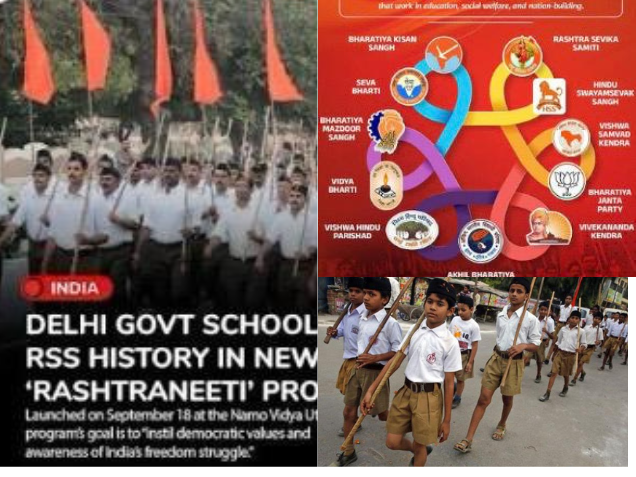
India’s education system stands at a dangerous crossroads. What began as an ideological project of the Rashtriya Swayamsevak Sangh (RSS) to “decolonise the Indian mind,” integrate a selective Indian Knowledge System, and foster pride rooted in Hindutva has steadily moved from the margins of its own school network into the mainstream of public schooling and higher education. Critics correctly call this process the saffronisation of education. Since 2014 it has accelerated through curriculum surgery, institutional appointments and policy design. The result is not merely a contest over textbooks. It is a systematic narrowing of historical understanding, scientific temper and critical inquiry that will shape the minds of an entire generation—and leave them ill-equipped for a competitive, plural, knowledge-driven world.
The Ideological Engine and Its Laboratory
The RSS has long treated education as the primary instrument of cultural transformation. Its principal vehicle, Vidya Bharati Akhil Bharatiya Shiksha Sansthan, founded in 1977, now runs more than 12,000 formal schools educating over 3.3 million students across hundreds of districts. These institutions have served as laboratories. Supplementary texts such as the Sanskriti Bodhmala series credit ancient sages with inventing aviation and plastic surgery, present a golden Hindu past destroyed by foreign invaders, and systematically erase or diminish non-Hindu contributions.
A 1990s National Steering Committee on Textbook Evaluation already warned that such materials promoted “bigotry and religious fanaticism.”
What was once confined to these schools has entered the national bloodstream. Former Union Education Minister Dharmendra Pradhan had publicly acknowledged Vidya Bharati’s role in shaping the National Education Policy 2020. Core Vidya Bharati priorities—mother-tongue emphasis and the institutionalisation of Indian Knowledge Systems—now sit at the heart of official policy. Parallel organisations such as Shiksha Sanskriti Utthan Nyas have pressed for the removal of “historical distortions,” while higher-education think tanks work to de-Westernise campuses. The project is no longer peripheral; it is structural.
Curriculum as Contested Territory
Under the banner of “rationalisation” after the pandemic, the National Council of Educational Research and Training has carried out successive rounds of textbook revision. Entire chapters on Mughal courts disappeared from Class 12 history. References to the Delhi Sultanate, the definition of a mosque, the 2002 Gujarat violence, the 1984 anti-Sikh killings, the Babri Masjid demolition and the subsequent Rath Yatra were diluted or excised. Passages noting that the RSS was banned after Mahatma Gandhi’s assassination vanished from political science texts. Officials insist the changes reduce student burden and correct an alleged over-emphasis on medieval Muslim rule while elevating indigenous Hindu empires. Yet the pattern is consistent: material that complicates a majoritarian narrative is removed; mythic claims of ancient technological supremacy are elevated.
Historian Irfan Habib has described the outcome bluntly: a false narrative fed to young minds produces “an absolutely outrageous vision of India” that threatens the social fabric. Romila Thapar warned years ago that such interventions amount to the “de-intellectualisation of education,” replacing disciplined historical method with political propaganda. Tushar Gandhi observed that the deletions conveniently erase references implicating the Sangh in Gandhi’s murder. When mythology is presented as empirical history and inconvenient violence is declared unfit for classrooms, students are denied the tools of evidence-based reasoning.
Institutional
Capture and the Narrowing of Inquiry
Curriculum change is reinforced by personnel change. Leadership of bodies such as the Indian Council of Historical Research, the Indian Council of Social Science Research and NCERT has shifted toward scholars aligned with a prioritisation of the Vedic past over medieval and modern complexity. Allegations that university vice-chancellors and faculty appointments increasingly favour ideological affinity over pure academic merit are widespread among teacher associations. The effect is cumulative: research agendas, syllabi and classroom discourse tilt in one direction. Critical debate is recast as anti-national; plurality becomes suspect.
The Price Paid by Students and Society
The deepest damage is inflicted on the students themselves. An education that privileges one civilisational narrative, downplays syncretic achievements and treats scientific claims as optional appendages to mythology produces graduates whose historical literacy is partial and whose capacity for independent critical thought is constrained. When Indian Knowledge Systems are reduced to uncritical celebration of ancient texts rather than rigorous comparative inquiry, the scientific temper enshrined in the Constitution is weakened. Claims that plastic surgery or aircraft technology flourished in antiquity, when presented without methodological caution, do not strengthen national pride; they invite ridicule in international academic settings.
Future graduates will compete for places in foreign universities and for jobs in a global labour market that rewards analytical precision, comfort with complexity, and the ability to engage diverse perspectives. Employers and admissions committees look for evidence of rigorous training, not ideological conformity. A cohort raised on selective history and contested science will find itself at a disadvantage against peers from systems that emphasise evidence, debate and global literacy. India’s already high outbound student mobility reflects, in part, a quiet vote of no confidence in the domestic system’s capacity to prepare young people for the highest levels of international competition.
Beyond individual careers lies the societal cost. A generation taught to view large segments of India’s past through a lens of perpetual victimhood and cultural purity is less equipped for the negotiations of a multi-religious, multi-lingual democracy. Polarisation that begins in the classroom migrates into public life, eroding the habits of mutual recognition that hold a diverse republic together. The products of this system risk becoming not confident global citizens but citizens whose mental maps are drawn in monochrome.
Education is the most powerful technology a society possesses for shaping its future. When that technology is captured by a single ideological project, the damage compounds across decades. India does not need less knowledge of its civilisational depth; it needs more rigorous, inclusive, evidence-based knowledge. The alternative is a generation of students who leave school with pride carefully curated and curiosity carefully limited—ill-prepared for the open, demanding, plural world that awaits them.

~Hasnain Naqvi is a former member of the history faculty at St. Xavier’s College, Mumbai….
The opinions expressed here are solely those of the author.