

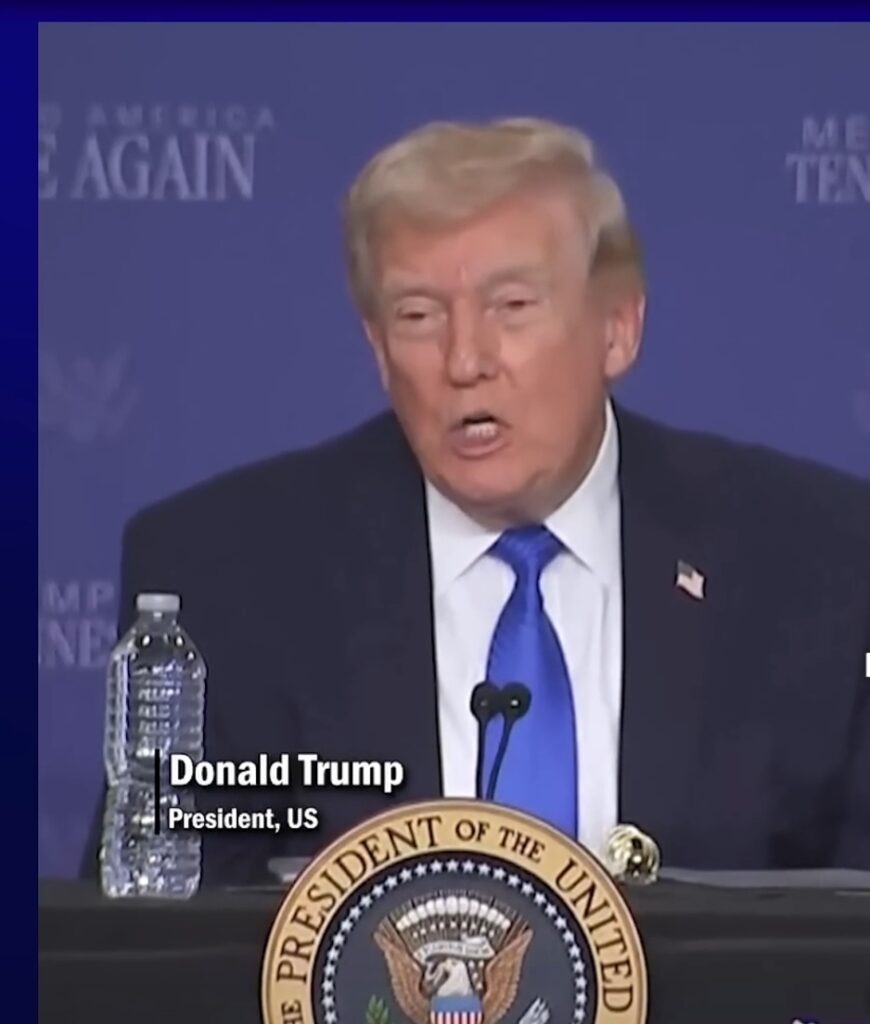
Donald Trump’s latest provocation on Truth Social—reposting a polemic that brands India and China as “hell‑holes on the planet”—has laid bare both the enduring volatility of his rhetoric and the oddly muffled register of India’s official response. The remark, lifted from a US conservative commentator railing against birth right citizenship, is not so much a policy critique as a snapshot of the prejudices that increasingly animate the White House under his second term. That an incumbent American president can still traffic in such language, while diplomats scramble to insist that it “does not reflect” the Indo‑US relationship, speaks less to the resilience of ties than to the fraying patience of New Delhi’s public sphere.
India’s Ministry of External Affairs has, in measured but unmistakable terms, described Trump’s endorsement of the “hellhole” imagery as “uninformed, inappropriate and in poor taste.” Significantly, this rebuke has been confined largely to the diplomatic‑bureaucratic channel; the prime minister himself has yet to address the episode in public, even as opposition parties frame his silence as a price of deference to a mercurial US president. Critics argue that at a moment when India positions itself as a “global swing state,” the absence of a clearer, more personal rebuttal—especially from the head of government—sends its own signal: that the maintenance of transactional leverage with Washington matters more than the symbolic defence of national dignity.
Internally, too, the incident has cut along a predictable fault line. The ruling establishment emphasises continuity in the India‑US strategic partnership, warning that diplomatic rows over social‑media irruptions should not be allowed to disrupt long‑term cooperation. By contrast, the main opposition questions what it calls a “silence” from the prime minister, framing Trump’s remarks as an affront not just to the government but to 1.4 billion Indians and to the diaspora that has long contributed to American dynamism. What is at stake, beyond the immediate insult, is whether India will calibrate its responses to the US by the yardstick of realpolitik alone or occasionally insist on a more assertive defence of its own image.
“Kabhi India aa ke dekho”: Tehran’s jibe and the politics of soft power
If the Trump‑India row reveals the limits of New Delhi’s diplomatic bravado, Iran’s response exposes the theatre in which such slights are now performed. The Iranian consulate in Mumbai, rather than issuing a stilted diplomatic note, posted a short video and a tongue‑in‑cheek message suggesting that Trump might benefit from a “one‑way cultural detox” in India. Under the hashtag “#India Aa ke dekho” (“Come visit India and see it yourself”), the consulate invoked Mumbai’s street food—vada pav, pav bhaji, bun maska—and the linguistic and culinary diversity of South India, playfully contrasting the “hellhole” slur with the everyday pleasures of Indian life.
Iran’s consulates in Mumbai and Hyderabad have thus turned an insult into a soft‑power vignette: a reminder that India’s global image rests not only on strategic alignments and economic data but also on the texture of its streets, languages and cuisines. In one throwaway line about “roti and respect,” and another about India “unlocking its heaven mode” in the south, Tehran’s diplomats have staged a subtle counter‑narrative to the crudeness of Trump’s borrowed rhetoric. For New Delhi, the irony is acute: an Iranian mission, operating in a country often cast as a rival in the West‑Asian theatre, is more willing than India’s own political leadership to dramatise the absurdity of the “hellhole” label.
The episode also underscores the migration of diplomacy from formal communiqués to the vertiginous arena of social media. When an American president speaks in memes and reposts, and foreign consulates respond with montages of heritage sites and street food, the language of international relations acquires a distinctly performative cast. New Delhi’s measured response , while diplomatically defensible, risks being drowned in this visual cacophony unless Indian officialdom learns to match coarse rhetoric with similarly vivid, yet self‑assured, cultural arguments.
In the end, the “hellhole” row is not about whether India is insulted—most nations periodically endure such epithets from world leaders—but about how it chooses to answer. The silence from the top of the Indian government, amid an election‑season campaign, may be read as a calculation of political cost and benefit. Yet, as Tehran’s consulate reminds viewers in Mumbai and beyond, there is another way of responding: by showing, rather than merely explaining, that any country reduced to a single slur on a social‑media feed is, in truth, too vast, too variegated, and too alive to be contained by such a word.
Picture credit social media

~Hasnain Naqvi is a former member of the history faculty at St. Xavier’s College, Mumbai….
The opinions expressed here are solely those of the author.

