

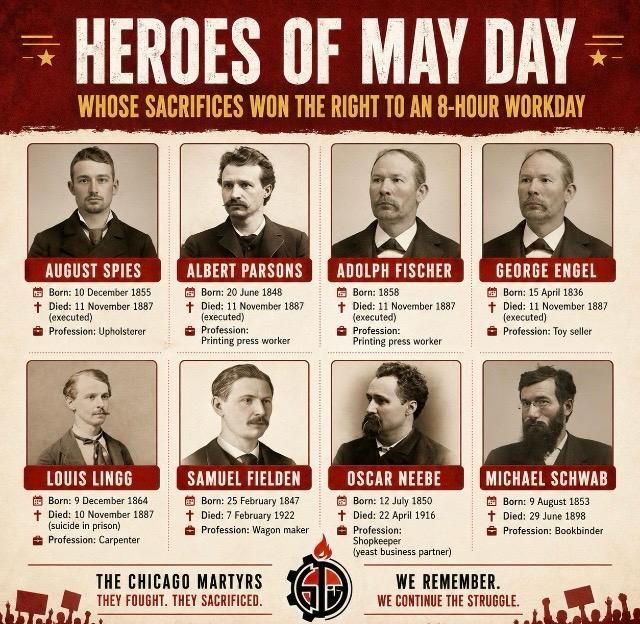
Every May Day, as the world pauses to celebrate the dignity of labor, we stand in the long shadow cast by the gallows of 19th-century Chicago. It is easy to view the modern eight-hour workday as a natural evolution of progress, but history tells a far bloodier and more noble story. We owe our weekends, our evenings, and our rest to eight men—the Chicago Martyrs—whose defiance in the face of industrial tyranny rewrote the social contract of the modern world.
The year was 1886. Chicago was a churning cauldron of industrialization, where men, women, and children were often worked to the point of collapse in 12-to-16-hour shifts. The demand for an eight-hour day was not merely a policy request; it was a plea for humanity. Leading this charge were thinkers and organizers of profound conviction. Among them was *August Spies*, furniture craftsman and brilliant orator, whose final words on the scaffold became a chilling prophecy: *”The time will come when our silence will be more powerful than the voices you are throttling today.”*
The movement reached its tragic zenith at Haymarket Square on May 4, 1886. Following a peaceful rally, a bomb thrown by an unknown assailant led to a police riot and a subsequent legal travesty. Despite a total lack of evidence connecting them to the blast, the leaders of the movement were tried for their ideas rather than their actions. *Albert Parsons*, a printer and editor of *The Alarm*, famously surrendered himself to stand trial with his comrades, choosing the gallows over cowardice. Alongside him stood *Adolph Fischer*, a principled pressman, and *George Engel*, a toy seller who believed deeply in a fairer world for the next generation.
While the gallows claimed four, others suffered in the pursuit of justice. *Louis Lingg*, a carpenter of fierce spirit, cheated the executioner by taking his own life in his cell. *Michael Schwab*, a bookbinder and editor, and *Samuel Fielden*, a teamster, saw their death sentences commuted to life in prison before eventually being pardoned. *Oscar Neebe*, a partner in a yeast business, was also swept up in the state’s fervor, serving years in prison for his association with the pursuit of workers’ rights.
On November 11, 1887—known as Black Friday—Spies, Parsons, Fischer, and Engel were executed. Their deaths did not crush the spirit of labour ; instead, they ignited a global firestorm. By 1889, the Second International declared May 1st a day of international solidarity in their honour. The Martyrs’ sacrifice forced a global reckoning with the exploitation of the working class, eventually leading to the standard labor protections enjoyed by billions today.
As we navigate a new era of labour —marked by the gig economy and digital “hustle culture”—the legacy of the Chicago Martyrs remains a vital compass. They remind us that the struggle for fair conditions is never truly over, and that the rights we hold dear were won through the courage of those who dared to speak when silence was the safer option. Today, we do not just remember their names; we live the freedom they bought with their lives.
~Hasnain Naqvi is a former member of the history faculty at St. Xavier’s College, Mumbai

~Hasnain Naqvi is a former member of the history faculty at St. Xavier’s College, Mumbai….
The opinions expressed here are solely those of the author.