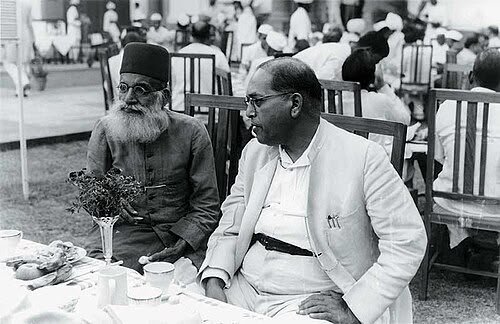
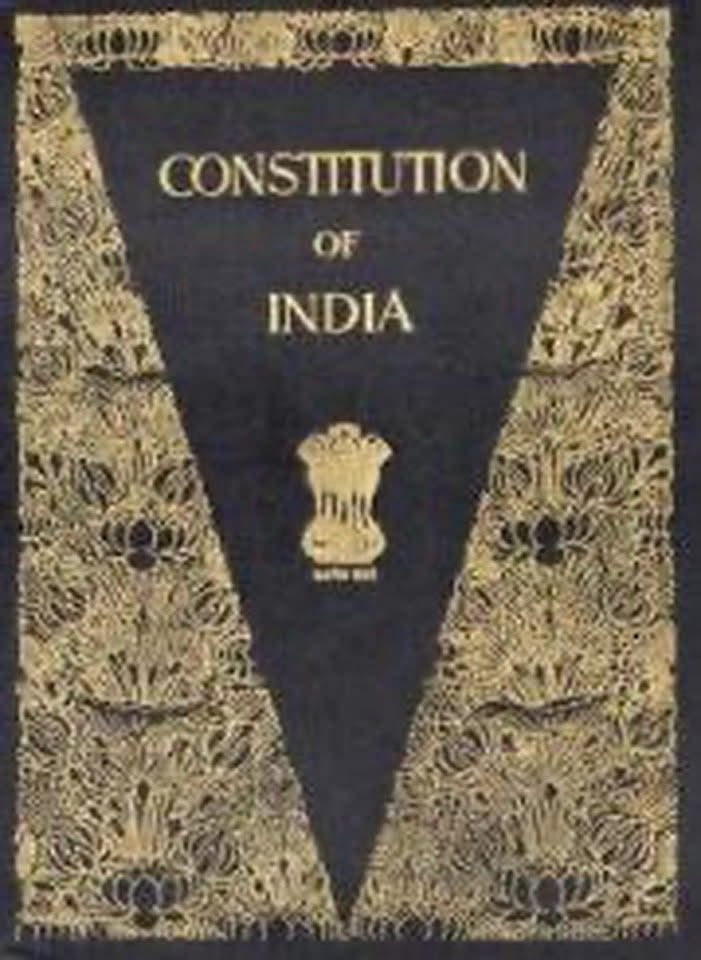
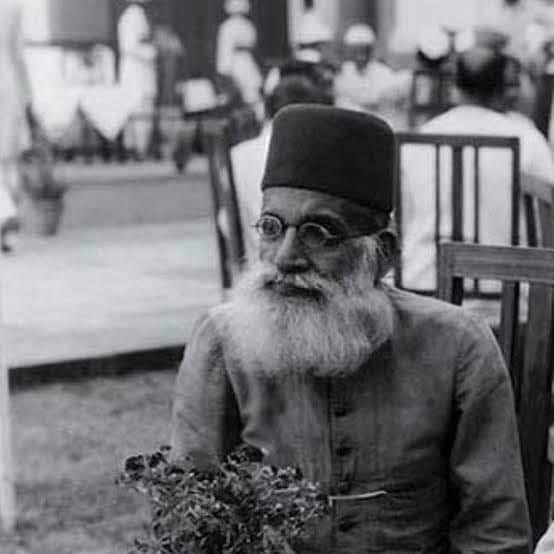
On the afternoon of November 26, 1949, as the President of the Constituent Assembly, Dr. Rajendra Prasad, prepared to put the motion for the adoption of the Indian Constitution to a vote, the historic Constitution Hall in New Delhi crackled with triumph. After two years, eleven months, and eighteen days of painstaking deliberations, three hundred representatives of a newly independent nation were about to give birth to the world’s largest democracy. The room erupted into thunderous applause as the “Ayes” carried the day. Yet, piercing through the chorus of acclamation was a solitary, defiant voice shouting “No!” That lone voice belonged to Maulana Hasrat Mohani—the frail, white-bearded poet-revolutionary in a battered fez, who had given India its most enduring battle cry, “Inquilab Zindabad” (Long Live the Revolution), nearly three decades earlier. Two months later, on January 24, 1950, as members queued up to affix their signatures to the illuminated calligraphic manuscript of the founding document, Mohani cemented his legendary defiance by declining to sign the final draft. Joined by a tiny handful of ideological allies such as Damodar Swarup Seth, Mohani stood out as the most prominent constitutional conscientious objector in modern Indian history. Mohani’s refusal was neither an act of personal petulance nor a rejection of the Indian nation. Rather, it was the culmination of a lifelong commitment to radical democracy, uncompromising anti-imperialism, and socialist federalism. As a founding leader of the Social Democratic Party—the first formal opposition group within the Constituent Assembly—Mohani used his platform to issue prophetic warnings about the dangers of over-centralisation, executive authoritarianism, and the marginalisation of ordinary citizens. Decades later, as legal scholars, historians, and citizens re-examine the origins of the Indian Republic, Mohani’s sharp critique reveals itself not as an eccentric footnote, but as an essential benchmark for measuring the democratic health of the republic.
A Crisis of Legitimacy: Democracy for the Masses or Dictation by the Elite?
At the core of Maulana Hasrat Mohani’s dissent lay a fundamental question of democratic legitimacy: who truly had the moral and political right to frame the supreme law of a free India? The Constituent Assembly had been convened in 1946 under the terms of the British Cabinet Mission Plan. Its members were not elected through universal adult franchise, but indirectly by provincial legislative assemblies that had themselves been chosen under the restrictive rules of the Government of India Act of 1935. Consequently, the electorate represented barely 15 percent of the adult Indian population—dominated by property owners, taxpayers, and the educated elite. Furthermore, the Assembly was structured along communal electorates, partitioning representation between Hindus, Muslims, and Sikhs. To Mohani, this structural flaw compromised the Assembly’s mandate from day one. On November 4, 1948, during the general discussion on the Draft Constitution, Mohani delivered a scathing indictment directly to Dr. B.R. Ambedkar and the Drafting Committee. Thumping his desk, he declared:
“Unless the Constituent Assembly is elected on a non-communal basis and on the basis of adult franchise, you have no right to get a constitution passed by this Constituent Assembly.“
Mohani argued that a document claiming to begin with the majestic preamble “We, the People of India” was suffering from a foundational hypocrisy if “the People” had been systematically excluded from choosing their framers. He contended that a truly sovereign constitution could only emanate from a body directly elected by the working masses, peasants, and disenfranchised millions of the subcontinent. This challenge exposed a deep tension within India’s constitutional moment. While the dominant leadership of the Indian National Congress viewed the Assembly as a pragmatic bridge to statehood, Mohani insisted that compromising on popular sovereignty at the outset would inevitably produce a state apparatus designed to serve elite interests rather than subaltern liberation. For Mohani, a constitution framed by an elite minority could never automatically claim the unreserved consent of the governed.
Federalism vs. Over-Centralisation: A Union of Republics or a New Empire?
If the assembly’s lack of direct popular mandate was Mohani’s first foundational objection, the structural architecture of the proposed state was his second. Mohani was a relentless champion of radical decentralisation and provincial autonomy. His opposition to centralized authority was deep-seated; as early as 1928, he had broken ranks to oppose the Motilal Nehru Report, criticizing its unitary tendencies and advocating instead for a loose, highly autonomous federal framework. When the Constituent Assembly took up the reports of the Union Powers Committee in July and August 1947, Mohani emerged as one of the most vocal critics of the emerging constitutional draft. He watched with growing alarm as the trauma of Partition impelled the majority of framers—led by Jawaharlal Nehru, Vallabhbhai Patel, and Dr. B.R. Ambedkar—to construct a strong Centre equipped with sweeping legislative, financial, and emergency powers. Mohani argued fiercely against this centralizing tide. He insisted that the sequence of constitution-making was fundamentally flawed: by designing an all-powerful Centre first, the Assembly was leaving the provinces with mere leftovers, reducing autonomous regions to glorified administrative municipalities. Speaking during the debates on the division of powers, Mohani delivered a stern warning:
“It would become a purely Indian Empire in which provinces will have no powers. This is my opinion. That is what I am totally opposed to.”
In place of this hyper-centralized structure, Mohani presented an alternative vision inspired by radical socialist confederations. He proposed that India be constituted as a decentralised “Union of Socialist Republics”—a federation of autonomous, self-governing units where sovereignty resided at the grassroots. Below the provincial level, Mohani argued that self-governing village panchayats should form the basic units of political and economic administration. In his model, power would flow upward from the village to the district, the province, and finally to the Union, rather than cascading downward from the imperial desks of New Delhi. Furthermore, he was an early proponent of reorganizing states along linguistic lines to bring governance closer to the people’s native idioms—a demand the Assembly initially shelved, but which the Indian state was ultimately forced to adopt in 1956 under intense popular pressure. Crucially, Mohani made it clear that his defence of provincial autonomy was not born of narrow regionalism or communal defensiveness, but of pure socialist principle. He argued that true socialization of the economy and genuine democratic participation were impossible under a behemoth central state. A centralised Constitution, no matter how noble its welfare promises, concentrated coercive and economic power in too few hands, creating a bureaucratic monolith that would inevitably distance ordinary citizens from the decisions governing their daily lives.
The Shadow of the Colonial Police State: Preventive Detention and Civil Rights
Having spent decades battling British imperialism, Maulana Hasrat Mohani brought a seasoned political prisoner’s skepticism to the Assembly’s debates on fundamental rights and personal liberty. Mohani knew firsthand the crushing weight of state repression. For publishing anti-colonial articles in his journal Urdu-e-Mualla, the British authorities had not only imprisoned him but also subjected him to hard labor—forcing him to grind corn at a hand mill—and levied heavy fines that stripped him of his modest personal possessions. Consequently, when the Drafting Committee introduced provisions allowing for preventive detention without trial and executive emergency powers (which eventually became Articles 22, 352, and 356), Mohani reacted with fierce outrage. He viewed these provisions as direct lineage from the draconian colonial statutes—such as the Rowlatt Act—that the freedom movement had pledged to dismantle. During the intense debates on civil liberties, Mohani repeatedly challenged the inclusion of preventive detention laws in a constitution for a free republic. He demanded rigorous judicial safeguards and the uncompromised protection of the writ of habeas corpus. He warned the House that granting the executive the authority to incarcerate citizens without trial on grounds of “state security” was a fatal concession to authoritarianism. To Mohani, a free India that retained colonial-style detention laws had not truly achieved liberation; it had merely changed the hands holding the keys to the prison cells. He warned his colleagues that powers enacted under the pretext of emergency or national security would inevitably be weaponized against political dissenters, trade unionists, peasant leaders, and religious minorities. History would later vindicate his anxiety, as successive post-independence governments routinely deployed preventive detention legislation to quell political opposition.
Minorities, Secularism, and the Courage of Universal Citizenship
The horrific violence of Partition in 1947 had cast a dark shadow over the Constituent Assembly, leaving Indian Muslims traumatized, politically vulnerable, and uncertain of their status in the new republic. In this volatile atmosphere, many minority representatives sought refuge in legal guarantees such as reserved seats in legislatures, separate electorates, or weightage systems. Mohani’s position on minority rights was both paradoxical and deeply visionary. He refused to seek special political privileges or communal safeguards for his own community. When the Assembly debated reserved seats for religious minorities, Mohani argued strongly against political reservation, opposing any party or electoral structure organized along communal lines. His stance was not a surrender to majority rule, but a profound rearticulation of democratic secularism. Mohani believed that separate electorates and reserved seats were dangerous traps that would permanently segregate minorities into political ghettos, inviting perpetual hostility from the majority. When the Constituent Assembly eventually voted to abolish reservations for religious minorities in 1949, it formally adopted a direction Mohani had supported. However, Mohani’s opposition to communal reservations was contingent on a crucial caveat: minorities would only be safe if the Constitution provided an ironclad, non-negotiable guarantee of individual fundamental rights, freedom of speech, freedom of conscience, and strict state neutrality. He argued that minorities did not need political crutches; they needed a robust, secular democracy where every citizen stood completely equal before the law, protected against state overreach and majoritarian tyranny. Mohani’s convictions were not mere academic exercises; he lived them with extraordinary personal courage. During the height of the anti-Muslim riots in Delhi in late 1947, when many Muslim leaders were fleeing to Pakistan or moving into heavily guarded government compounds, Mohani refused all armed protection. He chose to reside in a small, unpretentious mosque near the Assembly hall, walking alone through the distressed streets of the capital, embodying his faith in the shared humanity of his fellow citizens.
The Saint-Revolutionary: Uncompromising Integrity and Radical Politics
To fully understand Maulana Hasrat Mohani’s constitutional dissent, one must understand the unique synthesis of his personal life and political philosophy. Born Syed Fazl-ul-Hasan in Mohan, United Provinces, in 1875, he was a rare intellectual polymath whose life seamlessly bridged three distinct yet interconnected domains: profound Sufi spirituality, pioneer communist activism, and classical poetic excellence. As a spiritual seeker, Mohani was a devout Sufi Muslim who harbored a lifelong, passionate devotion to Lord Krishna. He routinely wrote tender lyric poetry celebrating Krishna’s divine love and made annual pilgrimages to Mathura for Janmashtami, exemplifying a syncretic Hindu-Muslim heritage that challenged narrow religious orthodoxy. Politically, he operated as a vanguard of the Indian left, co-founding the Communist Party of India at its historic 1925 Kanpur conference, establishing the Social Democratic Party inside the Constituent Assembly, and dedicating his career to proletarian and peasant liberation. In the literary sphere, Mohani was a master of the classical Urdu ghazal—immortalized by works like Chupke Chupke Raat Din—who harnessed the power of poetry for national awakening. In 1921, at the Ahmedabad session of the Indian National Congress, he became the first leader to formally move a resolution demanding Poorna Swaraj (Complete Independence), years before the party adopted it as official policy. It was during this same revolutionary fervor that he coined the immortal slogan “Inquilab Zindabad”, providing the Indian independence struggle with its defining anthem. In an era where political office increasingly brought material comfort, Mohani’s asceticism remained legendary. He consistently refused government accommodations, parliamentary per diems, and official privileges. He traveled to Assembly sessions in cramped, third-class railway compartments, carrying his own meagre belongings tied in a cloth bundle. When he died in Lucknow on May 13, 1951, he left behind no personal property, no real estate, and no bank account—only an unblemished legacy of total political and moral integrity.
An Enduring Prophecy for the Republic
When the Constituent Assembly wrapped up its work on November 26, 1949, Maulana Hasrat Mohani’s solitary vote of “No” was viewed by many of his contemporaries as an impractical, ideological eccentricity. The mainstream press focused on the historic achievement of drafting a unified constitution for a nation of vast diversity. Yet, distance and historical perspective have recast Mohani’s dissent into a profoundly analytical critique of the new republic’s foundation. When viewed against the backdrop of the constitutional majority’s choices, Mohani’s dissent highlighted four fundamental divides that defined the framing of India’s democracy. Where the majority accepted an indirectly elected Assembly under the 1935 Act as a pragmatic necessity to secure immediate statehood, Mohani insisted that absolute legitimacy could only spring from direct elections based on universal adult franchise. On the question of state structure, while the majority chose a hyper-centralized union to safeguard stability in the wake of Partition’s chaos, Mohani advocated for a radical, bottom-up “Union of Socialist Republics” anchored in autonomous village panchayats. Similarly, on civil liberties, the majority deemed preventive detention and executive emergency powers essential safeguards against national disintegration, whereas Mohani fiercely rejected them as colonial relics designed to crush political opposition. Finally, regarding minority security, while the majority dismantled separate electorates in favor of individual equality under a broad state umbrella, Mohani agreed with abolishing communal reservations only on the condition that fundamental rights and individual liberties were made absolute and inviolable against majoritarian overreach. The very issues Mohani raised on the floor of the House—the tension between central authority and state autonomy, the routine abuse of executive emergency provisions, the expansion of preventive detention laws, and the fragile status of minority rights—have remained the central battlegrounds of Indian constitutional politics for over seven decades. Mohani did not refuse to sign the Constitution out of malice toward the young nation, but out of an unyielding devotion to an ideal of freedom that was absolute, decentralized, and genuinely socialist. He refused to settle for a post-colonial order that preserved the authoritarian tools of the British Raj under a new sovereign flag. In revisiting Maulana Hasrat Mohani’s solitary defiance, India is reminded that a democracy’s vitality is measured not merely by the unanimity of its majorities, but by the moral clarity of its grand dissents. His quiet refusal in the historic Constitution Hall remains a living benchmark for an ongoing democratic journey.