

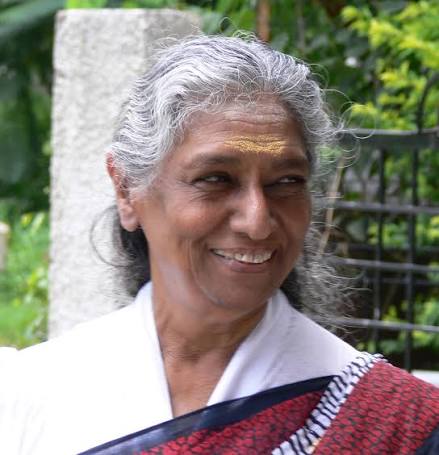
Indian music lost one of its most luminous stars as the legendary playback singer Sistla Janaki—affectionately known to millions as “Janaki Amma” and celebrated as the “Nightingale of South India”—passed away on July 11, 2026, at a private hospital in Mysuru. She was 88. Her demise marks the twilight of a golden epoch in playback singing that spanned nearly seven decades and yielded an astonishing treasury of over 48,000 songs.
A Peaceful Farewell to a Musical Titan
The poignant news of her passing was shared by her granddaughter, Apsara Vydyula, who conveyed that the veteran singer passed away peacefully, surrounded by the warmth and love of her family. Janaki Amma had been receiving intensive medical care in Mysuru, where she spent her retirement years. As word of her passing following cardiac complications spread, a wave of profound grief swept through the cultural landscape of the country. Tributes poured in from cinematic stalwarts like Rajinikanth, Kamal Haasan, Mohanlal, and Mammootty, alongside political leaders who lamented the departure of an irreplaceable national treasure.
From Guntur to the Recording Booths: The Genesis of a Legend
Born Sishtla Sreeramamurthy Janaki on April 23, 1938, in Guntur, Andhra Pradesh, she possessed an organic, chameleon-like genius that largely bypassed formal classical training. Her early foundation in music was shaped under the guidance of a Nadaswaram vidwan, Paidiswamy, but it was her uncanny capacity for vocal mimicry and an expansive vocal range that truly set her apart.
Urged by her family to pursue her gift, she moved to Chennai in her late teens and found employment at AVM Studios. Her playback journey commenced in 1957 with the Tamil film Vidhiyin Vilayattu and the Telugu film M.L.A. Propelled by sheer talent, she recorded in six different languages within her very first year in the industry—a prophetic beginning for a singer destined to transcend linguistic boundaries.
The Alchemist of Human Emotion
Janaki Amma’s voice was never a mere instrument; it was a shape-shifting vessel of human experience. She held a rare ability to alter the texture of her vocals to match the character on screen, flawlessly traversing the entire spectrum of human sentiment. Whether capturing the innocent wonder of childhood, the heavy pathos of heartbreak, the playful mischief of a romantic duet, or the comforting embrace of a maternal lullaby, she completely dissolved the boundary between singer and actor.
Her historic 1962 breakthrough, Singara Velane Deva from Konjum Salangai, remains an unparalleled milestone in Indian music. Singing alongside the complex, cascading notes of maestro Karukurichi Arunachalam’s Nadaswaram, Janaki displayed such breathtaking vocal control and precision that her voice perfectly mirrored the nuances of the classical wind instrument, catapulting her into immediate stardom.
Definitive Partnerships and a Polyglot Legacy
Though Telugu was her mother tongue, Janaki became the heartbeat of South Indian cinema, weaving herself into the cultural memory of Tamil Nadu, Kerala, and Karnataka. In Karnataka, she recorded her highest number of songs, becoming an inseparable part of Kannada cinema’s golden era alongside icons like Dr. Rajkumar and Vishnuvardhan. In Kerala, she was embraced so wholly that generations grew up considering her one of their own; her soulful voice served as the emotional backbone for Mohanlal’s cinematic debut in Manjil Virinja Pookkal.
Her artistic symbiosis with maestro Ilaiyaraaja produced a matchless string of classics. Beginning with his debut film Annakili (1976), Ilaiyaraaja recognized Janaki as his most expressive interpreter, capable of translating his complex rural and semi-classical melodies into enduring masterpieces. Decades later, she continued to enchant younger generations under the baton of A.R. Rahman, lending her voice to unforgettable tracks like Ottagathai Kattikko and Nenjinile Nenjinile.
A Legacy of Fierce Integrity
Over her illustrious career, Janaki was decorated with four National Film Awards for Best Female Playback Singer and a staggering 33 State Film Awards across multiple regions. Yet, her greatness lay not in the trophies she accumulated, but in her unyielding artistic integrity.
In 2013, when the Government of India announced the Padma Bhushan for her, she famously and politely declined the honour. With characteristic candor, she stated that the recognition had come much too late in her half-century-long career, choosing instead to advocate for timely appreciation for South Indian artists while they were active. For Janaki Amma, the unconditional love of her listeners was the only accolade that truly mattered.
The Swan Song and an Eternal Echo
In 2016, she brought her recording career to a poetic close with the touching Malayalam lullaby Ammapoovinum from the film Pathu Kalpanakal. Fittingly, her final public concert took place in October 2017 in Mysuru—the historical city she chose as her retirement home, away from the media glare. Her choice to spend her final years and have her last rites performed in Mysuru brought her lifelong relationship with Karnataka to a full-circle conclusion.
The Southern Nightingale has fallen silent, but her voice remains indestructible. It lives on in the rustle of old film reels, the quiet comfort of a mother’s lullaby, and the timeless melodies that continue to soothe a billion hearts. Janaki Amma has left the stage, but her song will echo forever.

~Hasnain Naqvi is a former member of the history faculty at St. Xavier’s College, Mumbai….
The opinions expressed here are solely those of the author.

