

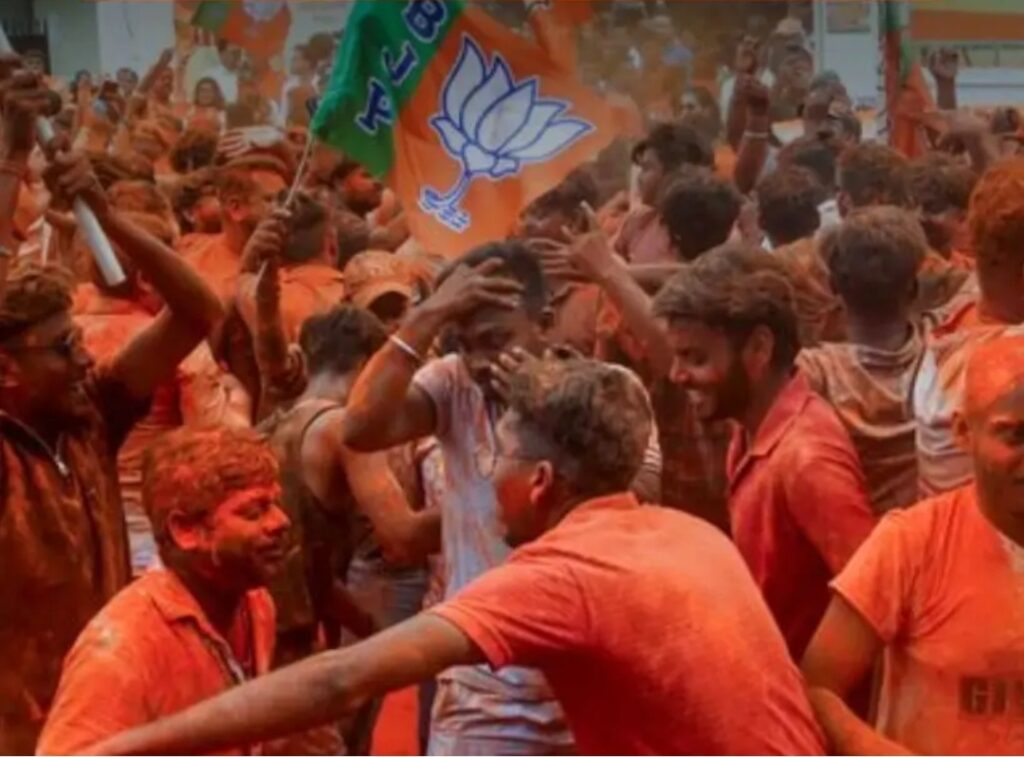
Despite a historic conquest in West Bengal and dominance in the North, the BJP’s ‘One Nation, One Culture’ narrative faces a stubborn checkmate in Tamil Nadu, Kerala, and Puducherry.
In the grand chessboard of Indian politics, the Bharatiya Janata Party (BJP) has emerged as a near-invincible titan in the North and West, and most recently, a historic victor in the East with its May 2026 breakthrough in West Bengal. Yet, as the dust settles on another cycle of high-stakes elections, a stark geographic reality remains: the three southern territories of Tamil Nadu, Kerala, and Puducherry continue to represent an impenetrable fortress against the saffron surge.
Despite a decade of high-decibel campaigning, the BJP failed to secure even 10 seats out of the 404 available across these regions. This isn’t merely an electoral loss; it is a profound cultural and ideological rejection that persists even in a post-2024 landscape where the party has otherwise expanded its footprint.
*The Ideological Moat: Dravidianism vs. Hindutva*
The most formidable barrier in Tamil Nadu remains the deeply entrenched Dravidian ideology. For nearly a century, the politics of the state has been defined by a rejection of what is perceived as “Northern cultural hegemony.” While the 2026 elections saw a tectonic shift with actor Vijay’s *Tamizhaga Vettri Kazhagam* (TVK) disrupting the DMK-AIADMK duopoly, the underlying current remains fiercely regional.
The BJP’s centralizing “One Nation” slogans—whether regarding language (Hindi) or a monolithic religious identity—clash violently with the South’s decentralised, caste-inclusive social justice model. In Tamil Nadu, the BJP is still widely viewed as a “Brahmin-Baniya” party from the Hindi heartland, a perception that even the most grassroots outreach has struggled to erase.
*The ‘Southern Model’ of Faith*
In Kerala and Tamil Nadu, the practice of Hinduism does not easily translate into the political “frenzy” seen in states like Uttar Pradesh or Madhya Pradesh. Religion in the South is often a deeply personal, ritualistic, and community-oriented experience rather than a tool for political mobilization.
In Kerala, the socio-religious fabric is woven with a significant Christian and Muslim presence (nearly 45% of the population), making the BJP’s brand of majoritarianism a mathematical and social challenge. While the party managed a historic breakthrough in 2026 by winning three seats—including Nemom and Kazhakoottam—the state overall returned the Congress-led UDF to power, preferring a secular alternative over the BJP’s polarizing rhetoric.
*Development: A Redundant Sales Pitch?*
The BJP’s primary electoral weapon—the “Double Engine” development model—often falls on deaf ears in the South. According to NITI Aayog’s Sustainable Development Goals (SDG) India Index and various health surveys, Kerala and Tamil Nadu consistently top the charts in literacy, infant mortality rates, and life expectancy.
When BJP leaders campaign on a platform of progress, southern voters often look at the developmental lag in BJP-ruled heartland states and find the pitch unconvincing. To a voter in Chennai or Thiruvananthapuram, the BJP isn’t offering a step up; it is offering a model they feel they surpassed decades ago.
*The Leadership Vacuum and the Linguistic Divide*
The language barrier remains the BJP’s Achilles’ heel. While Prime Minister Narendra Modi has made frequent visits, often quoting Thirukkural or wearing traditional attire, the party lacks a local “Mass Leader” who can articulate its vision in the vernacular without sounding like a translation of a Delhi-scripted speech.
In the 2026 Assembly elections, the rise of TVK’s Vijay demonstrated that South Indian voters are willing to embrace new alternatives, but they prefer them to be homegrown. The BJP’s reliance on Delhi-centric leadership creates a disconnect that no amount of social media engineering has yet been able to bridge.
*The 2026 Verdict: A New Political Map*
The latest results from May 2026 underscore this divergence. While the BJP celebrated a landslide in Assam and a “Poriborton” (change) in West Bengal, the South remained a different story:
*Tamil Nadu:* Vijay’s TVK swept 108 seats, proving that the vacuum left by the decline of traditional Dravidian giants is being filled by new regional forces, not national ones. The BJP, allied with AIADMK, remained a marginal player.
*Kerala:* The Congress-led UDF comfortably displaced the LDF. The BJP’s three-seat win is a “bloom” in the desert, but hardly a forest.
*The Southern Synthesis: Beyond the Saffron Horizon*
The BJP’s failure in the South is not for lack of trying, but for a lack of “tuning.” As long as the party is perceived as a force that seeks to homogenize India’s diverse linguistic and cultural identities, the Vindhya mountains will remain a formidable wall. For the BJP to truly conquer the South, it may need to stop trying to make the South like the North, and instead, learn to speak the language—both literal and political—of the Deccan.

~Hasnain Naqvi is a former member of the history faculty at St. Xavier’s College, Mumbai….
The opinions expressed here are solely those of the author.