

From Parliament to the Streets, Has the Congress Leader Redefined the Role of the Opposition?
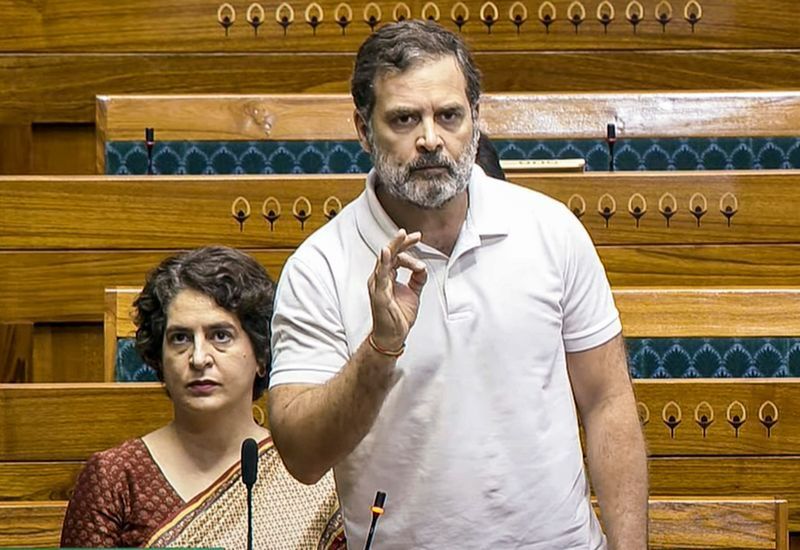
Two years after assuming office as the Leader of the Opposition (LoP) in the Lok Sabha on 26 June 2024, Rahul Gandhi has transformed a constitutional position that had remained vacant for a decade into one of the most visible centres of political contestation in contemporary India. Whether one agrees with his politics or not, his tenure has altered the character of opposition politics by combining parliamentary interventions with sustained public mobilisation.
The office of the Leader of the Opposition is not merely ceremonial. It exists to scrutinise the executive, defend constitutional institutions, articulate public grievances and ensure that democracy remains accountable. Judged against these parameters, Rahul Gandhi’s tenure has been marked by an unusual blend of legislative engagement, nationwide campaigns and issue-based politics.
As he completed two years in office, Gandhi stated that every day of his tenure had been devoted to carrying “the voice of every Indian to the corridors of power”, promising to continue fighting “from the streets to Parliament” for constitutional values, electoral integrity, social justice and the rights of ordinary citizens. Recent summaries released by the Congress also highlight his interventions on electoral reforms, education, social justice, unemployment and environmental protection.
Reclaiming the Opposition’s Constitutional Space
One of Rahul Gandhi’s most significant political achievements has been restoring visibility to an office that had effectively disappeared during the previous decade because no opposition party had secured the required numerical strength.
Since June 2024, Parliament has witnessed a more assertive opposition that has consistently questioned the government on unemployment, inflation, caste census, federalism, national security, foreign policy, social justice and alleged institutional erosion. Gandhi has frequently argued that Parliament must remain a forum for accountability rather than merely endorsing executive decisions.
His speeches have often centred on defending the Constitution, warning against concentration of power and emphasising that democratic institutions derive legitimacy from public trust rather than executive authority.
Electoral Integrity and the “Vote Chori” Campaign
Perhaps no issue has occupied Gandhi’s political agenda more consistently than electoral transparency.
Over the past two years, he has repeatedly alleged that India’s electoral process requires greater scrutiny, raising questions regarding voter rolls, electoral management and the functioning of the Election Commission. His campaign, popularly framed around the slogan of “Vote Chori” (vote theft), has sought to bring technical electoral procedures into mainstream political debate.
Whether one accepts these allegations or not, Gandhi has compelled public discussion on electoral accountability, voter registration, deletion of names, transparency in election management and institutional independence. These interventions have placed the Election Commission itself under greater public scrutiny while intensifying demands from sections of the opposition for electoral reforms.
The campaign has arguably succeeded in making electoral integrity a central political issue rather than a technical administrative subject.
Championing Students and India’s Youth
If electoral reforms formed one pillar of Rahul Gandhi’s politics, education and youth issues constituted another.
Repeated examination controversies—including allegations relating to NEET, paper leaks and irregularities affecting competitive examinations—enabled Gandhi to position himself as one of the most vocal parliamentary advocates for students.
His interventions consistently focused on the anxiety of millions of young Indians confronting examination uncertainty, unemployment and shrinking opportunities. He accused the government of failing to safeguard merit and repeatedly demanded institutional accountability following examination controversies.
The nationwide “Chhatron Ki Goonj” campaign further extended these concerns beyond Parliament. Through direct interaction with students, aspirants and youth organisations, Gandhi attempted to convert scattered educational grievances into a broader national conversation on educational justice, employment and governance.
Unlike traditional political rallies, these engagements were designed as listening exercises where students narrated experiences concerning examinations, admissions, evaluation systems and career insecurity.
Speaking for the Marginalised
Rahul Gandhi’s political messaging has increasingly revolved around communities he describes as those “left behind” by economic growth.
His sustained advocacy for a nationwide caste census, expansion of affirmative action, protection of constitutional safeguards and greater representation for Scheduled Castes, Scheduled Tribes, Other Backward Classes, minorities and economically weaker citizens reflects this approach.
His parliamentary interventions have repeatedly connected unemployment, inequality and social exclusion with broader questions of democratic representation.
Supporters view this as an attempt to revive welfare-oriented politics rooted in constitutional justice; critics argue that it reinforces identity-based mobilisation. Regardless of political interpretation, social justice has remained one of the defining themes of his tenure.
Environment versus Development: The Great Nicobar Question
Among the less publicised yet significant aspects of Gandhi’s opposition politics has been his intervention on environmental governance.
He has questioned the ecological implications of the proposed Great Nicobar infrastructure project, expressing concern regarding its impact on fragile ecosystems, biodiversity and indigenous tribal communities.
His position has reflected a wider argument that infrastructure development must be balanced with environmental sustainability and constitutional protections for vulnerable communities.
By foregrounding the Great Nicobar project, Gandhi broadened opposition politics beyond electoral issues to include climate change, conservation and ecological justice.
Politics Through Public Contact
Rahul Gandhi’s politics has increasingly relied upon sustained public engagement rather than exclusively parliamentary interventions.
His earlier nationwide yatras fundamentally reshaped his public image by projecting accessibility and direct engagement. During his tenure as LoP, this style continued through frequent visits to universities, farmers, labour groups, youth organisations, Dalit settlements, tribal communities and disaster-affected regions.
Rather than limiting opposition politics to press conferences and parliamentary speeches, Gandhi sought to combine legislative oversight with grassroots mobilisation.
This strategy reflects an attempt to redefine opposition leadership as continuous public engagement rather than episodic electoral campaigning.
Changing the Political Conversation
Perhaps Rahul Gandhi’s most enduring contribution has been altering the vocabulary of opposition politics.
Terms such as constitutional protection, institutional independence, caste census, unemployment, paper leaks, electoral transparency and social justice have increasingly become recurring features of national political discourse.
His interventions have often compelled both Parliament and the ruling establishment to respond to issues that might otherwise have remained peripheral.
Whether this has translated into electoral gains remains uncertain. However, it has undoubtedly reshaped public debate.
An Incomplete but Consequential Tenure
Rahul Gandhi’s report card after two years is neither one of unqualified success nor one of political failure.
His critics continue to question Congress’s organisational weaknesses, limited electoral expansion and his ability to convert issue-based campaigns into durable political victories. Others argue that allegations regarding electoral manipulation require substantiation through institutional and legal processes rather than political rhetoric.
Yet even critics acknowledge that he has emerged as the principal national face of opposition politics, restoring visibility to an office that had been absent for ten years.
In parliamentary democracies, the strength of the opposition is measured not only by the number of seats it commands but also by its ability to question authority, amplify public grievances and defend constitutional accountability.
Judged by that broader democratic standard, Rahul Gandhi’s first two years as Leader of the Opposition have restored political contestation to the centre of Indian democracy. Whether these interventions ultimately reshape India’s electoral landscape will depend not only on his leadership but also on the ability of the wider opposition to convert public engagement into sustained political organisation.
As Rahul Gandhi himself observed on completing two years in office, “The journey is long.” The next phase will test whether his activism as Leader of the Opposition can evolve into an alternative governing vision capable of persuading a broader electorate.

~Hasnain Naqvi is a former member of the history faculty at St. Xavier’s College, Mumbai….
The opinions expressed here are solely those of the author.

