

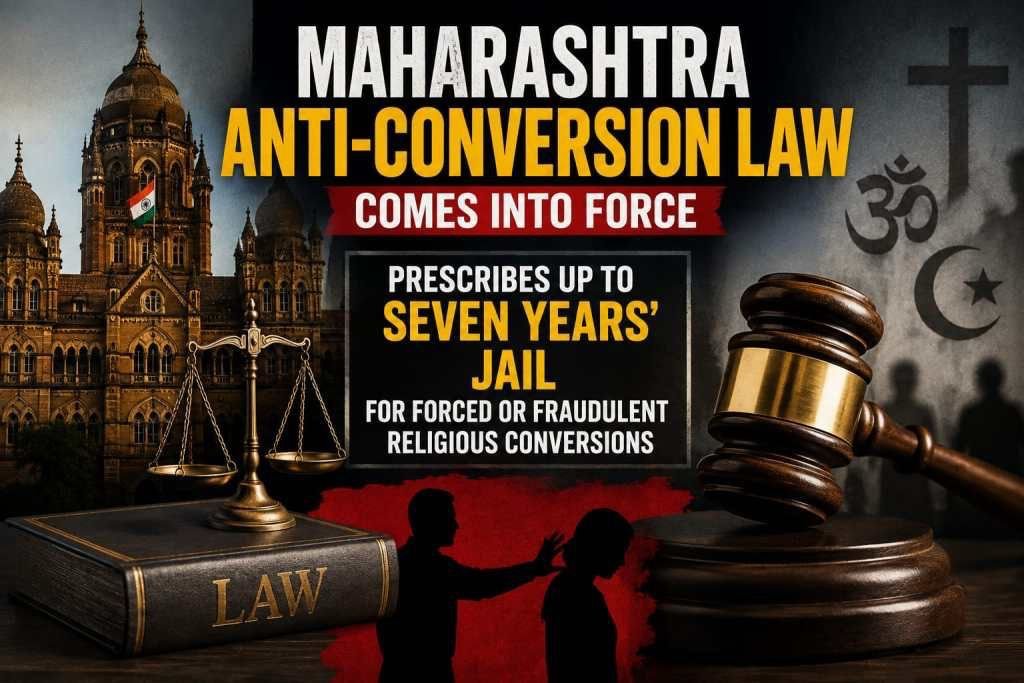
A law ostensibly enacted to protect religious freedom risks turning freedom of conscience into a matter of police scrutiny, bureaucratic permission and family objection
Maharashtra will witness a fundamental change in the relationship between the citizen and the State when the Maharashtra Freedom of Religion Act, 2026 comes into force across the state on August 28. Officially presented as a law to protect people from coercion, fraud, inducement and forced religious conversion, it has been welcomed by the government as a safeguard for religious freedom. But its architecture raises a more disturbing question: can freedom of conscience really be protected by placing the private decision to change one’s faith under an elaborate regime of prior notice, public disclosure, police inquiry and criminal suspicion?
The Act deserves serious scrutiny not because the State has no legitimate interest in preventing coercion or fraud—it plainly does—but because it goes considerably beyond punishing demonstrable coercion. It regulates the circumstances in which an adult may exercise one of the most intimate choices recognised by the Constitution: what to believe.
A law born without adequate democratic consultation
The most troubling feature of the legislation is the process through which it travelled from proposal to statute.
The Bill was introduced in the Maharashtra Assembly in March and passed by both Houses within days. Opposition parties sought referral to a Joint Select Committee and public consultation, but those demands were not accepted.
To be precise, the government says a special committee comprising the Director General of Police and officers of concerned departments examined conversion and studied similar laws in other states. The Bill’s Statement of Objects and Reasons refers to this committee. But that is not the same thing as an independent commission empowered to establish, through publicly verifiable evidence, the scale and nature of forced conversion in Maharashtra.
That distinction matters. A law imposing criminal penalties and interfering with privacy requires more than an administrative assertion that unlawful conversions are increasing. Where is the publicly available empirical evidence demonstrating the magnitude of the problem? Where are the statistics establishing that existing criminal laws are inadequate? Where is the independent assessment of the alleged phenomenon?
Advocate Lara Jesani of the People’s Union for Civil Liberties put the question bluntly: “There is no data on forced conversions.” She has also questioned why the government did not first establish whether such a law was actually necessary.
Thirty-five civil-society organisations, including women’s, civil-liberties, minority-rights and social-justice groups, opposed the proposal and demanded wider consultation. Teesta Setalvad of Citizens for Justice and Peace argued that the legislation violates constitutional guarantees of life, liberty, privacy and freedom of religion.
A government may win a vote in the legislature. It cannot, however, substitute legislative arithmetic for constitutional deliberation.
When choosing a faith becomes a bureaucratic event
The Act’s most intrusive feature is its elaborate procedure for a supposedly voluntary conversion.
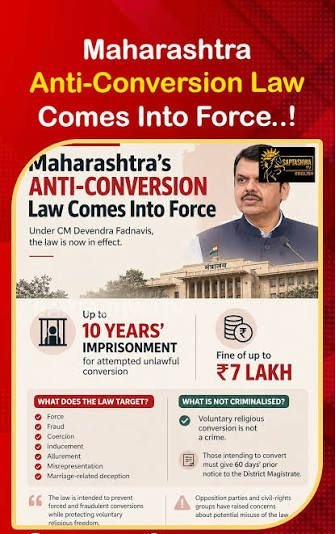
An individual intending to convert must give 60 days’ prior notice to the competent authority. The notice is then publicly displayed and objections may be invited. A police inquiry can follow into the intention, purpose and circumstances of the proposed conversion. After conversion, a declaration containing personal details must also be submitted within the prescribed period. Failure to comply can render the conversion legally void.
This transforms an intensely personal decision into a quasi-public administrative proceeding.
Imagine an adult woman deciding to embrace another faith after months or years of personal reflection. Why should she be required to announce that decision to the State before exercising it? Why should strangers be invited to object to her conscience? Why should police officials investigate the authenticity of her belief?
The Constitution does not make religious freedom conditional upon social approval.
The Supreme Court’s jurisprudence points in the opposite direction. In Shafin Jahan v. Asokan K.M., the Court emphasised that matters of faith and marriage fall within an area where individual autonomy is supreme and that the State cannot dictate whom an adult should marry or how that person should exercise intimate choices.
The nine-judge Bench in K.S. Puttaswamy recognised privacy as encompassing decisional autonomy—the ability to make intimate and personal choices free from unnecessary State interference. More recent Supreme Court jurisprudence has reiterated that privacy protects individual autonomy and dignity.
The constitutional question, therefore, is not whether the State can punish coercion. It unquestionably can. The question is whether it can construct a surveillance architecture around consensual belief in order to identify coercion before it has occurred.
The dangerous elasticity of “allurement”
The Act also adopts an unusually expansive concept of “allurement”. The statutory definition encompasses gifts, money, employment, free education, promises of marriage, better lifestyle and divine healing, besides portraying one religion in a detrimental manner vis-à-vis another. The legislation also refers to “brainwashing through education”—a phrase whose breadth invites serious concern.
This is where legitimate protection against fraud can blur into regulation of religious persuasion.
Religions necessarily propagate ideas. Religious institutions run schools, hospitals, charitable programmes and social-service organisations. Religious communities also speak about healing, salvation and their understanding of a better life. Drawing a legally precise line between legitimate religious activity and criminal “allurement” will be extraordinarily difficult.
Asaduddin Owaisi questioned the breadth of the “brainwashing through education” provision, asking in substance whether studying a holy book with a religious scholar could itself be construed as brainwashing.
The question is not frivolous. Criminal law must satisfy the principle of legality: citizens should be able to know in advance what conduct constitutes an offence. Vague terminology becomes particularly dangerous when the consequences include arrest, non-bailable prosecution and imprisonment.
The burden of proof—and the presumption of suspicion
The Act makes offences cognisable and non-bailable and places the burden of establishing that a conversion was lawful on the person accused of facilitating it. Penalties can reach seven years’ imprisonment, with enhanced punishment in cases involving women, minors, Scheduled Castes, Scheduled Tribes and other protected categories; repeat offenders can face up to ten years and a substantial fine.
Protection of vulnerable people is obviously legitimate. But a legal framework that begins with suspicion and then requires the accused to establish innocence risks weakening one of the most important safeguards of criminal justice.
The problem is compounded by the Act’s provision allowing the convert’s parents, siblings and other relatives connected by blood, marriage or adoption to lodge complaints. Police can also take suo motu cognisance.
In a deeply patriarchal society, this is particularly consequential for women.
Lara Jesani has warned that such a law can become a weapon “in the hands of families, vigilante groups and the state machinery” to prevent women from marrying partners of their choice or converting voluntarily.
That is not an abstract concern. The Supreme Court has repeatedly held that adult citizens possess autonomy in choosing their partners and that social disapproval cannot override constitutional liberty.
From “love jihad” politics to legal suspicion
The government insists that the legislation is religion-neutral and targets only unlawful conversion. Chief Minister Devendra Fadnavis has defended it on precisely those grounds.
The text of the law indeed does not name any religion.
But laws operate within political contexts. Civil-society groups have pointed to the wider political discourse surrounding “love jihad”, a phrase that has no legal definition and has repeatedly been invoked to cast suspicion upon interfaith relationships. The People’s Union for Civil Liberties has specifically warned against allowing such narratives to influence legislation governing intimate choices.
The danger is that a formally religion-neutral statute may have unequal social consequences if complaints disproportionately target particular religious minorities or interfaith couples.
The first warning has already arrived
The most revealing warning may have come even before August 28.
Pune police invoked the new Act in two cases registered on August 5 and 9—before the officially notified commencement date. After the Home Department clarified that the Act would come into force only on August 28, police removed the Act’s provisions from both cases. The Pune Police Commissioner acknowledged that the police had assumed the law was already operational.
This episode should alarm anyone concerned about rule-of-law safeguards. If a complex new criminal statute can be invoked by police before its commencement, the government must explain what mechanisms will prevent more serious errors once the law is fully operational.
The issue is not merely bureaucratic competence. An erroneous invocation of a non-bailable criminal provision can mean arrest, stigma, financial ruin and social ostracisation even if the allegation ultimately collapses.
Maharashtra deserves better than a politics of suspicion
Maharashtra has a proud history of social reform—from Jyotirao Phule and Savitribai Phule to Dr B.R. Ambedkar and the state’s long traditions of rationalism, social justice and individual emancipation.
That legacy should make Maharashtra especially cautious about allowing the State to enter the most private chambers of human conscience.
The Supreme Court in Rev. Stanislaus upheld laws against conversion by force, fraud and inducement. That judgment provides no licence for the State to treat every voluntary conversion as presumptively suspect. The constitutional task is to distinguish coercion from consent, fraud from belief, exploitation from persuasion—and to punish the former without criminalising the latter.
The Maharashtra government could have chosen a narrower law focused squarely on demonstrable coercion, fraud and exploitation. Instead, it has created an elaborate regulatory framework involving advance notice, public objections, police inquiry, declarations, relatives’ complaints, reverse burdens and severe criminal penalties.
That is why the Act deserves judicial scrutiny.
The real test of a democracy is not whether the State can protect citizens from coercion. It is whether, while doing so, it can resist the temptation to decide what citizens may believe, whom they may love and how privately they may change their faith.
A truly free Maharashtra should protect the convert from coercion—and protect the citizen from the State.
The right to conscience cannot become a privilege granted after permission.
It is a constitutional freedom.

~Hasnain Naqvi is a former member of the history faculty at St. Xavier’s College, Mumbai….
The opinions expressed here are solely those of the author.