

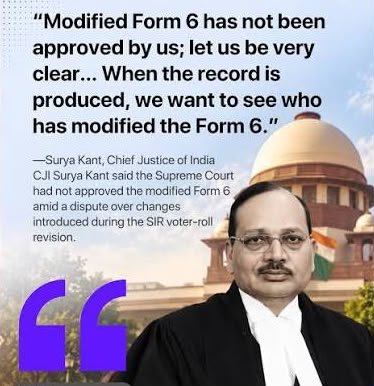
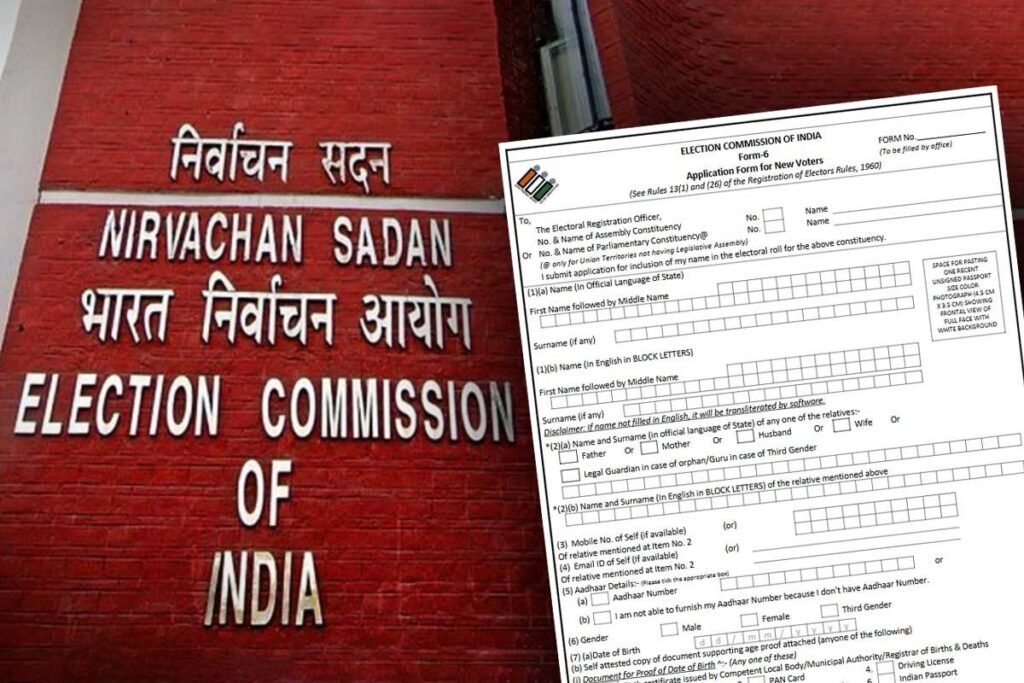
The architecture of democratic institutions rests on a simple but non-negotiable premise: those charged with safeguarding the electoral process must themselves operate within the bounds of collective responsibility and statutory restraint. On 5 October 2026, a three-judge bench of the Supreme Court, led by Chief Justice of India Surya Kant, delivered an oral observation that cut through layers of institutional defence with unusual clarity. The Court stated, without ambiguity, that any modifications to Form 6—the foundational application through which citizens seek enrolment as new voters—had not been made by the judiciary. That single sentence dismantled a carefully constructed narrative and exposed deeper fractures within the Election Commission of India.
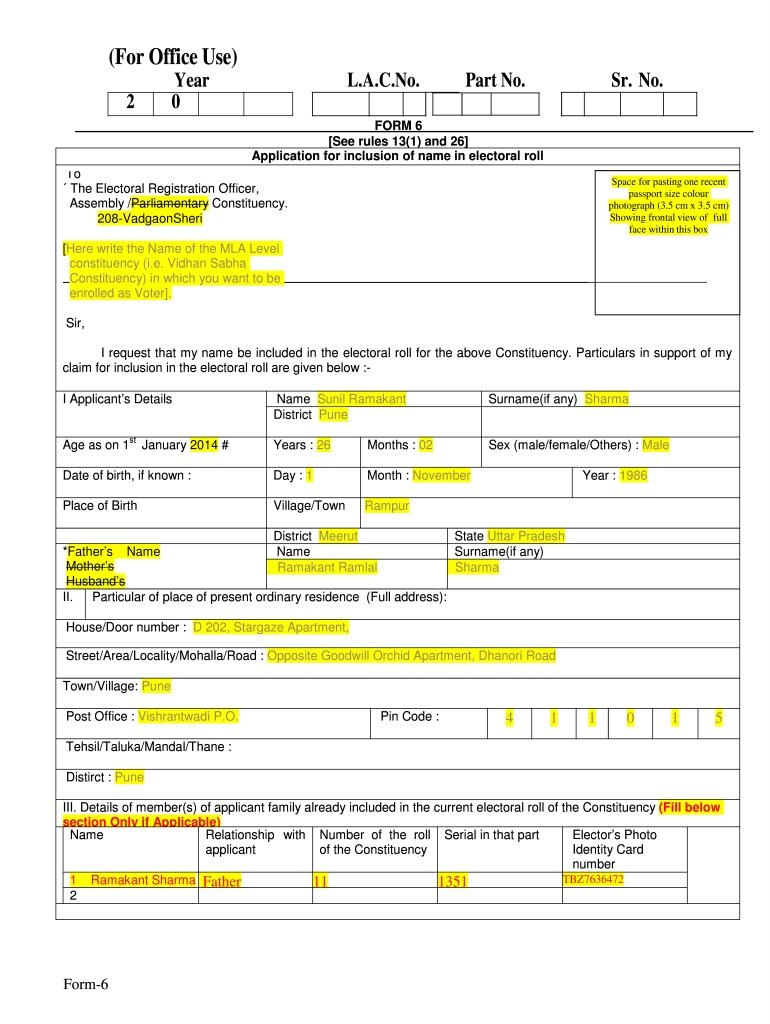
Form 6 is no ordinary bureaucratic document. It is the gateway through which the constitutional right to vote is claimed. Any alteration to its structure, particularly the insertion of new questions linked to intensive revision exercises, carries consequences that reach far beyond administrative convenience. The Court’s disavowal therefore goes beyond a technical correction. It raises fundamental questions about how such changes were authorised, whether the multi-member character of the Commission was respected, and what accountability mechanisms remain when internal dissent is sidelined.
The Shadow of Unilateral Decision-Making
The controversy surrounding Form 6 did not arise in a vacuum. For nearly a year, serious questions had circulated about the functioning of the three-member Commission. Two Election Commissioners had recorded formal written objections on multiple occasions spanning ten months. Their concerns centred on decisions, software changes and administrative directives issued during the Special Intensive Revision of electoral rolls without the knowledge or concurrence of the full body. For more than four months, full-commission meetings were not convened. Orders continued to be issued, agendas were not circulated in the ordinary course, and official minutes of collective deliberation were absent.
Against this background, the modification of Form 6 became a flashpoint. New questions were introduced and linked directly to the intensive revision process. These changes were implemented despite recorded dissent. The result was an administrative process that appeared to invert the statutory requirement of collective functioning. Under the governing legislation, the Commission is required to strive for unanimity. Where consensus proves elusive, decisions must rest on a clear majority. The operational pattern under scrutiny suggested that this framework had been set aside in favour of individual authority.
A Defence That Collapsed in Open Court
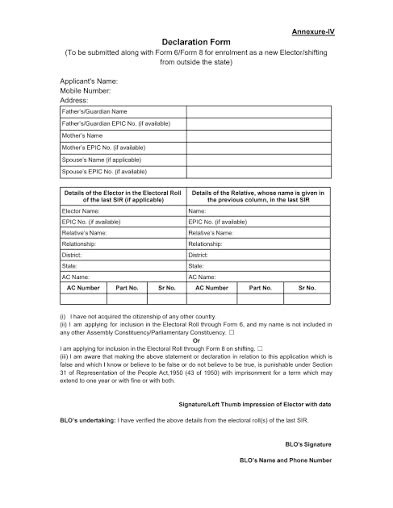
When public scrutiny intensified, the Commission sought to defend the alterations by invoking judicial endorsement. In a formal press release, it asserted that the modified declaration attached to Form 6 had been upheld by the Supreme Court in the context of an earlier Special Intensive Revision exercise. The claim was designed to place the changes beyond challenge by wrapping them in the authority of the apex court.
That defence did not survive the hearing. The bench made clear that no such judicial validation existed. By distancing itself from the modifications, the Court transformed what had been presented as a settled administrative step into an open question of institutional integrity. The burden of justification shifted decisively. It is no longer sufficient to point to prior judicial language about revision exercises; the specific alterations to Form 6 must now stand or fall on their own procedural legitimacy.
The Court’s direction that the Commission produce its internal records and files underscores the seriousness of the inquiry. The demand is not for abstract explanations but for contemporaneous documentation showing who authorised the changes, when they were approved, and whether the statutory process of collective decision-making was followed. In a multi-member constitutional body, the absence of such records is itself significant.
The Statutory Principle Under Examination
At the heart of the litigation lies a straightforward legal question: does the Chief Election Commissioner possess unilateral authority to alter instruments that determine voter enrolment? Petitioners have argued that the answer is no. The statutory scheme contemplates joint institutional decision-making. Written objections by two of the three members cannot be treated as irrelevant formalities. The freezing of full-commission meetings for months further compounds the problem, because it removes the very forum in which dissent is required to be confronted and resolved.
The Supreme Court has taken cognisance of this structural distortion. Its insistence on collective functioning is not a procedural nicety; it is a safeguard against the concentration of power in a single office. When that safeguard is bypassed, the risk is not merely internal disharmony but the erosion of public confidence in the neutrality of the electoral machinery.
Implications for the Ongoing Hearings
The immediate consequence of the Court’s observations is a sharpening of the evidentiary focus. Although the bench declined an interim prayer for suspension of the Chief Election Commissioner, it has issued notices to both the Election Commission and the Central Government. The hearings will now move from preliminary objections to a detailed examination of the internal record. That examination will test not only the legality of the Form 6 changes but also the broader pattern of decision-making during the Special Intensive Revision.
A further dimension concerns the scope of official immunity. The amended legislation contains provisions that seek to shield election officials from prosecution for actions taken in the course of their duties. Petitioners contend that arbitrary modifications leading to voter deletions and potential disenfranchisement fall outside the protective umbrella when those modifications lack multi-member authorisation. If the Court accepts that unilateral action voids the protection of official immunity, the consequence will be a recalibration of personal accountability at the highest levels of the electoral administration.
These questions will not be resolved in a single hearing. They will unfold through the production of files, the testing of affidavits, and the interpretation of statutory language that has only recently been amended. The Court’s refusal to allow its own earlier rulings to be pressed into service as retrospective authorisation signals that it will not serve as a convenient cover for contested administrative steps.
Restoring the Equilibrium of Constitutional Bodies
Beyond the immediate controversy, the episode carries a larger institutional lesson. The electoral roll is not a mere database; it is the definitive register of the sovereign citizenry. Any alteration to the mechanism by which a citizen asserts the right to vote must be transparent, collective and strictly lawful. When that standard is compromised, the damage is not confined to one form or one revision exercise. It touches the credibility of the entire process.
The Supreme Court’s observation on 5 October 2026 has performed an essential corrective function. By refusing to endorse changes it did not make, and by demanding the production of the record that would show how those changes came about, the Court has reasserted the principle that constitutional discretion is not synonymous with unregulated authority. The path ahead requires the restoration of collegial functioning, the enforcement of statutory procedures, and the reaffirmation that the body charged with conducting free and fair elections must itself remain beyond reproach. Only then can public trust in the foundational architecture of democracy be fully secured.

~Hasnain Naqvi is a former member of the history faculty at St. Xavier’s College, Mumbai….
The opinions expressed here are solely those of the author.

