
When John F. Kennedy was assassinated, an anguished Indian poet invoked the “Ma Nishada sloka,” the first verse (Adi Kavya) of Sanskrit literature, uttered spontaneously by Sage Valmiki in grief and rage after a hunter killed one of two mating sarus cranes (Krauncha). It curses the hunter to never be at peace for killing an unsuspecting bird in love.
Such was the anguish in an Indian heart thousands of miles away from Atlanta, where Kennedy was shot dead. Contrast this with the cartoons and memes that Donald Trump has been causing for calling India – indirectly through — a ‘hellhole’ and topping it with his admiration for “my good friend Modi.”
If this is the proverbial ‘hundredth’ insult, like in the Mahabharata, of Krishna killing cousin Shishupala after enduring 100 insults, the official Indian response to Trump’s name-calling, although diplomatic, said that it was “uninformed, inappropriate and in poor taste”.
Things were never so bad in Indian-American relations, even when they traversed the Cold War era and not-so-cold hostility at the height of the Bangladesh crisis in 1971. Even America’s disapproval of Jawaharlal Nehru being at the vanguard of the Non-Aligned Movement (NAM), which John Foster Dulles termed ‘immoral’, did not match this insult. A scholar described India and America as “distant democracies”. Despite mistrust between the two governments, it was always possible to reach the people directly.
The pity is that now such insults come despite the two countries being strategic partners, having enormous trade ties. 5.4 million Indians have made America their home, bringing the two democracies closer. At times, even they suffer in silence.
The relations have been numbed by a year of wrangling over trade tariffs and Trump’s claim that he ended the India-Pakistan conflict last year. One has lost count of how many times he has repeated this claim. India does not acknowledge it, but its arch-rival Pakistan did with great alacrity, also endorsing the Nobel Peace Prize.
Now, Trump has switched his affections to Pakistan, especially to “my favourite field marshal” Munir. Many in India think that Trump has taken India’s dual rejection to heart. They think his repeated references to “my friend Modi” are tongue-in-cheek. They taste like rancid butter applied to burnt toast.
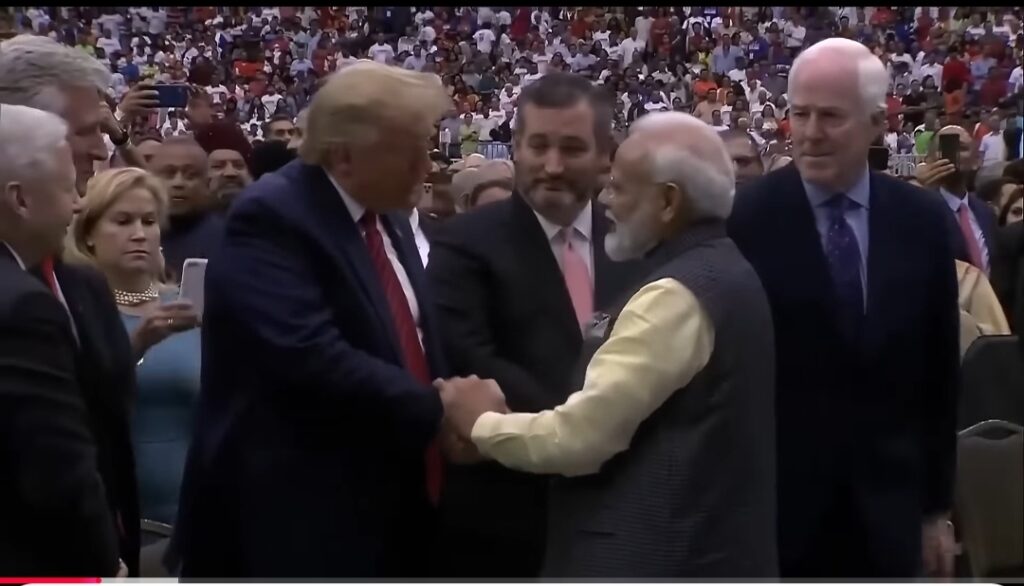
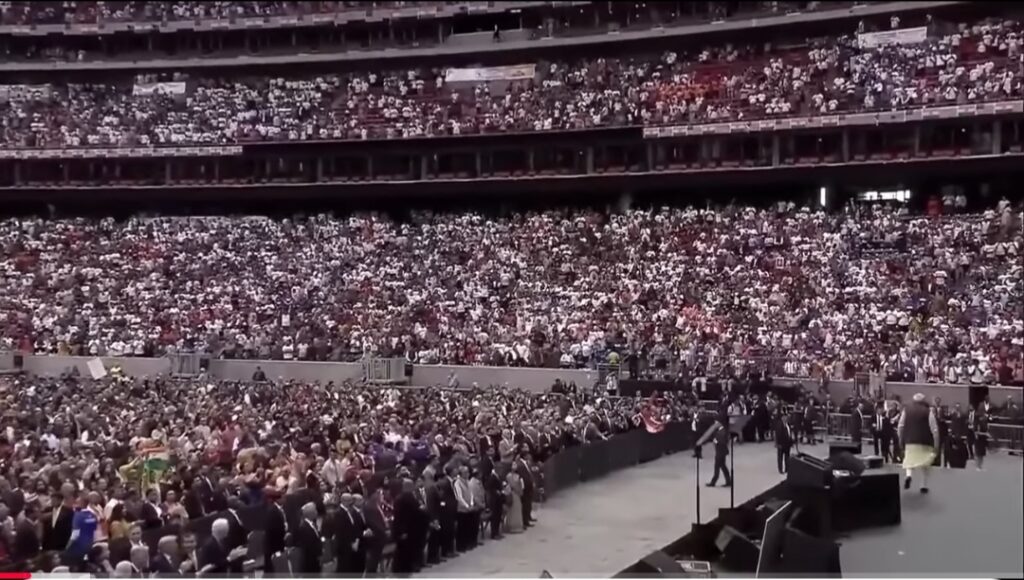
The same Trump had appeared alongside Modi at the “Howdy, Modi!” event in Houston, Texas, in 2019. He was certainly a ‘hit’ with the people of Gujarat when he visited during his first term. The two hugged and held hands, to the ovation of 50,000 at the jam-packed stadium.
Since Trump’s visit during this term remains speculation, let us assess bilateral ties by recalling past presidential visits.
Kennedy never visited India. But his wife Jacqueline did, and it was a big event. Excluding Joe Biden, who had come to attend the G20 Summit, seven US presidents have officially visited India. Dwight D. Eisenhower (1959) was received with as much warmth as were Britain’s Queen Elizabeth, Soviet leaders Nikita Khrushchev and Nikolai Bulganin, and China’s Premier Zhou Enlai, who made several key visits to India between 1954 and 1960 to foster “Hindi-Chini bhai bhai” relations.
Thousands lined up the New Delhi streets when ‘Eike’ visited. The story goes that S. Moolgaonkar, editor of the largest-selling newspaper, The Hindustan Times, had a hard time disciplining his reporters covering the route who went overboard. One of the reports quoted an old enthusiast calling Eike “Amrika ka Badshah” (Emperor of America). India then had its many maharajahs.
In 1969, Richard Nixon probably did not impress, or was not impressed by India. Veteran diplomat Maharaj Krishna Rasgotra records in his memoirs that Prime Minister Indira Gandhi, whom he met before leaving for Washington as ambassador to the US, had cautioned him about Nixon. Rasgotra writes that he did not encounter any such negativity. But she proved right when 1971 changed it all, because Nixon and Henry Kissinger needed China and, hence, Pakistan. India’s pleas were ignored, but Kennedy’s brother Edward visited the refugees from East Pakistan, and Yehudi Menuhin joined Pandit Ravi Shankar in promoting “Joy Bangladesh”. That’s an old story.
Jimmy Carter’s 1978 visit carried considerable charm. His mother, Lillian Carter, was a Peace Corps volunteer who served as a nurse in Mumbai’s Vikhroli suburb from 1966 to 1968, working among leprosy patients. “Miss Lilian”, as she was called, prompted her son to visit the village of Daulatpur in Haryana. It was renamed Carterpuri to commemorate the visit.
Bill Clinton visited in 2000, an India that had both angered and awed the world community with its nuclear tests. Clinton began the process of turning the relationship around. He charmed the Indian lawmakers when he addressed them in Parliament’s Central Hall. Even today, an Indian cameraman recalls falling from a chair he had climbed to take a better shot of Clinton. Before anyone could, Clinton rushed to help, inquiring: “Are you hurt?”
George W. Bush came in 2006, post-9/11, also post-Iraq. Leftist lawmakers organised protest demonstrations against him. One of them, fresh from the demo, was at the presidential banquet the same evening. Putting away the red cap worn during the protest, he shook hands with Bush, but also conveyed “India’s anger” at the US. Minutes later, Prime Minister Manmohan Singh told Bush, “People of India love you.” Singh’s reason was clear. Unpopular elsewhere, Bush had offered a civil nuclear pact, something unthinkable earlier.
After Kennedy and Clinton, Barack Obama, who visited twice, remains the most popular American president to visit India. In 2010, he addressed Parliament, and in 2015, he was the chief guest at the Republic Day parade.
Perhaps the most memorable event was the Obamas mingling with the young in Mumbai. In the quadrangle of the historic Saint Xavier’s College, Michelle ‘introduced’ Barack, like she would any other Chief Guest. She then handed the mic over to Bollywood star Aamir Khan, who conducted a scintillating question-and-answer session. By Indian standards, or even American, this was the most informal, touching connection a visiting dignitary could make.
These are points to ponder for Trump, should he consider visiting the “hellhole” again.
Mahendra Ved is a veteran Journalist and an Expert on international affairs.