

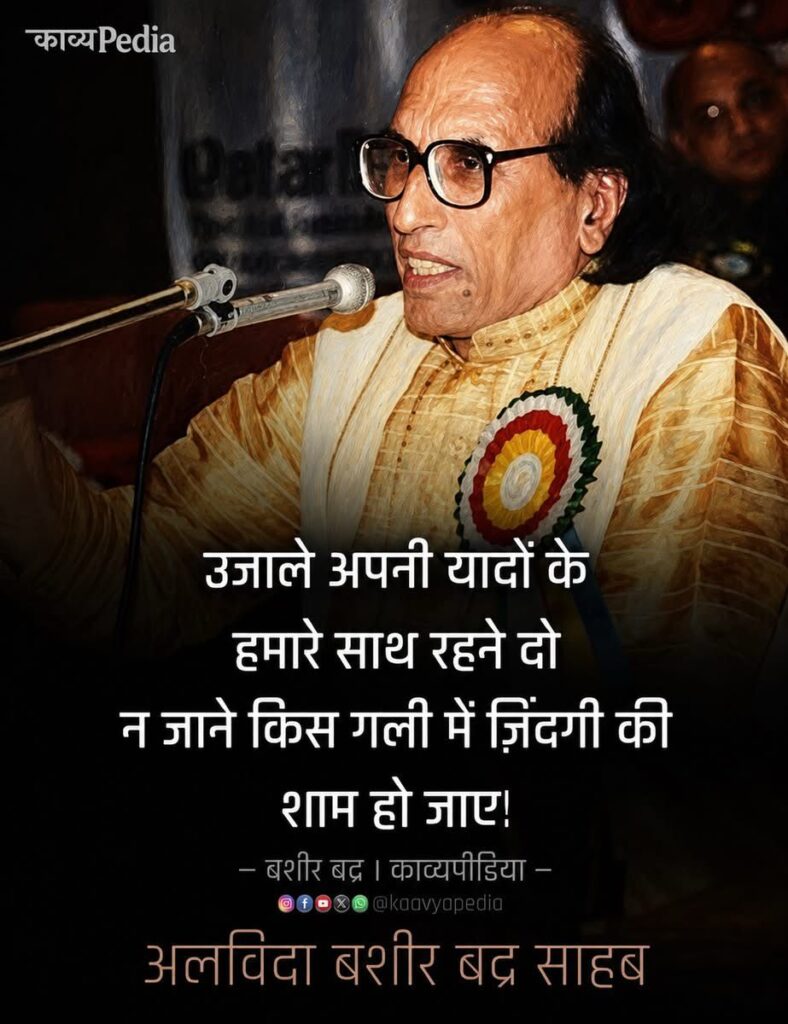
Dr. Bashir Badr, the legendary Padma Shri recipient who ruled the horizon of Urdu literature and modern ghazals for over six decades with his velvety voice and effortlessly conversational verses, is no more. He breathed his last at the age of 91 on May 28, 2026, at his residence, ‘Bashir Manzil’, in the Fatehgarh area of Bhopal. He had been battling severe dementia for a long period. When his wife, Dr. Rahat Badr, shared the heartbreaking news on social media with the poignant words—*”Bashir Sahab left us… Prayers”*—the hearts of poetry lovers across the globe skipped a beat.
The passing of Dr. Bashir Badr is not merely the loss of a poet; it marks the definitive end of a golden era of the ‘Nayi Ghazal’ (New Ghazal) movement in Urdu literature. He was a pioneer who liberated the ghazal from the shackles of heavy Persian metaphors and the restrictive confines of traditional romance, successfully embedding it into the everyday struggles, joys, and heartaches of the common man.
*Profound Philosophy in Simple Words*
Bashir Sahab’s greatest genius lay in his ability to articulate life’s deepest philosophies in the language of the masses. One did not require a heavy dictionary (*lughat*) to understand his verses; they directly pierced the soul. Today, whenever societal strings fracture or political rivalries turn bitter, his immortal couplet echoes from parliament corridors to street corners:
> *Dushmani jam kar karo lekin ye gunjaish rahe,*
> *Jab kabhi hum dost ho jayen to sharminda na hon.*
> “Carry out your enmity with all your might, but leave this much room,
> Should we ever become friends again, we do not feel ashamed.”
>
*From Ayodhya to Bhopal: A Saga of Creation from Ash**
Born Syed Mohammad Bashir on February 15, 1935, in Ayodhya (Faizabad), Uttar Pradesh, he completed his early education in Itawah. He then moved to the Aligarh Muslim University (AMU), where he earned his BA, MA, and PhD degrees. His brilliance was so undeniable that his poems were included in the AMU curriculum even before he had completed his post-graduation. Later, he served as the Head of the Urdu Department at AMU and subsequently at Meerut College for nearly 17 years.
However, life tested his resilience with brutal severity. During the 1987 communal riots in Meerut, his home, his priceless personal library, and a lifetime of savings were reduced to ashes. This tragedy shook him to his core, prompting his permanent relocation to Bhopal. He channelled this profound grief into words that became an indelible part of public consciousness:
> *Log toot jaate hain ek ghar banane mein,*
> *Tum taras nahin khate bastiyan jalane mein.*
> “People shatter and break just to build a single home,
> You show no mercy or pity while burning down whole settlements.”
>
> *Har dhadakte patthar ko log dil samajhte hain,*
> *Umr beet jaati hai, dil ko dil banane mein.*
> “People mistake every throbbing stone for a beating heart,
> A lifetime passes away in turning a heart into a true heart.”
>
*A Poet of Human Dignity and Nuanced Relationships*
Bashir Badr was an astute observer of human behavior and social dynamics. He possessed a sharp understanding of the fragile boundaries between self-worth and arrogance. In literary gatherings (*mushairas*), his famous couplet served as a gentle yet sharp critique of vanity:
> *Bade logon se milne mein hamesha fasla rakhna,*
> *Jahan dariya samandar se mila, dariya nahin rehta!*
> “Always maintain a distance when meeting high and mighty people,
> Where the river merges with the ocean, the river ceases to be a river.”
>
Over his illustrious career, he penned more than 10,000 poems and ghazals. His seminal anthologies include *Ikaai*, *Aahat*, *Aas*, and *Kulliyat-e-Bashir Badr*. His book *Ujale Apni Yaadon Ke*, published in the Devanagari script, skyrocketed his popularity among Hindi-speaking readers. For his unparalleled contribution to literature, he was honored with the prestigious Sahitya Akademi Award in 1999 (for *Aas*) and the Padma Shri by the Government of India in the same year. He also served with distinction as the Chairman of the Bihar Urdu Academy.
*The Twilight Years: When Memories Began to Fade*
In a cruel twist of irony, the very poet who taught the world how to cherish memories spent his final years robbed of his own by dementia. He gradually forgot the golden days of his packed *mushairas* and could no longer remember the iconic verses he himself had written. Throughout this difficult period, his wife, Dr. Rahat Badr, and his son, Tayyab, stood by him as pillars of strength. They would often whisper his own lines into his ears, trying to spark that old familiar twinkle of *‘Wah-wah’* or *‘Irshad’* on his lips. He passed away peacefully in the very room that once hosted the greatest literary luminaries of the country.
Dr. Bashir Badr has left us physically, but as long as the sweetness of Urdu and Hindi remains on our tongues, as long as love is celebrated, and as long as the pain of displaced lives is felt, he will remain alive in the mirror of his ghazals. His own deeply cherished verse serves as the most fitting farewell to his journey:
> *Ujale apni yaadon ke hamare sath rehne do,*
> *Na jaane kis gali mein zindagi ki shaam ho jaye…*
> “Let the lights of your memories remain here with us,
> Who knows in which lonely street the evening of life may fall…”
>
Farewell, King of the Ghazal. The literary world will forever hold your light close to its heart.

~Hasnain Naqvi is a former member of the history faculty at St. Xavier’s College, Mumbai….
The opinions expressed here are solely those of the author.

