

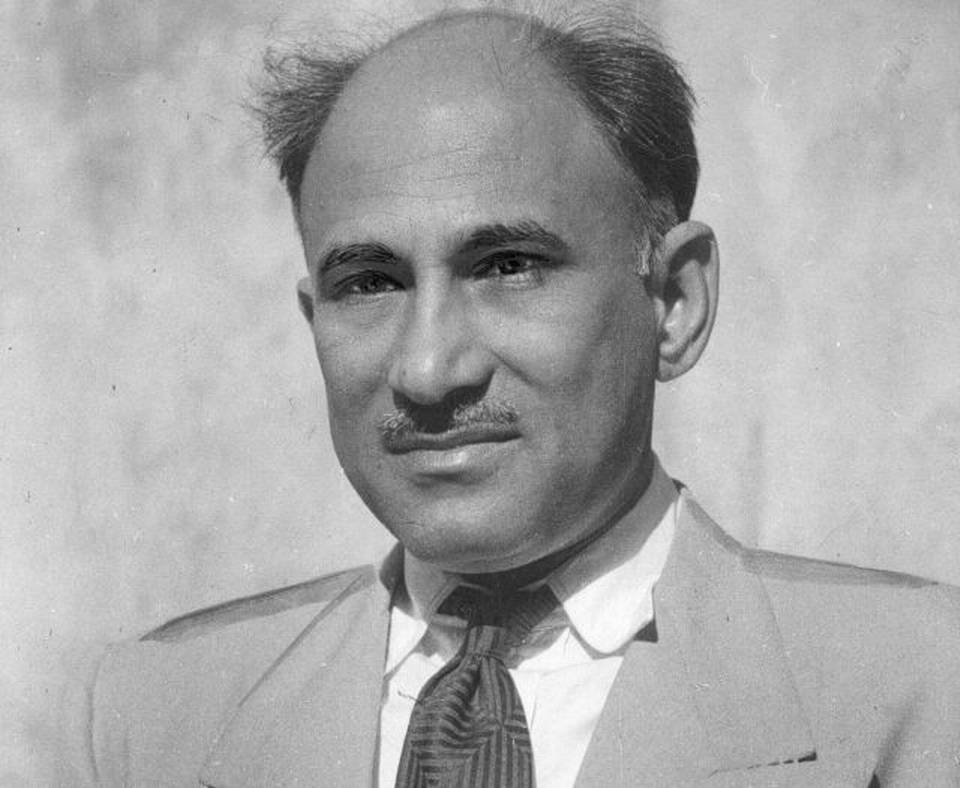
Khwaja Ahmed Abbas belonged to a generation of Indian intellectuals who believed that literature, theatre, journalism and cinema could be instruments of social change. Born on 7 June 1914 in Panipat and active until his death in 1987, Abbas wore many hats—novelist, short‑story writer, journalist, screenwriter, director, documentarian and cultural activist. Yet beneath those labels ran a consistent moral thread: a restless commitment to the poor, the dispossessed and the idea of an inclusive India.
On his 112th birth anniversary we remember a man who practiced public conscience as craft, and who shaped modern Indian cinema’s conscience in the process.
A journalist first, a storyteller always
Abbas’s public life began in newspapers. He joined the Bombay Chronicle in the mid‑1930s and soon built a reputation as a sharp political commentator and film critic. His “Last Page” column—started in 1935—later ran for decades in Blitz and became one of Indian journalism’s longest continuous columns. He wrote with the impatience of a reformer: terse, observant, and never shy of naming hypocrisy whether in politics, religious life or popular culture.
His fiction and essays followed the same impulse. Over a lifetime he produced dozens of books, hundreds of short stories and thousands of journalistic pieces in Urdu, Hindi and English. Those writings—whether humane sketches or blistering polemics—aimed to hold a mirror to society and to prod it toward compassion and equity. Stories such as “Benaras ka Thug” and “Teen Aurtein” retain a sting because they expose societal rot without sentimentality.
IPTA, the Progressive Movement and politics of the left
Abbas helped found the Indian People’s Theatre Association (IPTA) and remained closely associated with the Progressive Writers’ Movement. IPTA fused art with mass politics: street‑theatre, plays, songs and films were conceived not as mere entertainment but as instruments to politicize and mobilize. Through IPTA he worked alongside colleagues—Sajjad Zaheer, Ali Sardar Jafri, Balraj Sahni, Kaifi Azmi, Majrooh Sultanpuri, Utpal Dutt, Prithviraj Kapoor—who shared a left‑leaning vision that the newly independent nation should prioritize social justice and workers’ rights.
Abbas’s politics were unmistakable.
A committed socialist and close to Communist circles, he did not hide his convictions: he lived modestly, spoke passionately for labour and peasants, and used each platform to press for structural reform. His brand of Nehruvian humanism—admiring of state‑led development, skeptical of communalism and deeply invested in secularism—permeated his work. Even when his political language aged, the ethical questions he raised—about inequality, displacement and civic responsibility—remain urgent.
Cinema: neo‑realism and the social film
If journalism was his public pulpit, cinema was Abbas’s mass medium. He was among the pioneers who brought a neo‑realist sensibility to Indian cinema—filmmaking that foregrounded ordinary lives, social causes and economic realities rather than escapist fantasy. Two landmark films from 1946 encapsulate this turn: Dharti Ke Lal, which he co‑directed and which dramatized the Bengal famine and migrant desperation, and Neecha Nagar, for which he wrote the screenplay; the latter won the Grand Prix at the first Cannes Film Festival. These films signalled that Indian cinema could also be a vehicle for international dialogue on social art.
As director, Abbas continued to make socially engaged films—Shehar Aur Sapna (1963), Saat Hindustani (1969) and Do Boond Pani (1972) among them—several of which received National Film Awards for their treatment of national integration and social themes. He experimented with documentary and feature forms, often blurring boundaries between reportage and drama. His documentary *Chaar Sheher Ek Kahani* produced a notable constitutional moment by provoking judicial discussion about free speech and film censorship—testimony to how his work pushed institutional limits.
The Raj Kapoor collaboration: poetry for the screen
Abbas’s collaboration with Raj Kapoor remains one of the most fruitful writer‑director partnerships in Hindi cinema. He penned the scripts for several of Kapoor’s enduring films—Awaara (1951), Shree 420 (1955), Jagte Raho (1956) and later credits on films such as Mera Naam Joker and Bobby. These movies fused social critique with lyrical melodrama: the tramps and streetwalkers, the betrayed lovers and ambitious migrants became figures of moral inquiry, rather than mere archetypes.
Abbas’s contributions to Raj Kapoor’s work were more than writerly craft; they provided an ethical grounding. The screenplays translated questions about class, urban modernity, and justice into images and melodies that reached mass audiences across India and abroad. Awaara’s courtroom fantasy of conscience and Shree 420’s critique of materialistic values remain touchstones precisely because Abbas supplied the moral queries that Kapoor’s cinematic lyricism dramatized.
Introducing new talent, bearing failures
Abbas had an eye for talent. He gave Amitabh Bachchan his first screen role in Saat Hindustani (1969)—a film that won acclaim for its theme of national integration even if it flopped at the box office. Abbas was candid about his cinematic record: he often made films that critics admired but audiences ignored. He admitted, in a rare self‑mocking line, that earnings from mainstream projects often went into “flops” that pursued social aims. That willingness to risk commercial disaster for convictions summed up his priorities: cinema for social conscience rather than for easy profits.
Awards, recognition and yet restless dissent
Official recognition came—Padma Shri in 1969 and multiple National Film Awards, Cannes accolades for films he wrote—and yet Abbas was never satisfied with honors. He was an inveterate dissenter, railing equally at communalists, opportunistic politicians and authoritarian cultural gatekeepers. His fierce 1939 open letter to Mahatma Gandhi defending cinema as a legitimate art form is emblematic: Abbas refused to let technology or culture be dismissed as trivial when it could be a medium of mass education.
A legacy complicated, enduring
Khwaja Ahmed Abbas’s reputation has rarely been domesticated. To some he remains a generous humanist who used every available medium to address injustice. To others he epitomizes the earnest leftist artist whose didactic streak sometimes dampened narrative subtlety. Both assessments contain truth. Many of his films and books can read as exhortatory, and in a few instances his commitment to message over entertainment limited popular reception. Yet to evaluate him only on those terms is to miss what he achieved: he created a language of committed cinema; he trained attention on the lives of the poor; he bridged journalism, fiction and film to press for an ethical public sphere.
Why he matters today
In an era of polarized public culture and shrinking spaces for critical art, Abbas’s model—of the engaged writer who moves across media to keep civic conscience alive—has renewed relevance. He reminds us that storytelling can be a vehicle for solidarity and for imagining institutions that care for the vulnerable. His life also warns of the pitfalls of reducing cultural work to doctrinal formulas; the balance between didacticism and art remains the challenge he struggled with and bequeathed to later artists.
A final note
K. A. Abbas did not merely chronicle his times; he tried to change them. His career—spanning journalism, fiction, IPTA activism and a lifetime of films—maps an alternative genealogy of Indian modernity, one in which the artist’s duty included public pedagogy and political engagement.
On his 112th birth anniversary we can best honour him by recovering that ethic: by writing without fear, making films that interrogate, and insisting that culture retain a robust commitment to social truth. The title I propose is now: “Khwaja Ahmed Abbas at 112: The Conscience of India’s Cinema and Public Life”—a more nuanced tribute to his role as an ethical architect and moral interlocutor in Indian cultural life.

~Hasnain Naqvi is a former member of the history faculty at St. Xavier’s College, Mumbai….
The opinions expressed here are solely those of the author.