

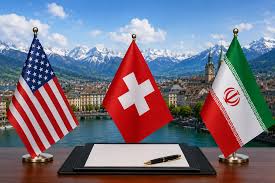
New Delhi, 20 June— In a move to give diplomacy a chance, mediators Pakistan and Qatar are holding a series of meetings in Switzerland to start the technical talks between Washington and Tehran to put the process of the Memorandum of Understanding signed by US President Dondald Trump and Iranian President Masoud Pezeshkian on Wednesday earlier this week back on rails after a delay caused by Israeli attack in Lebanon.
Switzerland said diplomats from several countries had continued efforts at Bürgenstock to maintain dialogue on implementing the US-Iran memorandum of understanding, but underlined that confidentiality prevented it from identifying those present or discussing the talks.
US and Iranian envoys are moving toward Switzerland after a planned Friday meeting was cancelled, raising expectations of possible Iran-US talks even as no new date has not yet been announced.
Meanwhile, Iran’s Deputy Foreign Minister said that Tehran is “ready to move forward” on diplomacy with Washington, but the United States must ensure Israel abides by the terms of the deal to end the war. Tehran also said that it will close Strait of Hormuz over ceasefire breaches in Lebanon.
The Lebanese armed group says that while committed to a ceasefire, it will not hesitate to confront any attempt by Israel to seize territory in Lebanon.
The Iran-backed group added in a statement that it attacked Israeli troops that had advanced towards an area near Nabatieh in southern Lebanon overnight.
Hezbollah criticised the Israeli violations that started last night and continued today, adding that it had adhered to the ceasefire since Friday evening, even after Israel violated it from the very first moments.
“However, it remains vigilant, prepared to respond, given the enemy’s history of treachery and betrayal,” the group said.
Meanwhile playing to the domestic gallery, Trump said on Saturday Iran had “got away with ‘murder’ for 47 years” until he took office and had since been “completely defeated militarily,” while criticizing Barack Obama and Joe Biden as weak leaders.
With their back towards the wall, Trump and Vance are desperately trying to defend the deal at home, saying relief can be adjusted based on Tehran’s conduct, while Democrats and Republican hawks remain divided.
Notwithstanding domestic opposition to the deal, biggest stumbling block on the path of any long lasting agreement between the US and Iran is Isral. Despite agreeing to a ceasefire just yesterday, Israel has killed at least 22 people across Lebanon throughout the day.
The Gaza Government Media Office says Israel has violated the ceasefire in the Strip 3,338 times since it entered into force 251 days ago, killing 1,012 people and wounding 3,208.
Former US President Barack Obama, who signed Washington’s last nuclear deal with Iran, has criticised the Trump administration’s agreement with Tehran, telling NBC that the US is “worse off” than before.
Former Israeli Defence Minister Moshe Ya’alon has told Israeli Channel 12 that Israel is “paying the price for the hallucinations of Prime Minister Benjamin Netanyahu and his government”.
Issuing a warning, Russian Security Council Deputy Chairman Dmitry Medvedev said an agreement between the US and Iran could easily be derailed by new provocations, and expecting peace is “rash” given that Israeli Prime Minister Benjamin Netanyahu’s government is “sustained by war”.
“An unstable agreement easily explodes with new strikes on Lebanon or other provocations. And that’s exactly what the Netanyahu cabinet, which is sustained by war, needs. So, expecting peace is rash,” Medvedev wrote on the Russian social media platform Max.
Russia has deepened its existing ties with Iran since the start of the Ukraine war, with Moscow and Tehran expanding military and economic cooperation – though the partnership has shown limits, with Russia offering largely rhetorical support during Iran’s recent conflict with the US and Israel.
The Iranians are not happy at all, playing the waiting game. However, they know that there is a lot at stake.
A Foreign Ministry spokesperson said that the start of the talks for the final agreement depends on the initiation of the implementation of the articles of the memorandum of understanding, meaning the cessation of hostilities on all fronts, including Lebanon.
In 2015, both sides signed the JCPOA and Iran committed a lot to that. Then, three years later, 2018 saw the US unilaterally withdraw from that deal.
Last June, there were five rounds of talks, and everything was going well then the Americans and Israelis started to bomb Iran. This past February, after three rounds of diplomatic talks that sent out positive messages from both parties, the Americans and Israelis started to bomb Iran again.
So, all these bitter memories are there. Politically, economically and internationally, Iran is under huge pressure – and they want to make sure that the Americans are committed to the deal and they are honouring the signature that they have given.
Veteran Journalist and Political Commentator