

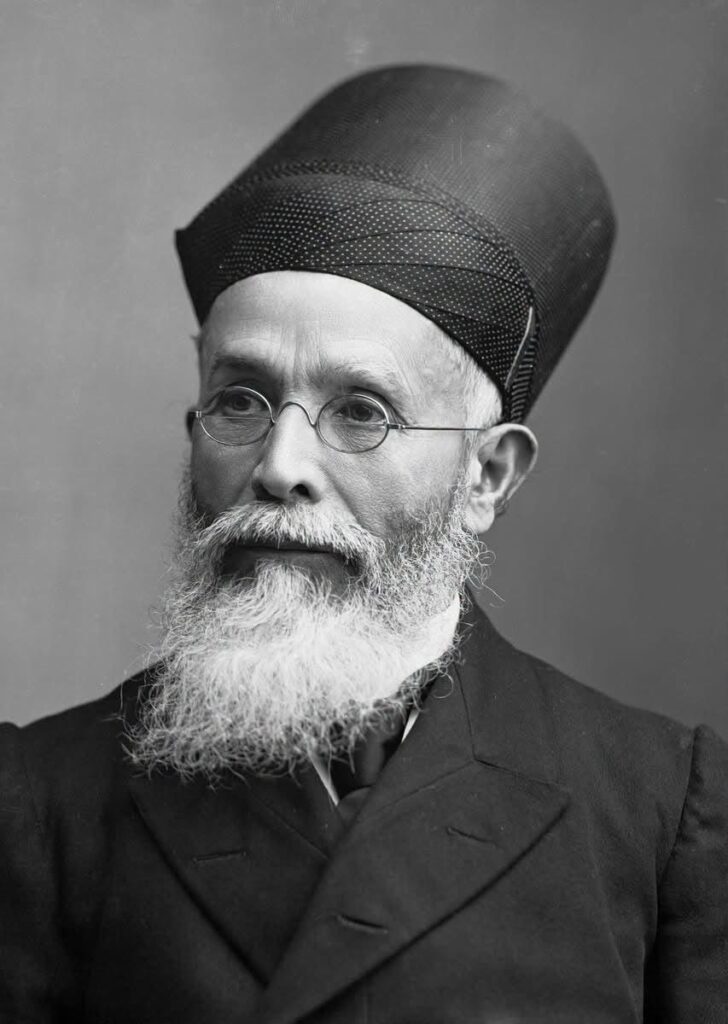
On Dadabhai Naoroji’s death anniversary, we remember the economist‑politician who turned numbers into a national argument
On 30 June 1917, Bombay (now Mumbai) lost a son who had taught a colony how to measure its own subjugation. Dadabhai Naoroji—teacher, parliamentarian, president of the Indian National Congress, and the first Asian to sit in the British House of Commons—did not carry a sword. He carried ledgers, speeches, and a stubborn belief that injustice, once quantified, could not be ignored.
A century and more on, as India charts its own course in a volatile world, Naoroji’s legacy endures not only in statues and street names but in the very idea that a people can demand accountability through reason, evidence, and organized politics.
From Elphinstone to Westminster
Born on 4 September 1825 in a Parsi priestly family near Mumbai, Naoroji excelled at Elphinstone College, where he later became the first Indian professor of mathematics and natural philosophy. He helped found the Bombay Association in 1852 and launched the reformist newspaper *Rast Goftar* in 1851, using print to argue for social change and Indian participation in governance.
In 1855 he travelled to England as a partner in a Parsi trading firm, but London soon became more than a business base. He taught Gujarati at University College London, became a life governor there, and turned his attention to the Indian Civil Service, campaigning successfully for greater Indian access. He returned to India to serve briefly as Diwan of Baroda (1873–74), then as a member of Bombay’s municipal and legislative councils, yet his gaze remained fixed on the imperial centre where decisions about India were made.
A Parliamentarian in a Racist Age
In 1886 Naoroji stood for the British Parliament from Holborn and lost. He tried again in Central Finsbury, overcoming internal opposition to win the Liberal nomination. The Conservative prime minister, Lord Salisbury, notoriously remarked that he doubted a British constituency would elect a “black man.” The remark backfired, galvanizing support. In the 1892 general election, Naoroji won by five votes—2,961 to 2,956—becoming the first non‑European MP in Westminster.
His victory was more than symbolic. In the Commons he pressed for enquiries into Indian administration, championed fair treatment for Indian recruits in the civil services, and insisted that India’s grievances be heard in the language of British liberalism itself. He lost his seat in the 1895 Conservative landslide and never returned to Parliament, but his presence had already redrawn the map of what was politically possible—for Indians in particular, and for minority communities in Britain at large.
The Drain Theory: When Economics Became a National Cry
Naoroji’s most enduring contribution, however, was not a bill passed but a theory advanced: the “drain of wealth” from India to Britain. Before the Battle of Plassey (1757), European traders brought bullion into India to pay for cotton and silk. After the conquest of Bengal, the East India Company reversed the flow, using Indian revenues to buy Indian goods and ship them abroad. What followed, Naoroji argued, was a continuous, one‑way transfer of resources that impoverished India while enriching Britain.
In an 1867 paper, *England’s Debt to India*, he wrote that nearly a quarter of the revenues raised in India “goes clean out of the country” and is added to England’s resources. He expanded these arguments in *Poverty in India* (1867) and, most famously, in *Poverty and Un‑British Rule in India* (1901). Using comparative data on national incomes, trade, prices, and taxation, he contended that British rule produced a unilateral outflow of capital—through home charges, salaries and pensions remitted to England, interest on debt, military expenditure, and the costs of the India Office and imperial ventures—without corresponding investment in India’s development.
He called the drain “the evil of all evils,” a “running sore” that kept India’s wounds perpetually open. Unlike the episodic plunder of earlier invaders, this was systemic, built into the architecture of colonial governance. The consequence, he warned, was not just slower growth but recurrent famines, stunted capital formation, and a distorted economy geared to serve an imperial metropolis.
A Movement Finds Its Economic Voice
Naoroji did not stand alone. Reformers like M. G. Ranade and the economic historian R. C. Dutt sharpened the critique. Ranade noted that a large share of India’s capital was siphoned off; Dutt lamented that “the moisture of India blesses and fertilizes other lands,” while the subcontinent suffered ever more frequent and fatal famines. In 1896, the Indian National Congress, at its Calcutta session, formally adopted the drain thesis, declaring that India’s poverty and famines were caused by the “drain of wealth of the country which has been going on for years together.”
This was economic nationalism in its most potent form: a moral argument clothed in statistics, a demand for justice framed as a balance‑sheet. It gave the nascent national movement a coherent indictment of colonial rule that could be debated in clubs in Calcutta, reported in London newspapers, and taught in classrooms long after independence.
The Congressman Who Believed in Reform—and in Pressure
One of the co-founders of the Indian National Congress, Naoroji served three terms as Congress president (1886, 1893, 1906), steering an organization that, in its early decades, sought reform within the imperial framework: greater Indianization of services, reduced military expenditure, and fiscal fairness. He trusted, up to a point, in British notions of justice, yet he also understood that trust had to be leveraged by pressure. His career embodied this dual strategy: petition and protest, persuasion and exposure.
He was also ahead of his time on social questions, advocating women’s equality and labour rights. His pamphlet *Rights of Labour* (1906) argued for dignity and protections for workers, linking economic justice at home to political justice in the empire. For Naoroji, nationalism was not merely about flags and anthems; it was about wages, representation, and the everyday dignity of citizens.
A Global Indian Before the Term Existed
Naoroji’s life stitched together worlds: Bombay and London, Elphinstone and Westminster, the Congress sabha and the Royal Commission. He was the first Indian member of a Royal Commission, serving on the inquiry into Indian expenditure (1895–1900) and signing a minority report that reiterated his drain argument. He represented India at the Inter‑Parliamentary Conference at The Hague in 1894 and led the London Indian Society for years, making the British capital a node of Indian political activism.
When he finally returned to India in 1907, he did so as a figure whose authority transcended regions and communities. The University of Bombay conferred an honorary LLD on him in 1916, a year before his death. He passed away in Mumbai on 2 July 1917, just months before the Montagu Declaration promised “responsible government” as the goal of British policy—a shift his decades of argument had helped make thinkable.
Why Naoroji Matters Now
At a time when data is weaponized and public discourse is often reduced to slogans, Naoroji’s method remains instructive. He showed that nationalism gains strength when it can count, compare, and corroborate; that moral outrage is most effective when anchored in evidence; and that representation matters—not only in legislatures but in who gets to define the terms of debate.
His drain theory may belong to the colonial era, but its spirit lives on in every demand for fair trade, transparent budgets, and equitable development. He taught India to ask not just “Who rules?” but “At what cost? For whose benefit? By what rules?”
The Five‑Vote Majority That Opened a Door
History turns on small margins. Naoroji’s five‑vote victory in Finsbury did not end empire, but it cracked its self‑image. It proved that an Indian could stand in the heart of imperial power and speak for India as an unofficial ambassador of India and also as an equal. That act of representation, combined with his relentless economic critique, helped transform a scattered set of grievances into a national claim.
On his death anniversary, the most fitting tribute is not reverence but emulation: to build institutions that reward reason, to insist that policy be answerable to people, and to remember that the grandest politics often begins with the humblest arithmetic. Dadabhai Naoroji counted India’s losses so that a nation could eventually claim its future.

~Hasnain Naqvi is a former member of the history faculty at St. Xavier’s College, Mumbai….
The opinions expressed here are solely those of the author.