

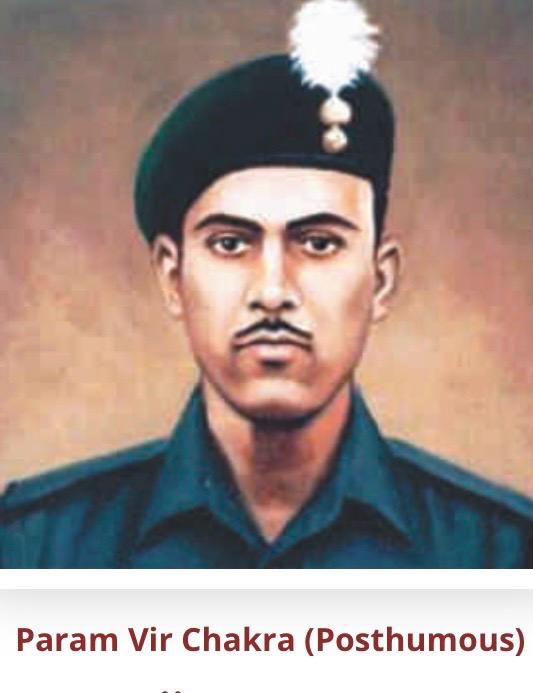
On July 1st, India pauses to honor one of its finest sons, a soldier whose unmatched bravery redefined the capabilities of foot soldiers against heavy armor. Today marks the birth anniversary of Company Quartermaster Havildar (CQMH) Abdul Hamid, a man who transformed from a humble tailor’s son into an immortal symbol of Indian military lore. Posthumously awarded the Param Vir Chakra, India’s highest wartime gallantry honor, Abdul Hamid’s story remains a timeless reminder of what sheer courage can achieve in the face of insurmountable odds.
The soul of his fearlessness is perfectly captured in the evocative verses of poet Munawwar Rana:
“shaheedon ki zameen hai – jisko Hindustan kahte hain > ye banjar ho ke bhi buzdil kabhi paida nahin karti” >
(This is the land of martyrs—known as Hindustan; > Even in its barrenness, it never gives birth to cowards.) > ~ Munawwar Rana
From Humble Beginnings to the 4 Grenadiers
Born on July 1, 1933, in Dhamupur, a small village in the Ghazipur district of Uttar Pradesh, Abdul Hamid grew up in a modest household. The son of Mohammad Usman, a local tailor, young Hamid was renowned in his village for his physical agility, fearlessness, and expertise in swimming and wrestling. Desiring to serve his motherland, he traveled to Varanasi and enlisted in the Indian Army on December 27, 1954.
After completing his training at the Grenadiers Regimental Centre in Nasirabad, he was posted to the 4th Battalion of the Grenadiers Regiment (4 Grenadiers). He proved his mettle as a veteran of the 1962 Sino-Indian War, but it was during the Indo-Pakistani War of 1965 that destiny would call upon him to etch his name into the annals of eternity.
The Strategic Crucible of Asal Uttar
In September 1965, the Khem Karan sector in Punjab became the focal point of a massive Pakistani offensive. The invading forces, led by their elite 1st Armoured Division, thrust across the border equipped with technologically superior, American-made Patton tanks. These steel monsters were considered nearly invincible at the time, severely outclassing India’s aging tank fleet. The 4 Grenadiers were tasked with holding a vital defensive line near the village of Chima on the Khem Karan–Bhikhiwind axis.
It was here, at the Battle of Asal Uttar (meaning “The Fitting Reply”), that Abdul Hamid was commanding a Recoilless Rifle (RCLR) detachment. Realizing the grave danger his battalion faced from the oncoming armored juggernaut, Hamid decided to launch an audacious, offensive defence.
A Jonga Jeep Against Armoured Giants
The disparity on the battlefield was stark. On one side were heavily armoured 40-ton Patton tanks equipped with 90 mm main guns. On the other side was Abdul Hamid, mounted on an open, unarmoured Jonga jeep equipped with a 106 mm Recoilless Gun. Utilizing the tall, dense sugarcane fields of Punjab for camouflage, Hamid turned his vulnerable vehicle into a highly lethal ghost.
On September 9, 1965, as the enemy tanks advanced, Hamid held his fire until the leading tank came within point-blank range—just 30 feet away. With pinpoint accuracy, he fired, sending the Patton up in flames. Swiftly changing his position to avoid retaliatory fire, he targeted and destroyed another tank, forcing the crews of the accompanying enemy tanks to abandon their vehicles and flee.
The next morning, September 10, the enemy launched a more ferocious assault backed by intense artillery shelling. Undeterred, Hamid stepped right back into the line of fire. He maneuvered his jeep through heavy shelling, systematically taking down two more Patton tanks. While his initial official Param Vir Chakra citation credited him with the destruction of four tanks—the number confirmed when the citation was dispatched mid-battle—subsequent military accounts record that his extraordinary accuracy neutralized as many as seven to eight enemy tanks during the operation.
The Supreme Sacrifice and an Enduring Legacy
During the climax of the battle on September 10, Abdul Hamid’s open jeep was spotted by an enemy tank. With no time to change his position or take cover, the fearless Havildar chose to stand his ground. He aligned his sights on the enemy tank at the exact moment the tank gunner locked onto him. Both fired almost simultaneously. Hamid’s shell struck home, but his jeep was instantly hit by a high-explosive 90 mm shell.
CQMH Abdul Hamid was martyred instantly, making the ultimate sacrifice for the territorial integrity of India. His supreme sacrifice, however, was not in vain. His relentless dismantling of the Patton tanks broke the spine and momentum of the Pakistani armoured thrust, inspiring his battalion and the entire division to hold their ground and turn the tide of the war.
The battlefield of Khem Karan ultimately became a graveyard for enemy armor, earning the famous moniker “Patton Nagar” (Patton Town), where dozens of captured and destroyed Pakistani tanks were later put on public display.
In recognition of his unmatched valor, indomitable spirit, and complete disregard for personal safety, Abdul Hamid was posthumously honoured with the Param Vir Chakra. The medal was presented to his proud widow, Rasoolan Bibi, by President Dr. Sarvepalli Radhakrishnan during the 1966 Republic Day Parade.
Decades have passed, but the legacy of the tailor’s son who brought the world’s most formidable tanks to their knees remains an unshakeable beacon of patriotism.
Today, on his birth anniversary, a grateful nation bows its head in deep reverence to Shaheed Abdul Hamid—the immortal hero who proved that it is not the machine, but the indomitable soul of the soldier behind it, that wins wars.
Long live Abdul Hamid, a brave-fearless soldier and a patriot par excellence!

~Hasnain Naqvi is a former member of the history faculty at St. Xavier’s College, Mumbai….
The opinions expressed here are solely those of the author.

